








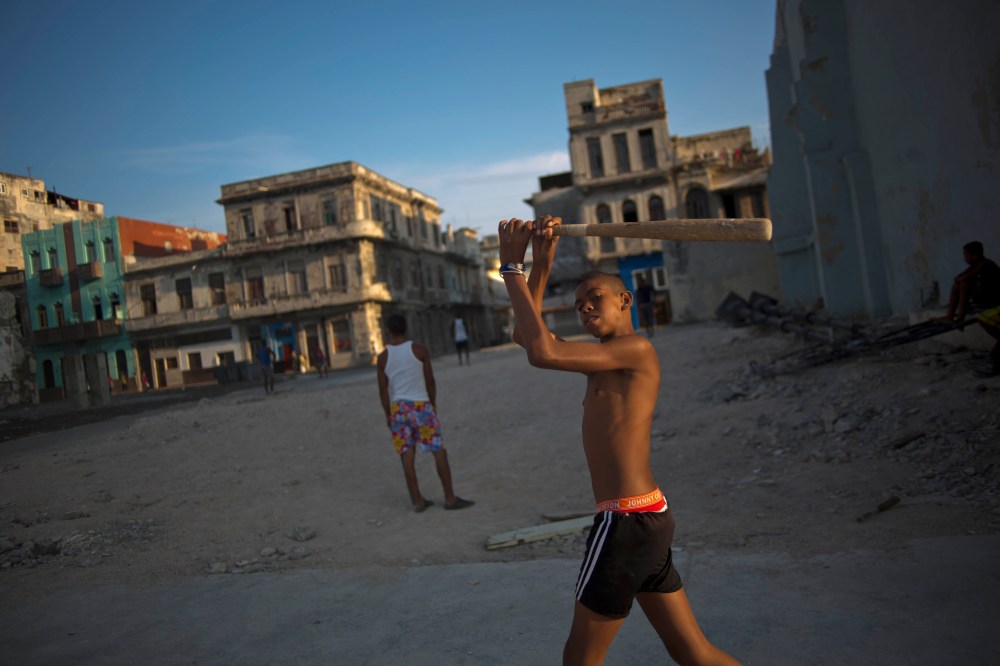
It’s been several years since Martucci’s Family Pharmacy served its last customer. The mom-and-pop shop was forced to shut its doors in West Hartford, Connecticut, unable to compete with the chain stores sprouting up across the middle-class suburb. Still, the store’s legacy and family’s name carries on in the most unlikely of places: on the jersey of a youth baseball league in Cuba.
The Martuccis aren’t the only team sponsors — there’s Olive Garden and SuperCuts, too — hundreds of miles away from Connecticut where baseball is just as much a religion as it is a national pastime. And though the young players have never ordered pasta at the restaurant chain or had their hair trimmed at a strip mall salon, the logo on their jerseys hardly matters to the kids playing ball.
RELATED: In one family, a generational divide over Cuba
While for decades the U.S. and Cuban governments engaged in a political and economic standoff, casting the other side as a fearsome enemy, just a couple of ordinary American men, both retired and living in the northeast, saw a place where both countries shared some common ground — inside a baseball diamond.
%22The%20kids%20will%20come%20out%20of%20nowhere%2C%20they%20play%20on%20the%20streets%20and%20under%20the%20highways.%22′
Leaders of both governments just announced Wednesday plans to ease the more than a half-decade’s worth of tensions and repair relations. But for Dick Foster and Denis Horgan, it’s a re-connection that they had been bridging for years, in their own small way.
Inspired by a documentary on youth baseball in Cuba where kids, barefoot and without equipment, would play ball wherever they could, the two men gathered what gear they could find. Stacked in piles in the garage and tucked away in boxes in the attic lay mounds of gloves, bats, helmets and outgrown uniforms in virtually every house on the block. It took little time for the pile of goods to stack up — but that was the easy part.
“I knew we could collect tons and tons of equipment,” Foster recalled. “The problem, was getting it through Cuba.”
RELATED: From ‘I Love Lucy’ to pop music, Cuba’s influence on America runs deep
A trade embargo spanning more than than five decades has left Cuba frozen in time. Generations of families were left impoverished and cut off from the outside world while an authoritarian government crackdown managed to keep everything out. Left in the middle were the kids who grew up living and breathing baseball, but had to be a little more than resourceful in order to find ways to play.
%22Baseball%20culture%20is%20so%20rich%20there%20it%20really%20truly%20is%20amazing%20it%E2%80%99s%20not%20anything%20like%20that%20here.%22′
“The kids will come out of nowhere, they play on the streets and under the highways. They use wooden sticks for bats, they have rolled up tape for a ball and they only have one glove,” said Horgan (whose son, also named Denis Horgan, is an executive producer at msnbc). “They’re not political operatives, they’re not Marxists — they’re children — and they love the game but can’t play it well because they don’t have equipment.”
But not every gateway into Cuba was sealed. After receiving a tip that an order of Catholic nuns were allowed to shuttle supplies from Miami to Havana, Foster and Horgan soon found an unlikely middleman linking a north-eastern suburb to makeshift baseball diamonds on an island nation hundreds of miles away.
Sister Maria Perez, a nun with the Daughters of Charity network in Miami, Fla., says that for the last decade and a half the nuns have sent supplies to their fellow sisters in Cuba. Permissions on humanitarian grounds allow them to send shipments to Cuba full of medical supplies, food, shoes and clothes, she said. But every few months, stacks of balls, bats and gloves make their way onto the boats. “In the church, we have a group of young people who play and they need these supplies,” Perez said. It’s no surprise that baseball would serve as a link between the U.S. and Cuba. After all, a wealth of superstar Major League Baseball players from Jose Conseco to Orlando Hernández Pedroso, aka “El Duque,” were born in Cuba and share dramatic stories of how they defected to the United States. There were 19 major league players in the 2014 season who were born in Cuba. And with the thawing of diplomatic relations on their way, sports fans are looking ahead to a potential open season one day when the U.S. can tap more of the Cuban baseball talent that runs deep. “Baseball culture is so rich there it really truly is amazing it’s not anything like that here,” Horgan said. Even with the recent easing of relations, both Horgan and Foster agreed that their makeshift program — called Baseball for Cuba — will not likely go away soon. “As long as the nuns will accept the equipment,” Foster said, “we’ll keep sending it.”
Amanda Sakuma Recommended


