








Visit NBCNews.com for breaking news, world news, and news about the economy
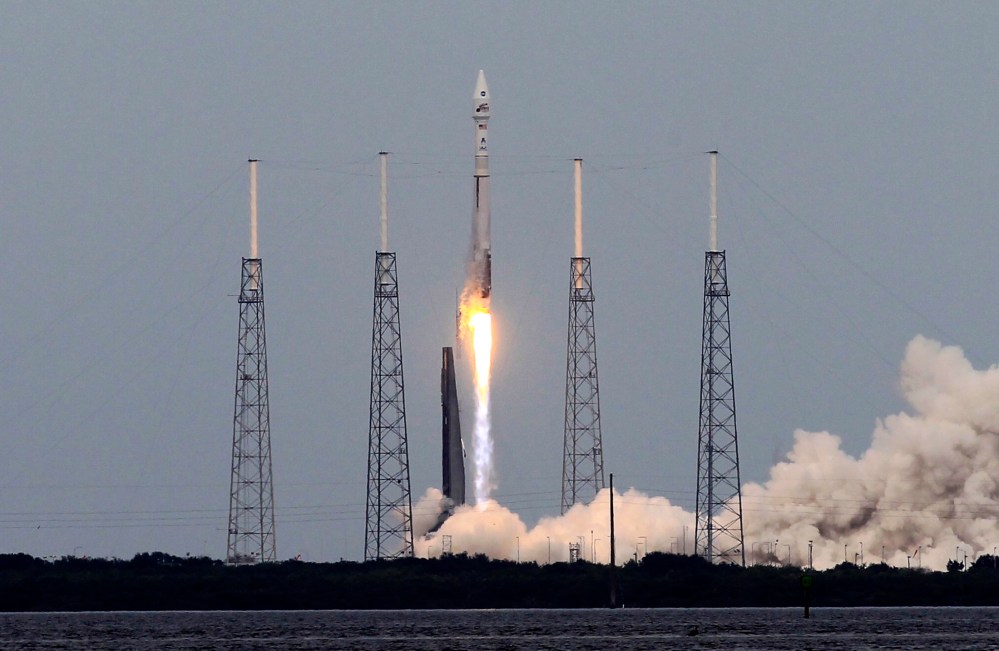
Spectators watching near Cape Canaveral, Fla., and across the Internet were treated to the thrilling rush of a successful rocket launch Monday afternoon as NASA’s Maven spacecraft blasted off toward Mars. The unmanned explorer took off on a United Launch Alliance Atlas V rocket from the Cape Canaveral Air Force Station on a mission to learn more about why Mars’ surface has become so dry and desolate.
Maven, short for Mars Atmosphere and Volatile EvolutioN, is “designed to investigate the scientific mystery that we have on Mars,” said Jared Espley, a planetary scientist with NASA’s Maven science team.
“It was very exciting to see something that you helped contribute to leaving this planet to go into space forever, to go explore some other world, to try and help us understand how the universe works… Scientists don’t usually like to be poetic, but in this moment it was reminiscent of joy and almost sadness,” he said, likening it to a parent watching their child grow up and depart into the world.
After what’s expected to be a $650 million, 10-month long journey to the Red Planet, Maven will be the first mission dedicated to studying Mars’ upper atmosphere, meaning it won’t actually touch down but will dip into the atmosphere, enter an elliptical orbit, and sample solar wind. It will examine how the atmosphere is thinning and why water disappeared over the area, hoping to capture a glimpse into what used to be similar Earth-like conditions with lots of minerals that could only have existed with liquid water. Scientists hope that discovering more about how the climate on Mars shifted over long periods of time could offer greater understanding to our changing climate here on Earth.
“Understanding the Red Planet’s atmosphere is essential to NASA’s goal of safely sending humans there one day,” astronaut Michael Hopkins said during a broadcast from the International Space Station minutes before the rocket’s liftoff. The atmospheric conditions are somewhat specific to the Martain case, but as Espley later added, “understanding how these things work together on Mars…. certainly will inform us how our own planetary system here on Earth works.”
A NASA video illustrates what Mars could have looked like 4 billion years ago, when researchers believe it was warm enough to have water – a key factor for supporting life:
NASA called this takeoff “a beautiful launch on a beautiful day,” but only two months ago, the 17-day government shutdown could have put logistical and financial barriers in front of Maven’s preparations. “There was quite a bit of anxiety about that,” said Espley. “If we can’t launch within our two-week period, we literally would have to wait two years for Mars to come around for the next configuration.” Fortunately for the Maven team, their communications relay was considered “essential” during the shutdown to send and receive information from the Curiosity and Opportunity rovers on Mars now. Thousands of people scattered across the Cape Canaveral region Monday afternoon to capture photos and take in the rocket’s powerful force as Maven lived its last moments on our planet. “It was inspiring,” Espley said. “They are here because they care about space exploration, they care about our connection to the cosmos, to other worlds, and our place as humans as explorers in that world and in that universe.” Maven is scheduled to reach Mars in September, 2014.
Kailani Koenig Recommended


