








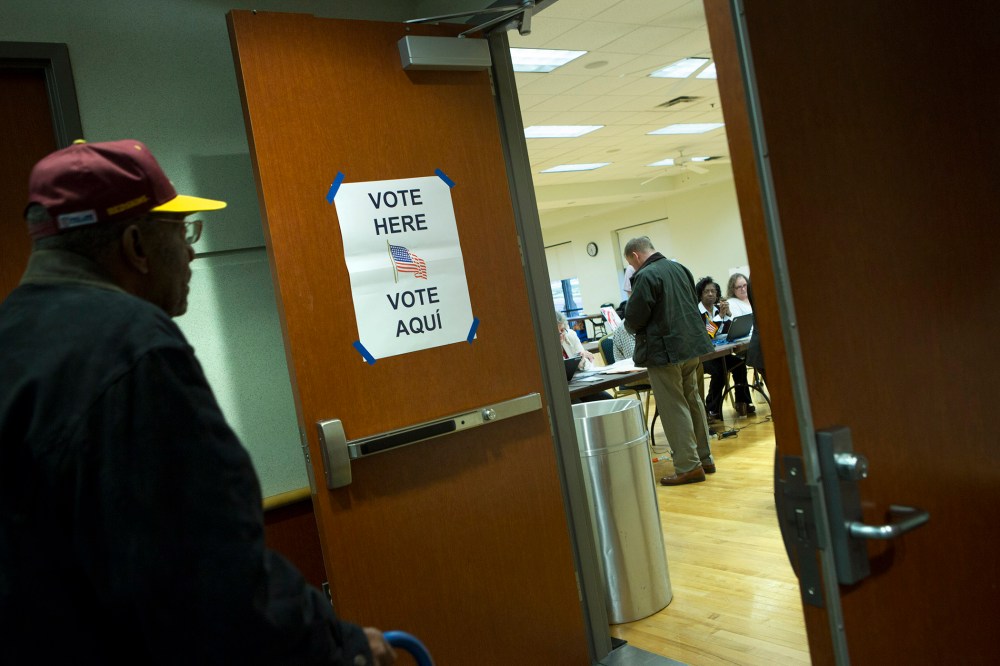
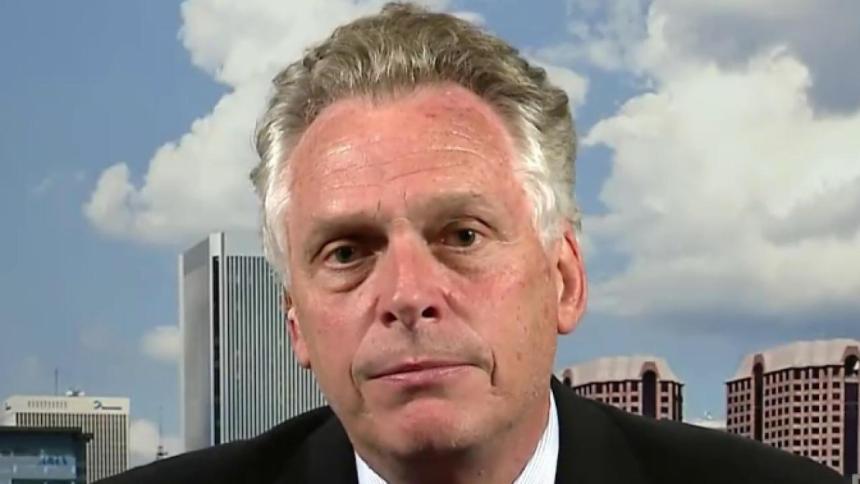
Virginia Gov. Terry McAuliffe’s announcement Friday that he’ll restore the voting rights of more than 200,000 former felons is perhaps the biggest step forward yet in the growing push to weaken felon disenfranchisement laws nationwide. But with Virginia shaping up as perhaps the single most pivotal swing state in the nation, it’s not impossible that the move could also tip the 2016 election for the Democrats.
McAuliffe, it’s worth noting, served as a top fundraiser for President Bill Clinton, and remains a close ally of the Clintons. Now there’s a small chance that with Friday’s order, he has helped put Hillary Clinton in the White House.
Of course, the fact that Democrats may get a boost from the move is irrelevant to whether it’s good or bad policy—and there’s growing support for the notion that people who have served their time should be full participants in society. Still, it’s hard to believe the political benefits didn’t cross the governor’s mind.
Donald Trump already is warning it’ll help Democrats, while badly mischaracterizing McAuliffe’s executive order. “In Virginia, 200,000 people in prison for horrible crimes are being given right to vote for the first time,” Trump told a crowd in Rhode Island Monday, calling it “crooked politics.” (In fact, the order applies to people who have completed their sentences and any supervised release, parole or probation, not to people currently in prison.)
“Virginia is a close state, I would win Virginia, I have properties,” Trump continued. “200,000 people convicted for the worst crimes…they know they’re gonna vote Democrat, and that could be the swing.”
McAuliffe’s office said the order will impact an estimated 206,000 people. What impact might that have this November? In short, it could give a small but significant boost to the Democratic candidate.
RELATED: In Baltimore, ex-felons cherish newfound right to vote
To answer the question, we need to know at what rate these new voters might turn out, and who they’d support. A 2002 study by the sociologists Christopher Uggen and Jeff Manza, who have looked at felon disenfranchisement more closely than perhaps any other scholars, examined presidential election turnout rates for populations that are demographically similar to felons in terms of race, gender, age, employment status, and other criteria. Based on that data, Uggen and Manza estimated that if disenfranchised felons had been allowed to vote, they’d have turned out at rates of 39 percent, 36.1 percent, and 29.7 percent in the presidential elections of 1992, ’96, and 2000 respectively. And in those three elections, they’d have voted Democratic at a rate of 73.6 percent, 85.4 percent, and 68.9 percent.
More recent research has taken a different approach, matching ex-felons to voter registration files in states where they’re allowed to vote. A 2014 study by the scholars Marc Meredith and Michael Morse looked at ex-felons who regained the right to vote between 2004 and 2008 in North Carolina, a state that borders Virginia and has a similar demographic profile. It found that just 21 percent of them voted in 2008, even though Barack Obama’s historic campaign and sophisticated grassroots outreach drew a high share of minorities and young voters to the polls. And it found that they voted Democratic at a rate of about 85 percent. (Meredith and Morse also looked at New York and New Mexico, and found even lower turnout rates for ex-felons. But those states are perhaps less relevant, because neither was a swing state in 2008, unlike North Carolina then or Virginia this year.)
The New York Times used the Meredith and Morse study to conclude Friday that McAuliffe’s move would give Democrats an additional 29,400 votes in Virginia, assuming that, as in North Carolina, newly enfranchised ex-felons vote at a rate of 21 percent and vote Democratic at a rate of 85 percent. (The Times assumed 200,000 newly enfranchised Virginians. Using the more accurate estimate of 206,000 provided by McAuliffe’s office, we get an increased Democratic margin of 30,282 votes).
Still, it’s not clear that the more recent studies are a better guide. Uggen, the co-author of the 2002 study, notes that the North Carolina study favored by the Times focused on people recently released from supervision, so the population it captured was likely to be younger and more transient — characteristics associated with low turnout. By contrast, because of the strictness of Virginia’s previous disenfranchisement law, many of the people re-enfranchised by McAuliffe’s order are likely to be older and more settled, which should lead to higher turnout. That gets at a crucial reality of felon disenfranchisement. In states with the strictest laws, they affect people who are decades removed from their crimes. “A lot of times in states like Florida and Virginia, we’re talking about people in their 50s, and they had a convictions in their 20s,” Uggen said. RELATED: Iowa high court hears challenge to felon voting ban But to be conservative, let’s assume the move gives Democrats an extra 30,000 votes in Virginia. That’s about 0.8 percentage points, based on the state’s 2012 presidential turnout. It wouldn’t have made a difference that year, when President Obama beat Mitt Romney by about 116,000 votes, or three percentage points. But in the last two presidential elections, three states (Missouri and North Carolina in 2008, and Florida in 2012) were decided by margins smaller than 0.8 points. So it’s certainly not beyond the realm of possibility that Virginia could be that close this November, and that it could decide the election, as a single state did in 2000 and 2004. And in 2014, Sen. Mark Warner, a Democratic, beat his Republican challenger, Ed Gillespie, by under 17,000 votes—a reminder that Virginia’s newly enfranchised felons could tip the balance toward Democrats in other statewide races, too. It’s worth saying again: the fact that McAuliffe’s party might gain from the move doesn’t make it wrong. Indeed, for those fighting to end felon disenfranchisement nationwide, the episode offers further proof of an important political adage: change is most likely to come when it benefits those with the power to make it a reality.
Zachary Roth Recommended


