








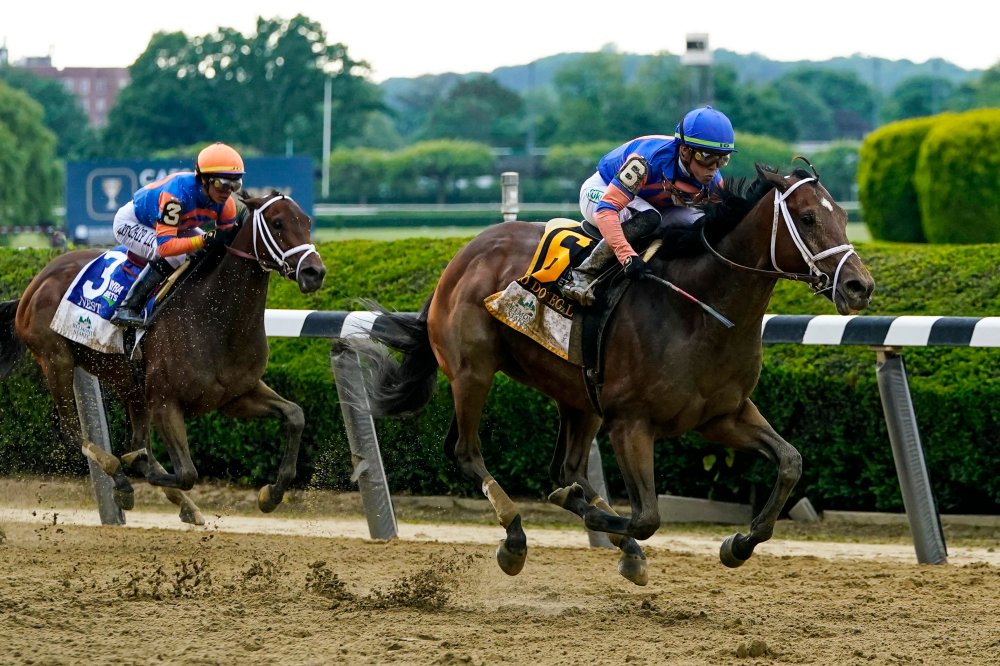
Churchill Downs in Louisville, Kentucky, has come under intense scrutiny after 12 horses died there in a month. But that statistic doesn’t convey the scope of the problem. Over the past five years, according to documents obtained by my organization, Horseracing Wrongs, Churchill Downs has been the site of 126 deaths, for an average of 25 deaths per year. At Belmont Park in Elmont, New York, the site of Saturday’s Belmont Stakes, things are even worse. Records we’ve obtained show that since 2009, 612 horses have died there. That’s almost 45 per year. And at Saratoga Race Course, in Saratoga Springs, New York, perhaps the pre-eminent track in the nation, almost 17 racehorses die per summer. These are the crown jewels of U.S. racing. So you can imagine what’s happening at the cheaper, bottom-rung tracks.
The main problem isn’t that certain horse racing locations are deadly. The problem is that the so-called sport is.
Churchill Downs Incorporated, the parent company for the track, announced that it is suspending all racing there so that it can “conduct a top-to-bottom review of all safety and surface protocols.” But attributing these deaths to a particular venue is a waste of time. And any promises from those venues to reform are meaningless. Because the main problem isn’t that certain horse racing locations are deadly. The problem is that the so-called sport is.
That at least some horses die at American racetracks is not news. But it wasn’t until 2014 when the organization I founded began filing freedom of information requests with state racing commissions that we learned how many horses were dying and the circumstances of those deaths. The reports have been nothing short of sickening. To date, we have documented — with names, dates, locations and details — almost 10,000 kills. Our research, however, indicates that the annual death toll is likely more than 2,000. That’s about six horses killed by the horse racing industry every day.
To be clear, death at the track is neither clean nor tranquil. Death at the track can come from cardiovascular collapse, or a failed heart, from animals that are mostly still in adolescence. Death at the track can be caused by pulmonary hemorrhage, or bleeding out from the lungs, blunt-force head trauma from collisions with other horses or the track itself. Dead racehorses can have broken necks, severed spines, ruptured ligaments and shattered legs. Sometimes skin is the only thing keeping the limb attached to the rest of the horse’s body.

Death at the track can come as colic, a painful, terrifying abdominal affliction, or laminitis, an excruciating inflammation in the feet. Then there are respiratory infections and neurological disorders. Sometimes the documents we get from our public records requests simply read “found dead in the morning.” These are not old horses. They are active horses, horses who die between races when they are, again, most likely still in adolescence.
Here’s the hard truth: Wherever there’s horse racing, racehorses will inevitably die. Here’s why:
First, there’s anatomy. Racehorses are bred for speed. How fast they can run is all that matters. However, breeding 1,000-pound thoroughbreds for massive torsos, spindly legs and fragile ankles is a recipe for breakdowns. To borrow the old highway-safety ad: Speed kills.
Breeding 1,000-pound thoroughbreds for massive torsos, spindly legs and fragile ankles is a recipe for breakdowns.
A horse does not reach full maturity — that is, when its bones have stopped growing and the growth plates in its vertebral column have fused — till around 6. And the taller the horse, the slower the process, so that the bones in the spine and neck are the last to fully develop. The typical racehorse, however, is thrust into intensive training at 18 months, and raced at age 2 — the rough equivalent of a first-grade child.
In the necropsies, we see horses 4, 3 even 2 years old dying with chronic conditions such as osteoarthritis and degenerative joint disease, clear evidence of the early, incessant pounding their unformed bodies were forced to absorb. The practice of training relatively immature horses is not going to change. Waiting till thorougbreds reach age 5 or 6 to begin training them would be too cost prohibitive.
Second, there’s the horse race itself. It’s unequivocally an unnatural act. The industry’s claim that horses are “born to run, love to compete” is a lie, at least in the way the industry means it. The way horses run and play in an open field bears no resemblance to what they’re made to do at a racetrack.

On a racetrack, humans perched on their backs compel horses — with a whip — to a breakneck speed that, not insignificantly, often takes place in close quarters. In nature, horses understand self-preservation. If they’re injured, they stop, rest and, if possible, heal. At the track, not only are many injured horses still urged onward by that whip, but in a cruel twist, they often try desperately to stay with their artificial herds.
The horse race can only exist by force. Third, there’s the economics. Because most racehorses cost less than a decent used car, and because most race purses are jacked up by taxpayer subsidies in the form of casino cash — cash that also allows many tracks to pay first through last. This is a major incentive to run horses who have no business being on the track, and the horseman has an incentive to push a horse past its limits. This leads to my final point. The relationship between the horseman and racehorse is the relationship between an owner and the thing owned. A piece of property, which is what a racehorse is, can have no meaningful protection under the law. A horseman can run his horse into the ground — and even to death — with near impunity. Horses are but disposable commodities. A horseman can run his horse into the ground — and even to death — with near impunity. Horse racing has always killed horses. But for more than 150 years, the poor horses died with few people noticing. Over the past 10 years or so, we advocates have become their voices. Only now that we’ve exposed those who race horses as the killers that they are, have they developed a sudden zeal for the horses’ “welfare” and “safety.” That phony concern alone should be enough for Americans to repudiate this so-called sport. All the “reforms” you’re hearing about are a sham. When horses continue to die — and they will — you’ll realize what we at Horseracing Wrongs (and the horse racing industry) already know: Those who race horses can’t stop horses from dying, at least not to any significant degree. The only way to stop racehorses from dying is to put an end to horse racing itself.
Patrick Battuello
Patrick Battuello is the founder and president of Horseracing Wrongs. 

