








Ohio Republicans’ push to make it harder for college students to vote is back in the headlines, with the news that Ohio Republicans appear to be sticking with it. As first reported by Plunderbund last month, the idea is to attach a price tag when colleges vouch for students registering to vote from school. If you’re currently paying out-of-state tuition, and you register to vote at your university with a letter or utility bill from your dorm, then the school would have to charge you the much lower in-state tuition.
Estimates for how much that would cost Ohio universities are as high as $370 million a year. The measure punishes schools for helping students vote.
Tucked inside the budget, it passed the House earlier this month. This week the Cincinnati Enquirer reports that, for now, the language appears likely to stay alive in the Senate.
The U.S. Supreme Court ruled in 1979 that under the 26th Amendment, students can register and vote where they go to school. In punishing schools that help make that possible, Ohio Republicans say they’re just trying to lower tuition. But as you can hear in the interview below with Ohio House Speaker William Batchelder on May 2, they also want to stop college students voting in local elections.
From the transcript:
House Speaker William Batchelder: [W]hen I first came here people who were coming in from New York or some other place could not vote in Ohio. Then there were federal court decisions and other peculiar things, so that was permitted. The real issue is, for local areas in particular, what happens after somebody from New York City registers to vote. How do they vote on the school levy, how do they vote on the sheriff’s race, and so forth?
Obviously it would be possible for people to become knowledgeable in those areas, but there’s to me a significant question, about what the particularly levies, what the result of having people who don’t have to pay for them would do in terms of adopting those things.
Reporter: So is this to discourage them from participating or is to level the playing field with other students?
Speaker Batchelder: Well, it’s to level the playing field in terms of who gets to vote on local issues in particular. I know, I can remember when this first started, it would have been ’70. And very frankly I don’t think most of our folks thought that you could do that up until it was done. It began down in Athens County, to the best of my recollection, but it’s a long time ago.
Reporter: Do you have any reason to believe that a university’s going to be less likely to give a letter or a utility bill based on this amendment?
Speaker Batchelder: Not on the basis of the studies I’ve seen on how faculty vote.
Recommended


Reporter: On how faculty vote?
Speaker Batchelder: Yes. I mean I think there’ll be encouragement from the administration in that regard.
Reporter: Universities estimate now that this will cost them about $370 million a year in tuition payments because they expect that everybody who is out of state will demand one of these letters just so they can get the in-state tuition. They say there is no money added to the budget to cover that cost. What is your response to their economic concern on this?
Batchelder: I don’t have a response. I’m obviously going to talk to the president of the Senate and well see. Obviously the bill is not in front of us. It’s in front of the Senate. That’s a rather gigantic amount of money, and I just couldn’t respond to it. I don’t know what to say.
How or whether Ohio Republicans would help universities recover from the hundreds of millions in lost tuition is still not clear. (Thanks to Marc Kovac of the Youngstown Vindicator for posting tape from that press gaggle.)
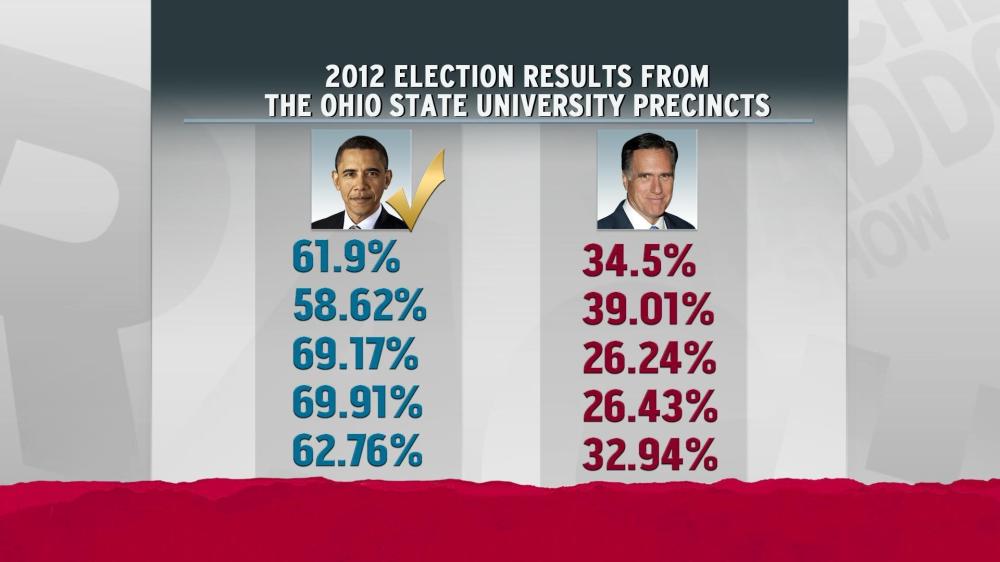
Since the 2012 election, Republicans in Indiana, North Carolina and Ohio have introduced bills to make it harder for students to vote — by banning out-of-state students entirely, or by imposing a financial penalty for exercising their rights. It’s easy to see why they would be so interested in curbing the college vote. The chart below shows how the student precincts of Ohio State voted — check out the margins for Barack Obama.
Bonus from the May 6 show: The history of students winning the right to vote goes back to Prairie View A&M, an historically black university in Texas.
The place for in-depth analysis, commentary and informed perspectives.
