








UPDATE:
November 6th
Tens of thousands of protesters took to the streets of Mexico City today to demand action from authorities. The marchers brought the capital city to a standstill. 40 days have passed but the 43 students have yet to be found. Mexican security forces have been using drones and boats to scan the area around Iguala, but have not turned up any solid leads. And two days ago, after a month on the run, Iguala’s mayor Jose Luis Abarca and his wife were finally arrested in Mexico City.
♦ ♦ ♦
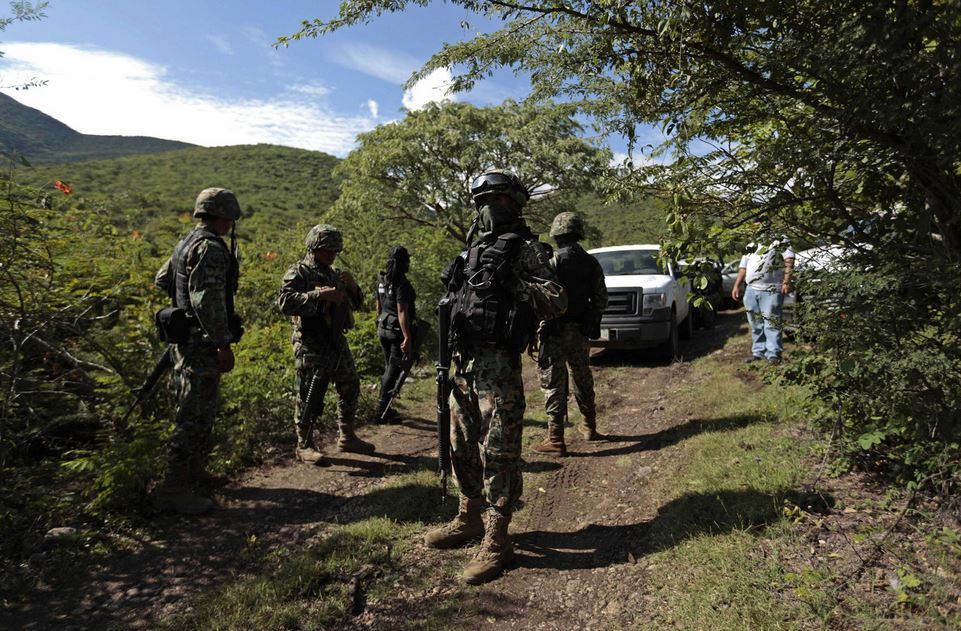
On September 26th, 43 students were abducted in the southern Mexican state of Guerrero. They were in the city of Iguala to march against hiring practices for teachers, but were stopped on buses bringing them back to school. The local police then opened fired on the group. 43 of the students were abducted, and later handed over to the Guerreros Unidos drug cartel. These students remain missing.
This story caught my attention on October 14th when I saw harrowing video of the Guerrero state capital building engulfed in flames; protesters had set fire to the building in an act of protest. Hopes were raised when mass graves were discovered on Monday in Cocula, but none of them ended up having any relation to the missing students.
Randy Archibold, The New York Times Bureau Chief for Mexico, Central America and the Caribbean, has been covering this unfolding drama; I spoke with him about the case and the ramifications for Mexico’s future.
♦ ♦ ♦
WF: Reuters reported on Monday that Mexican authorities arrested four drug gang members involved in the kidnapping. This announcement was simultaneous with a local media report that a mass grave had been discovered in a trash dump near the southwestern state of Guerrero. Does the good news of the arrest eclipse the bad news that the students might not have survived?
RA: Correct. That’s one way to put it. It appears that the Mexican PGR (more or less equivalent to our Justice Department) reported advances in the case – the arrest of four individuals from the organized crime gang believed to have carried out the abduction. Currently, two individuals are directly involved in taking away the students and may have given authorities information about the mass grave in Cocula, just south of Iguala. The federal Attorney General was at the scene investigating reports that bodies have been found, but he’s not saying how many or what condition they’re in. The reason that so much attention has shifted to the mass graves is because it comes at a time when they have detained individuals who are directly involved.
WF: How swift has Mexico’s reaction been? I read that federal authorities have arrested more than 50 people in connection with the incident, including dozens of police who allegedly have links to the Guerreros Unidos gang. Are people satisfied with the federal response? When these types of events occur here in the United States, many are often quick to lament how slowly investigations move.
RA: It’s fair to say that the general consensus is that this case was very slow to develop and perhaps not handled quite well at least initially. The case began as a local case in the state of Guerrero. Initially, the federal government was kind of playing back a little bit, saying it was a state matter, but I think the magnitude was clear. The increasing signs of students abducted in such a large number – that’s when the federal government stepped in and took over the case. However, there’s evidence that in some cases missteps were made by state authorities. It’s like the federal government coming in after the fact; a lot of people feel that they should have seized upon the case initially. But the swift arrest of the gang members and the warrant for the mayor who apparently ordered the students to be detained means they’re now moving quickly. The government cares very much about its international image and has made a point about improving it. So we’re now seeing the full force of federal government.
WF: Is it significant that President Pena Nieto has yet to visit Iguala?
RA: Some people believe that he should have made a stronger case, but in fairness he has sent his attorney general to the state.
WF: How did this story rise to national consciousness?
RA: This kind of developed organically. It kind of spoke to simmering issues, like the drug war and its unfinished business that may be worse than people imagined. The sheer number of people missing – people are questioning if that could really be right. It was clear that it appears to have really shocked the senses of the nation, especially people who feel that the government is not doing enough to address security issues. WF: What role have local politicians, namely the mayor of Iguala and his wife, played in this disappearance? How endemic is corruption in this particular state versus in other parts of Mexico? RA: The federal Attorney General has gone out in more than one press conference to say that the mayor and his wife are connected to organized crime and a drug gang. The wife’s family appears to have ties to even larger drug cartels. They are fugitives. They are missing. No one knows where they are. It speaks to a small town under the thumb of this drug gang where the local police force was their muscle. The sequence of events shows that the mayor was upset that students were in town collecting donations to drive to a protest they were planning to attend. Students in Mexico have a habit of taking buses or borrowing buses to be used for demonstrations. The mayor was upset at this and ordered his police force to stop them. At the same time, his wife was giving a speech in the city. She planned to run for mayor eventually. Perhaps he was angry that they were going to disrupt her speech, maybe it got out of hand, maybe they were mistaken for another cartel. According to the Attorney General, he ordered the police to stop them. There was a shooting – six people were killed – and students were rounded up in police cars and driven away and eventually handed over to the gang. The local police has long been one of the most corrupted institutions, often involved in drugs and crime. It’s a sad new benchmark in that state of corruption. WF: How vulnerable does this leave President Enrique Pena Nieto, and how does this incident feed into President Enrique Pena Nieto’s narrative about Mexico’s future? RA: From the get go this president came in with the idea of reforming the economy, changing Mexico from the drug war to talking about positive growth and potential for growth. He set about an ambitious reform agenda including laws allowing for foreign investors to partner with the state oil company, he revamped the telecommunications laws to allow more private competitors, and passed an education law that on paper could really diminish the influence of teachers’ unions. He set off on this ambitious agenda to really change the conversation about Mexico and succeeded to a certain extent. But the bottom line is that he chose not to make security a priority. He’s left the impression that he was not paying close attention until fairly recently. There have been arrests of big gang members, including Joaquin “El Chapo” Guzman. Some of it is pressure from the US. There’s DEA intel on these guys and pressure to act but I think the government is slowly coming around to the belief that it really can’t advance the country without tackling security problems. If there’s any case to be a wakeup call… WF: Is this a watershed moment for Mexico? RA: It’s a watershed moment for security matters in Mexico. There’s lots of other stuff going on – it’s a big country – but I think that this case and this moment…I won’t say define this president but certainly how he handles it will be closely scrutinized. What is lesson taken from this? Does he now propose a sweeping agenda on security? I think a lot is sort of riding on how he handles this case.
Willa Frej Recommended


