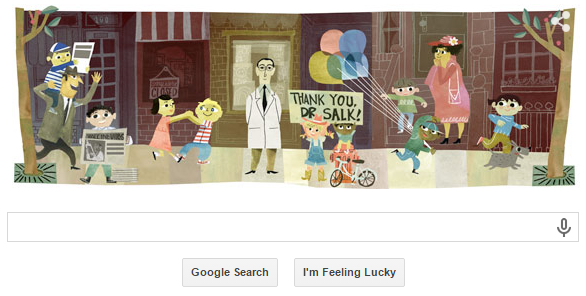
On what would have been his 100th birthday, Google honored Jonas Salk, who discovered the polio vaccine, with a “Doodle,” the search engine’s daily, artful logo iteration.
The Doodle depicts kids and adults running, playing, and holding up a newspaper whose front page announces the development of the polio vaccine. Salk stands in the middle, wearing a white coat as everyone around him celebrates his discovery.
It has been 57 years since Salk introduced the polio vaccine and 20 years since the virus was eradicated in the United States. Recently, however, other vaccine-preventable diseases, such as measles and whooping cough, have seen a resurgence, according to an interactive map released last week by the Council on Foreign Relations (CFR).
Much of this comeback can be attributed to a growing fear of vaccines in the United States which, according to The New York Times, has “gone viral.” In fact, at least one anti-vaccination group, VacTruth.com, has deemed the month of October “Vaccine Injury Awareness Month.”
So, why the 360 on vaccinations?
One of the most common complaints of the vocal anti-vaccine movement is a supposed link between vaccines — especially the vaccine for measles, mumps and rubella or MMR — and autism. But the Centers for Disease Control (CDC) has concluded “there is not a causal relationship between certain vaccine types and autism.”
RELATED: The truth about vaccines and autism Nonetheless anti-vaxxers continue to perpetuate the autism-link myth along with many others and their movement doesn’t seem be slowing, especially in California. And since the current Ebola outbreak arrived in the U.S., health hysteria seems to be running rampant, despite constant reminders from the medical community that our attention should be on helping West Africa — not panicking at home. On Jonas Salk’s birthday, to honor his memory, let’s put some things into perspective:
Emily Samsel Recommended