








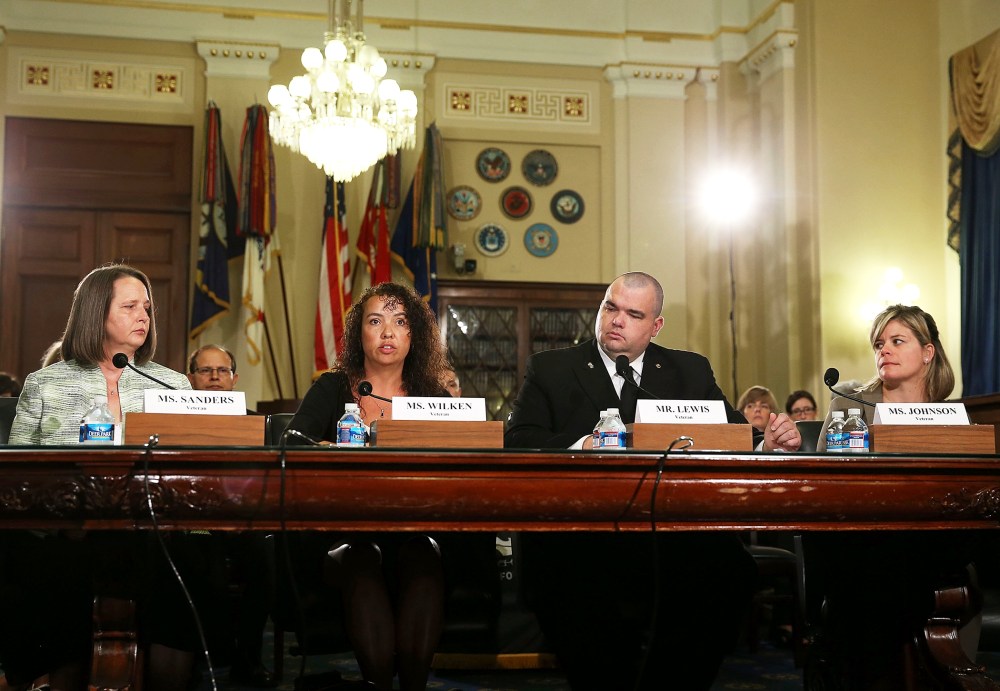
Senators at odds over competing proposals to change the way the military deals with its epidemic of sexual assault cases have united on a separate plan designed to address another flaw in the justice system.
On Tuesday, Sens. Barbara Boxer of California, Kirsten Gillibrand of New York and 11 others introduced a proposal to change the way court martial preliminary hearings are conducted. Joining efforts was Missouri Sen. Claire McCaskill, author of proposed reforms competing with changes designed by Gillibrand. The new bill would change Article 32 hearings to be more like preliminary hearings in civilian criminal trials.
This is the most recent major piece of legislation introduced designed to address sexual assault in the military this year. Reforming the military justice system to better prosecute sexual assault cases has been a major focus since a series scandals broke just as the Defense Department released a report estimating there were 26,000 incidents of unwanted sexual contact during the 2012 fiscal year. Of those, only 3,374 were reported, and only 302 of those were prosecuted. Of those who reported, more than 60% of victims said they experienced retaliation for reporting their assaults.
The proposed reforms will be folded into a larger defense bill, the National Defense Authorization Act, which the Senate is expected to debate before the Thanksgiving recess. The opening for debate would allow Gillibrand another chance to pass her Military Justice Improvement Act, a bill that would reassign convening authority for sexual assault cases and other serious crimes to a military prosecutor. Currently decisions about prosecution are made by an officer within the accused attacker’s chain of command.
The defense bill currently includes reforms supported by Armed Services Committee chairman Carl Levin and McCaskill. McCaskill’s reforms would leave authority within the chain of command.
Both senators’ proposals include reforms that would strip commanders of their ability to overturn jury convictions, mandate dishonorable discharges for anyone convicted of sexual assault, and make it a crime to retaliate against victims who report a sexual assault, but this disagreement over chain of command has caused deep divisions, even within the Democratic Party.
While veterans groups and many advocates for survivors of sexual assault support Gillibrand’s bill, it faces an uphill battle in the Senate. On Monday, Levin said that Gillibrand’s amendment would need to get 60 votes to be approved; Gillibrand has already collected the support of 45 other senators. South Carolina Republican Sen. Lindsey Graham also said Monday that he would do “whatever it takes” to stop Gillibrand’s amendment from passing.
Reforms to the military justice system and policies surrounding sexual assault cases will be one of the most contentious points of debate during the Senate’s work on the full defense bill, no small feat for legislation that includes bans on transferring prisoners from the military prison at Guantanamo Bay.
Boxer’s Article 32 reform bill could face an easier path thanks to both its broad coalition of supporters and recent events in a high profile case. The bill would make testimony by victims voluntary, something that is already allowed for civilians at Article 32 hearings. It would also, among other things, limit the scope of the proceedings to probable cause, which would protect victims from questions designed to impugn credibility and character.
“When military victims of sexual assault are forced to endure hours of insensitive and intrusive questioning by military justice officials, they are treated more like perpetrators than victims,” Sen. Richard Blumenthal, a Connecticut Democrat, said in a statement Tuesday. “Limiting the scope of Article 32 proceedings and requiring a military lawyer to oversee them will ensure that victims of sexual assault are not further harmed by the same military justice system that is put in place to protect them.”
The ongoing court-martial process for former Naval Academy football players accused of raping a female midshipman has allowed a glimpse into the way military sexual assault cases are prosecuted and inspired lawmakers to write this new bill. During the Article 32 hearing, the young woman who alleged she was assaulted by three men at a party was subjected to five days of cross-examination by a dozen defense lawyers, during which she was asked about what she was wearing and about how she performed oral sex.
Two of the three men accused in the Naval Academy case face court martial early next year. The Superintendent of the Academy referred those cases to trial after the officer who presided over the pretrial hearing recommended none of them face court martial and reportedly harshly criticized the alleged victim’s character. The Naval Academy case is not the only high-profile military sexual assault case to continue to cause controversy. Last month, when it was announced that James Wilkerson, a Lt. Col. whose jury conviction for sexual assault was overturned unilaterally by the officer in charge of the court martial, would retire Jan. 1 at a reduced rank, Rep. Jackie Speier called the reduction a “slap on the wrist.” Despite being convicted of sexual assault by a jury, Wilkerson will still receive his military pension. In addition to Boxer’s bill and the full defense bill debate, advocates and survivors are continuing to speak out about their experiences and call for change. Service Women’s Action Network, the Iraq and Afghan Veterans Association, and the Vietnam Veterans Association released an open letter Tuesday urging lawmakers to pass Gillibrand’s proposal. “Military sexual assault is a multi-generational issue. For decades, it has been swept under the rug yet continues to rear its ugly head,” said Marsha Four of Vietnam Veterans of America in a statement Tuesday. This year’s push for reform marks only the latest push in the wake of scandal. For decades, military leaders have lamented the lack of a “silver bullet” solution to sexual assault in the armed forces. In September, the Defense Advisory Committee on Women in the Services met to discuss reforms and recommended that the Department of Defense support Gillibrand’s bill. “Separating military justice decision-making from the chain of command will make it possible for commanders to concentrate on improving the climate in their commands that helps prevent sexual assaults,” said Nancy Duff Campbell, Co-President of the National Women’s Law Center said at a press conference about military sexual assault and proposed reforms held Wednesday. “They can model the behavior they expect from those they command. This is the leadership job that commanders should be called upon to do and the job for which they have particular expertise.” Anu Bhagwati also rejected the argument that commanders must retain control or face chaos in the ranks. “Often, we see the military justice reform debate framed as a choice to support either sexual assault survivors or military readiness,” she said in a statement released Tuesday. “Today, we want to be clear. A vote for Sen. Gillibrand’s Military Justice Improvement Act (MJIA) is a vote for our troops, and a vote for a stronger military.”
Meredith Clark
Meredith Clark is a freelance writer and editor. She was previously a senior news producer for "Patriot Act with Hasan Minhaj," a reporter with MSNBC.com, the digital politics and culture editor at Glamour and a senior news and politics editor at Refinery29. She has written for Vulture, Rolling Stone, Self, Marie Claire, Cosmopolitan, The Daily Beast and Bustle. Recommended


