








First Read is a morning briefing from Meet the Press and the NBC Political Unit on the day’s most important political stories and why they matter.
Rivals Unable to Slow Down Trump, Clinton
Three more contests down after last night, and the presidential races remain pretty much the same — Donald Trump is still on track (but barely) to win the GOP nomination, while Hillary Clinton maintains an almost insurmountable lead on the Democratic side. Let’s start with the Republican race: Trump easily defeated Ted Cruz in Arizona, 47%-25% (with 75% in), nabbing all of the state’s 58 delegates in that winner-take-all contest. And Cruz took 69% of the vote in Utah (while Kasich finished second and Trump third), winning all 40 of the state’s delegates.
Which means: Trump increased his delegate lead over Cruz by 18, and he needs to win 54% of the remaining delegates to hit the magic number of 1,237 delegates for a majority. And while that 54% might seem like a large percentage, consider that he took 59% of the available delegates last night, as well as 61% of the delegates from the March 15 contests. The next chance for Cruz and Kasich to stop Trump is in Wisconsin, which holds its primary on April 4. Trump is beatable there; a Marquette Law School poll had Trump at 30%, Rubio (before he dropped out) at 20%, and Cruz at 19%. The only question we have: Do Kasich (whose Super PAC is up with a new TV ad in the state) and Cruz divide up the anti-Trump vote, allowing the real-estate mogul to squeak by with a win?
Trump holds a 276-delegate lead over Cruz (it was 258 before last night)
- Trump 744 (48% of delegates won)
- Cruz 468 (30%)
- Rubio 172 (11%)
- Kasich 143 (19%)
Trump needs to win 54% of remaining delegates to reach 1237 magic number.
Cruz needs to win 84% of remaining delegates to reach 1237 magic number.
Kasich needs to win 120% of remaining delegates to reach 1237 magic number.
Sanders Chips Into Clinton’s Lead — But Barely
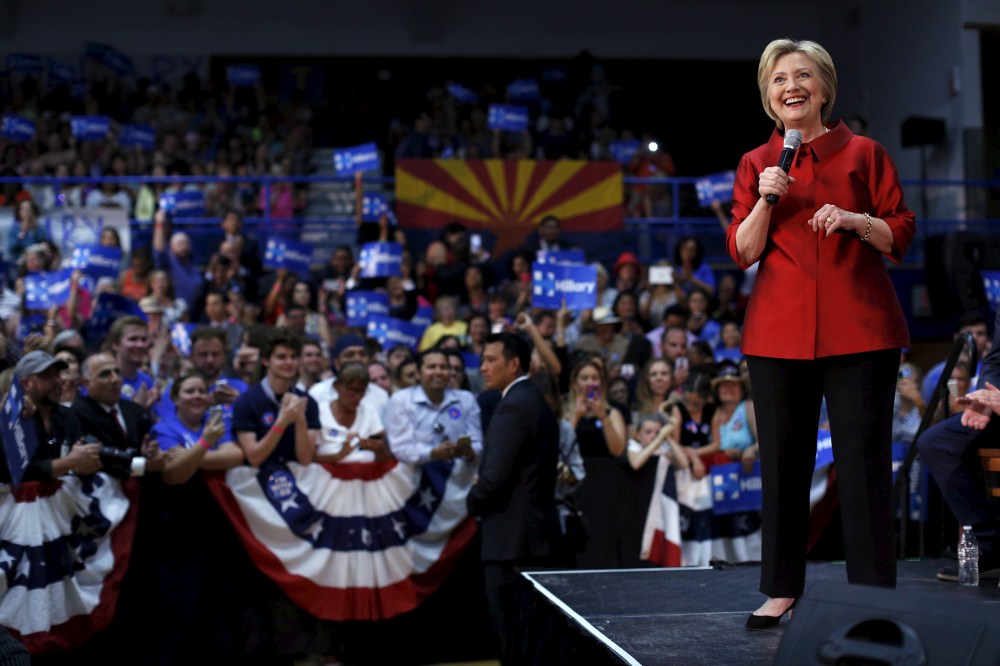
Meanwhile, in the Democratic contest, Bernie Sanders scored big wins in Utah (80%-20%) and Idaho (78%-21%). The problem for him: Clinton won delegate-rich Arizona, 58%-40% (with 78% in), which means that Sanders netted just seven delegates for the entire night (Sanders 61, Clinton 54) — with 10 delegates still unallocated in Arizona and six in Utah.
According to our math after last night, Clinton needs to win just 34% of the remaining delegates to hit the Dem magic number of 2,383 delegates, while Sanders needs to 66%, which is an almost impossible task when all of the Dem contests are proportional. “These decisive victories in Idaho and Utah give me confidence that we will continue to win major victories in the coming contests,” Sanders said in a statement last night. And he’s right — he’s expected to win big in Saturday’s contests in Alaska, Hawaii, and Washington. But notice what Sanders didn’t say: that he has confidence he’ll win the Democratic nomination. Sanders could end up netting 30-40 delegates on Saturday, but he’d still trail Clinton by a bigger margin in pledged delegates than he did before March 15, when Clinton held a 213-delegate lead.
In pledged delegates, Clinton holds a 296-delegate lead over Sanders (was 302 before last night)
- Clinton 1201 (57%)
- Sanders 905 (43%)
In overall delegates, Clinton holds a 709-delegate lead over Sanders (was 720 before last night)
- Clinton 1637 (64%)
- Sanders 928 (36%)
Clinton needs to win 34% of remaining delegates to hit 2383 magic number
Sanders needs to win 66% of remaining delegates to hit 2383 magic number
The 2016 Candidates React to Terrorist Attacks in Brussels Beyond last night’s primary/caucus results, however, the terrorist attacks in Brussels remain a big storyline in the 2016 contest. Ted Cruz issued this statement yesterday reacting to the attacks: “We need to empower law enforcement to patrol and secure Muslim neighborhoods before they become radicalized.” Clarifying that statement later in the day, Cruz added, per NBC’s Vaughn Hillyard: “Political correctness costs lives. And it is standard law enforcement — it is good law enforcement to focus on where threats are emanating from, and anywhere where there is a locust of radicalization, where there is an expending presence of radical Islamic terrorism, we need law enforcement resources directed there, national security resources directed there.” Trump agreed with Cruz’s call, while John Kasich took issue with it. “Just because you happen to be a Muslim doesn’t mean that you are a radicalized person who wants to destroy somebody in the West.” And the head of the NYPD snapped back, “I take great offense at his characterization of that whole [Muslim] population.” And on the Democratic side, Hillary Clinton today delivers a counterterrorism speech at Stanford University at 2:15 pm ET. Cruz Doubles Down on His Patrol/Secure Comments On “Today” this morning, Cruz doubled down on his patrol/secure-Muslim-neighborhoods call. “We are facing a war,” he told NBC’s Savannah Guthrie. “This [Obama] administration is mired in political correctness,” adding that if you want to stop radical terrorism, you need to do everything to do so. And asked about his Twitter back-and-forth last night with Trump over their wives (see here and here), Cruz responded, “Don’t you try to attack my wife.” Speaker Ryan — “Instead of talking about what politics is today, I want to talk about what politics can be” At 11:00 am ET, House Speaker Paul Ryan is set to deliver a speech on the “State of American Politics.” Per advanced excerpts that his office has released, Ryan is expected to say, “Looking around at what’s taking place in politics today, it is easy to get disheartened. How many of you find yourself just shaking your head at what you see from both sides? Now, a little skepticism is healthy. But when people distrust politics, they come to distrust institutions. They lose faith in their government, and the future too. We can acknowledge this. But we can’t accept it. And we can’t enable it either.” More Ryan: “My father used to say, if you’re not a part of the solution, you’re a part of the problem. So I have made it a mission of my speakership to raise our gaze and aim for a brighter horizon. Instead of talking about what politics is today, I want to talk about what politics can be. I want to talk about what our country can be.” The question we have: What does Ryan say about Trump? Jeb Endorses Cruz, Criticizes Trump’s “Vulgarity” Finally, Jeb Bush endorsed Ted Cruz earlier this morning. “For the sake of our party and country, we must move to overcome the divisiveness and vulgarity Donald Trump has brought into the political arena, or we will certainly lose our chance to defeat the Democratic nominee and reverse President Obama’s failed policies,” Bush said in a statement. “To win, Republicans need to make this election about proposing solutions to the many challenges we face, and I believe that we should vote for Ted as he will do just that.” On the Trail Ted Cruz hits New York City and Wisconsin… John Kasich also is in Wisconsin… And Chelsea Clinton campaigns in Wisconsin. Recommended


Chuck Todd
Chuck Todd is NBC News' chief political analyst and the former moderator of "Meet The Press."

Carrie Dann
Mark Murray