








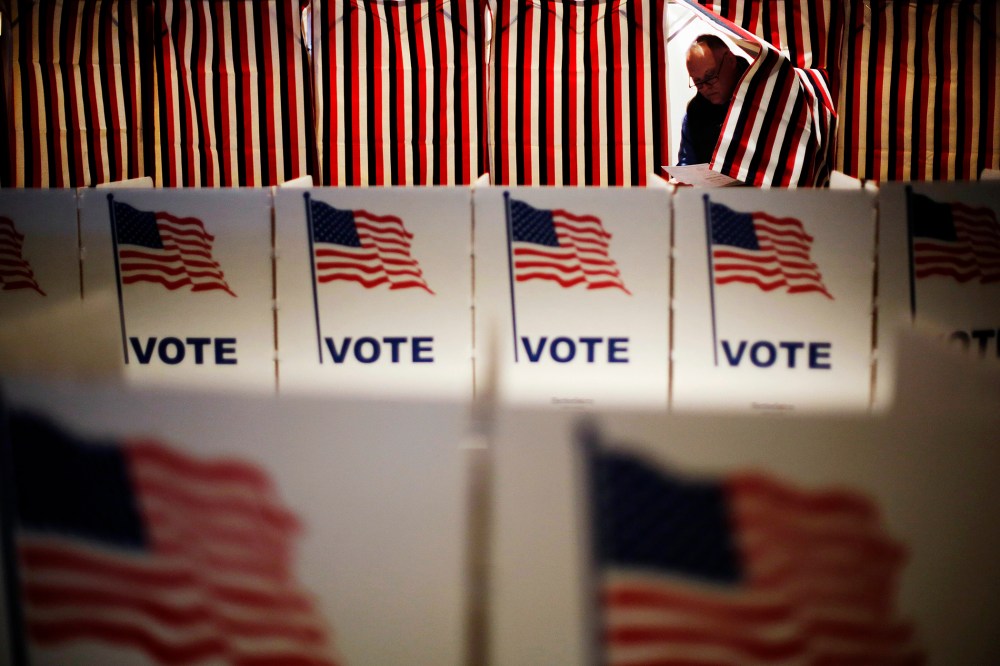
The first presidential election in more than half a century without the protections of the Voting Rights Act kicks into even higher gear over the next 12 days. And voters in several of the states with upcoming contests could face barriers to the polls.
North Carolina, Kansas, Mississippi and Ohio are all among the states that hold primaries or caucuses between Saturday and March 15, and all have new voting restrictions in place. Nominating contests tend to attract fewer voters, and a more engaged crowd, than the general election, so the immediate impact may be limited. But what happens could offer warning signs about problems that could arise on a much larger scale in November.
Already, voting restrictions and administrative snafus in Texas, Alabama, Georgia and Virginia, among other states, appear to have disenfranchised would-be voters.
Voting rights advocates will be looking closest at North Carolina, which holds its primary on March 15, though early voting is already underway. Weeks after the Supreme Court weakened the Voting Rights Act in Shelby County v. Holder in 2013, the state’s GOP-controlled legislature passed a multi-pronged crackdown on voting. In effect for the first time in a presidential election will be the law’s ID requirement, its ban on voting in a different precinct and its reduced early voting periods, among other provisions. The law also eliminated the state’s same-day registration period, but that period survives while the law is being challenged in the courts by the U.S. Justice Department and voting rights groups.
RELATED: Scattered problems for voters at polling sites, especially in the South
A progressive group estimated that around 30,000 people were disenfranchised by the law in the November 2014 midterms—and that was before the ID requirement went into effect. North Carolina is again shaping up as a pivotal swing state in the 2016 presidential election.
Then there’s Kansas, which holds caucuses Saturday, and has among the strictest voting rules in the nation. In addition to a voter ID law, the state has been battling the federal government to implement a requirement that anyone registering to vote show proof of citizenship. More than 30,000 Kansans have already been kept of the rolls as a result of the policy, voting rights groups have said.
Kansas Secretary of State Kris Kobach, a Republican anti-immigration crusader who has endorsed Donald Trump, pushed both laws. Last month, Kobach called the American Civil Liberties Union and the League of Women Voters “communist” for opposing the citizenship law.
It’s hard to predict what impact Kansas’ laws will have on the caucuses, which tend to attract more engaged voters who mostly have what they need to participate. Democrats will allow people to register to vote at the caucuses, but because of the law, they’ll need to show proof of citizenship. If they don’t, they can still caucus but will need to follow up later with proof of citizenship in order to be registered to vote. The GOP caucus doesn’t allow same-day registration, but all participants will be required to show ID. Kansas is shaping up as a surprising GOP battleground. Marco Rubio plans to make thee stops there Friday, canceling stops in Kentucky and Louisiana. And Ted Cruz made several appearances there Wednesday. Three days later, on March 8, Mississippians will go to the polls, with a voter ID law in force for the first time in a presidential election. The measure was passed in 2011 but went into effect only after Shelby. Mississippi has the highest share of black citizens in the nation, as well as a long and shameful history of finding ways to reduce black voting power. Ohio, which votes March 15, also has been in the spotlight for its voting rules. In 2014, Republicans cut early voting and made it harder to get an absentee ballot. Many of the cuts were reversed as part of a legal settlement, but the one-week early voting period when voters could register and vote on the same day did not survive. Missouri votes March 15, too. The state currently has no voter ID law, but Republicans are advancing a pair of bills designed to change that starting next year. One would put an initiative on the November ballot to allow voter ID. The other, to go into effect if the initiative passes, would impose an ID requirement.
Zachary Roth Recommended


