








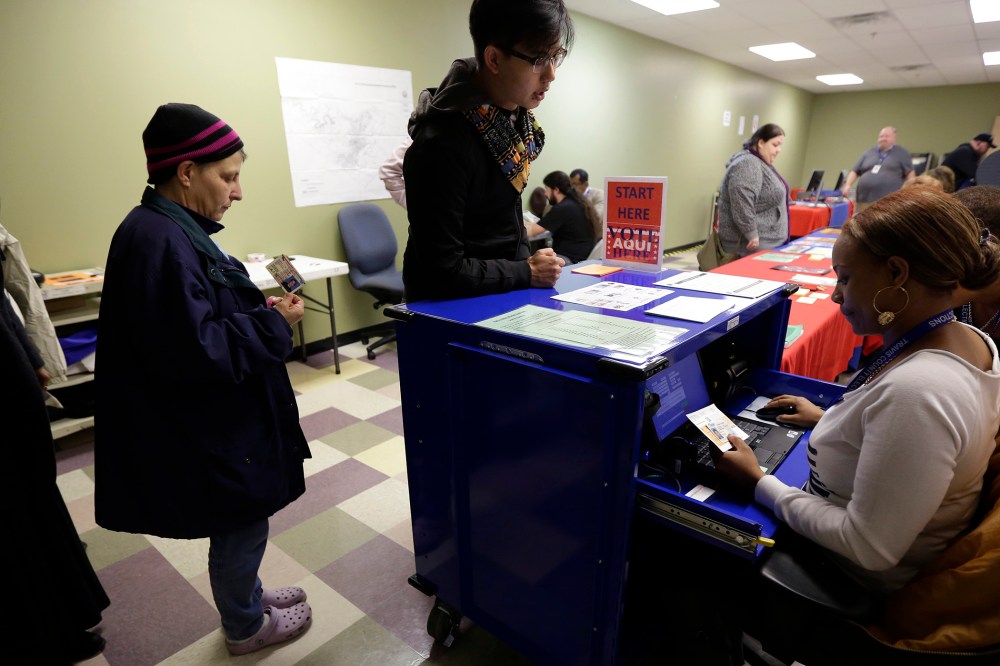
Whether Texas’s voter ID law goes into effect for the upcoming election is now in the hands of John Roberts and co. On Tuesday, a federal circuit court reinstated the law—which had been struck down by a federal judge last week—prompting voting rights groups to appeal to the Supreme Court.
At the heart of the legal issue now before the justices is this question: How to balance the well-established idea that courts should avoid changing the rules close to an election, with the competing need—which many would see as more pressing—to avoid racial discrimination in voting?
Related: Texas: No more voter IDs for you
The court’s answer to that question could determine whether hundreds of thousands of Texans can exercise their democratic rights this fall. Over 600,000 registered voters in Texas, disproportionately minorities, lack ID. About twice as many eligible voters are in the same boat.
First, some context: Over the last month, the Supreme Court has weighed in on three major voting rights cases.
In two, it sided with proponents of voting restrictions—striking down Ohio’s cuts to early voting and blocking North Carolina’s elimination of same-day voter registration. In the third, it sided with voting rights advocates, when it reversed a ruling that reinstated Wisconsin’s voter ID law, a measure that had been blocked for over two years.
The justices didn’t explain their reasoning in any of the cases, but one consistent thread has appeared to run throughout: Blocking last-minute court-ordered changes from taking effect, in order to cut down on voter confusion.
It’s what’s known as the Purcell principle—after a 2006 case in which the high court blocked an injunction, issued two weeks before an election, against Arizona’s voter ID law.
In its ruling Tuesday reinstating Texas’s strict ID law, the 5th Circuit Court of Appeals cited Purcell, and wrote that it was acting “based primarily on the extremely fast-approaching election date.”
But in their appeal to the Supreme Court, the law’s challengers argue that Purcell cuts the other way—that if the goal is minimizing voter confusion, the law should be blocked. That’s essentially because it’s easier for poll workers to administer the more expansive ID policy that would exist without the law than the more restrictive one that the law puts in place, they argue. It’s also because the law is itself confusing in terms of the types of IDs it allows, among other issues.
But wrapped up in that argument is a more expansive one: That avoiding last-minute changes, though an important goal, is less urgent than the simple need to not discriminate against racial minorities, who are far more likely than whites to lack ID.
Though the appeals court barely mentioned it, the district court’s original ruling, a careful but scathing 147-page opinion, found that the law intentionally discriminated against blacks and Latinos, calling it a “poll tax.” The challengers argue, in a nutshell, that stopping this discrimination is more important than avoiding whatever confusion blocking the law might create.
“Imagine that a state passed a law, six months before an election, stating that ‘Negroes cannot vote,’” they write. “This law—clearly intentionally discriminatory based on language and effect alone—is enjoined on that basis by a District Court two weeks before an election. It would be ludicrous for an appellate court to turn around and stay that injunction because of some per se rule that election laws can never change immediately prior to elections. [The Texas ID law], as the District Court found, is simply a more creative method of intentionally discriminating based on race than the above hypothetical.” Outside experts have made a very similar argument. “First, the risk of changing the rules close to the election should perhaps be balanced with the risk of disenfranchisement,” Rick Hasen, a prominent election law scholar who has written favorably about the use of Purcell in the other recent cases, wrote Tuesday. “Second, there is less of a problem of turning OFF a voter ID law than turning it ON. Here, there may be some people who are asked for ID who should not be if the ID law is put on hold. But that’s a lower risk of disenfranchisement than if the law, if discriminatory, remains in place.” Justin Levitt, a professor at Loyola Law School and another leading expert, has gone further. “There may well be a bit of confusion [if the law is blocked],” he wrote last week, explaining why Purcell might apply to the other three cases but shouldn’t to Texas. ”But weighing a small amount of confusion against the implementation of a law found to be the product of intentional discrimination with what a court found (after a full trial) to be a substantial amount of likely disenfranchisement is nothing the Court has yet encountered.” Of course, in the final analysis the only thing that matters is how five justices see it. And given their recent orders stopping last-minute changes, as well as their generally conservative record on issues of race bias in voting, it would be a surprise if they accept the challengers’ argument. But if they don’t, it’ll be the latest window into just how highly they value the right to vote.
Zachary Roth Recommended


