








The sequester could soon impede federal enforcement of labor rights regulations, thanks to furloughs on the federal employees who investigate claims of workplace discrimination and unfair labor practices. The Equal Employment Opportunity Commission, which is in charge of investigating claims of discrimination in workplaces around the country, is the most recent agency to be affected.
Furloughs could increase the agency’s backlog of discrimination cases by almost 40%, according to the union which represents EEOC employees.
“I think the National Labor Relations Board is going to have to implement some furloughs,” said Paul Secunda, law professor at Marquette University. “Some of the other agencies within the Department of Labor are also considering furloughs.”
In late February, the National Labor Relations Board (NLRB) told its employees to expect as many as 22 furlough days. The Occupational Safety and Health Administration (OSHA) has said that it would try to avoid employee furloughs by “reprogramming” funds and freezing hiring and bonuses.
A larger backlog of EEOC cases could increase the number of workplace discrimination cases which go directly to court. If a workplace discrimination charge goes unheard by the agency for more than 180 days, complainants can request that a “Notice of Right-to-Sue” be issued automatically. However, those cases could still go unheard thanks to a rash of vacancies in the federal courts.
Some of the cases unheard by the EEOC might not even be submitted to the courts in the first place, said Ross Eisenbrey, vice president of the Economic Policy Institute and a former OSHA commissioner.
“They’re hard cases to bring, hard cases to prove,” he said. Plus, “most people can’t afford attorneys to do it.” Instead, they rely on government agencies to “help them assert their rights.”
For complaints about health and safety standards, employees don’t even have the option of going to the courts on their own. Instead, all those complaints must go through OSHA. While that agency hopes to avoid serious reductions in its workload capacity due to the sequester, Eisenbrey said that the status quo at the department is already “completely insufficient.”
“The chance of having an OSHA inspection, if you’re an employer, in any given year is close to zero,” he said. He estimated that there were only about 1,000 inspectors in the agency, compared to seven million employers nationwide.
The NLRB is also struggling with prior enforcement problems which the furloughs could exacerbate. Currently, there are several pending legal challenges to the NLRB’s ability to make any binding rulings in its current form. In January, the DC Circuit Court ruled that President Obama’s recess appointments to the NLRB were invalid, meaning that the Board did not have the quorum required to legally issue rulings. The NLRB intends to appeal the circuit court’s ruling to the Supreme Court.
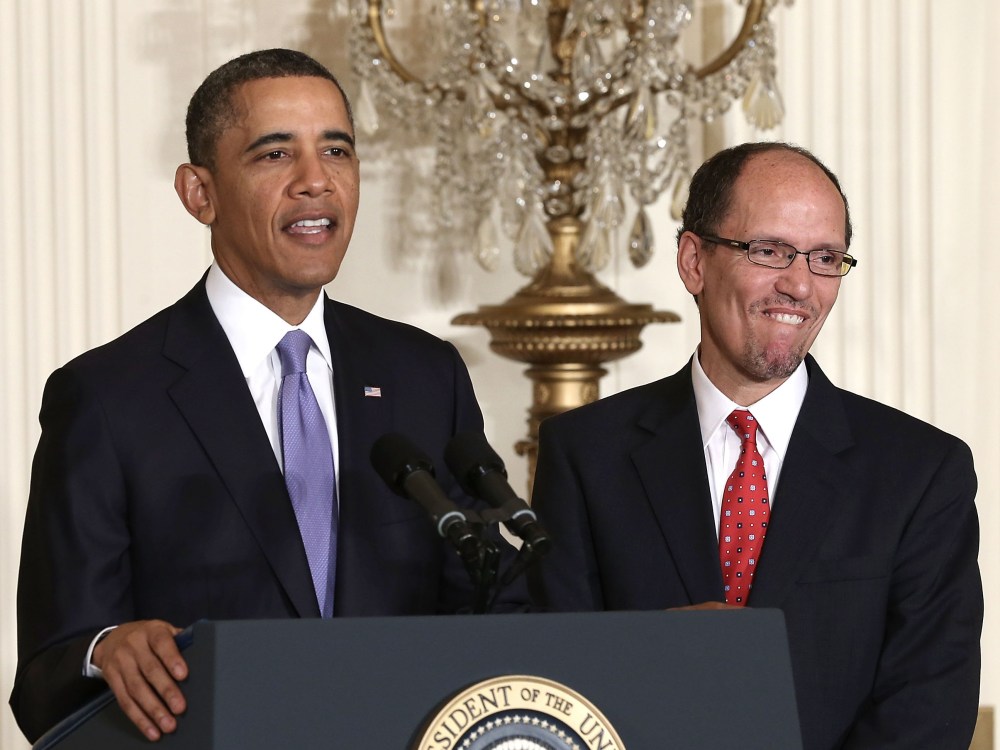
In the meantime, NLRB chair Matt Pearce has signaled that he intends to continue on with business as usual. “What I expect is that current members of the board … will continue to hear cases,” said Secunda. However, the current legal situation makes it very easy for employers to contest the Board’s decisions in those cases. “In order to get [an NLRB ruling] enforced, you have to file a case with the circuit court, and the circuit court will issue an enforcement order if it agrees with the NLRB,” said Secunda. Employers who want to avoid unfair labor practice charges can now choose to contest NLRB decisions before the DC circuit court, which has already decided that such decisions are invalid. Unions will be more cautious to do so, because they need the NLRB in order to hold certification elections. The NLRB could circumvent the DC circuit court’s decision if it had a quorum of members confirmed by Congress, instead of appointed through recess appointments. However, Secunda speculated that the Senate would stonewall any nominations, because “it serves the Republicans’ purpose to keep the NLRB dysfunctional.” At least one other key vacancy exists in labor enforcement: the Labor Department currently does not have a permanent head. Earlier this week, President Obama officially nominated Tom Perez to be the next Labor Secretary, but he still needs to be confirmed by the Senate. Senator David Vitter, R-La., subsequently announced that he would block the nomination. The acting Labor Secretary is currently Seth Harris, who was Deputy Secretary of Labor under former Labor Secretary Hilda Solis. Secunda, a friend of Harris’, said the acting head was doing an “excellent job,” and that the holdup in confirming Perez would not impede the department’s activities.
Ned Resnikoff is an urban policy analyst, researcher, writer, and editor. His byline has appeared in a variety of publications, including the New York Times, San Francisco Chronicle, Dissent, and The Nation. He writes the newsletter Public Comment, which can be found at publiccomment.blog. Recommended


