








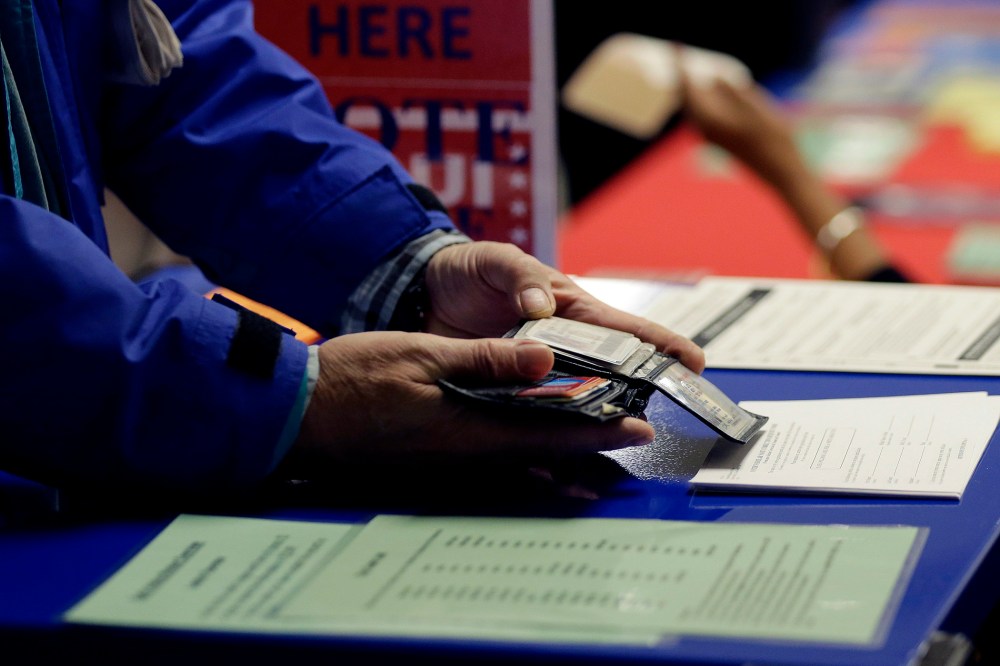
Texas’s strict voter ID law, struck down last week, is now back in place thanks to an appeals court ruling Tuesday. But while the state was pushing to get the law reinstated, it stopped issuing IDs. It said Wednesday morning that it has started again.
RELATED: Texas voter ID law back in place
The on-again-off-again schedule could add to the hurdles and confusion that voters face in obtaining an ID. And it offers a window into the GOP-controlled state’s approach to voting: In a nutshell, critics say, Texas jumped at the chance to stop issuing IDs, even though it was far from clear that a halt was required by law.
From the start, voting rights advocates have noted in court and in the media that Texas’s efforts to make the special state IDs it created — known as Election Identification Certificates (EICs) — available to those who need them have been half-hearted at best. Among other things, they’ve charged that the mobile ID offices that the state created for distributing IDs were poorly publicized, and weren’t sent to nearly enough locations. Between June 2012 when the law went back into effect and the end of August, just 279 EICs were issued, the state has said.
Over 600,000 registered voters in Texas, disproportionately minorities, lack ID. About twice as many eligible voters are in the same boat.
And Texas appears to have seized on the ruling last week, striking down the law as an excuse to weaken their efforts at issuing IDs even further. Before the ruling late Tuesday afternoon reinstating the law, Texas argued that under Saturday’s injunction that blocked the measure, it was barred from issuing EICs.
“Under the current injunction, the state cannot issue Election Identification Certificates,” Alicia Pierce, a spokeswoman for the Texas Secretary of State, told msnbc via email Tuesday early afternoon.
But voting rights advocates and election experts — also speaking before the appeals court ruling that put the law back in effect — disagreed. Some charged Texas intentionally adopted the broadest possible interpretation of the injunction, in order to make it harder for voters who lack ID to get one.
“It’s a self-serving interpretation,” said Natasha Korgaonkar, a lawyer with the NAACP Legal Defense Fund, which is among the organizations challenging the law. “If Texas wanted to keep issuing a free ID that people could use, they could do that.”
Already, the state was found last week by U.S. District Court Judge Nelva Gonzales Ramos to have intentionally discriminated against minorities in passing the law. The judge also ruled that the ID measure is an unconstitutional “poll tax.”
RELATED: Eric Holder: Texas ruling vindicates our voting rights strategy
But late Tuesday afternoon, the 5th Circuit Court of Appeals reinstated the law by putting a stay on Gonzales Ramos’s injunction, saying it was too close to the election to change the rules. The law’s challengers are appealing to the U.S. Supreme Court. But the justices recently blocked last-minute changes to election law in Ohio, North Carolina, and Wisconsin, suggesting they’re unlikely to reverse the appeals court .
The fate of the voter ID law could play a role in Texas’s gubernatorial race, in which Attorney General Greg Abbott, a Republican whose office has staunchly defended the law in court, leads state Sen. Wendy Davis, a Democrat and opponent of the law. %22It%E2%80%99s%20a%20self-serving%20interpretation.%20If%20Texas%20wanted%20to%20keep%20issuing%20a%20free%20ID%20that%20people%20could%20use%2C%20they%20could%20do%20that.%22′ Asked for the basis of the conclusion that it can no longer issue IDs, Pierce, the secretary of state’s spokeswoman, pointed to Section 20 of the law, which was enjoined by Judge Gonzales Ramos’s order Saturday. Section 20 lays out the costs of EICs — including no charge for Texans who need them in order to vote, aside from the underlying documents needed. But Justin Levitt, an election law scholar at Loyola Law School, said that in his view, that didn’t stop Texas issuing EICs. “I don’t see anything at all in the injunction that prevents the state from issuing ID certificates,” Levitt said via email, adding, “They may not be allowed to offer the certificate for free. I don’t see why they can’t offer a certificate.” Gerry Hebert of the Campaign Legal Center, one of the lawyers challenging the law, also criticized Texas’s decision to stop issuing IDs. “Texas could and should have gone to the trial court (who offered to give Texas a hearing but they did not accept the offer) to get clarity if they were unclear,” Hebert said via email. “But instead, they bypassed the court with the greatest familiarity with the facts and circumstances and went right to the 5th Circuit.” Hebert added that if the law is reinstated on appeal and Texas then returns to issuing IDs, it would cause “far more chaos and confusion.” That’s the situation that’s now occurring, of course. Pierce said Wednesday morning that the state has now returned to issuing IDs, thanks to the appeals court’s order blocking Gonzales Ramos’s injunction. On Monday, Texas cancelled plans to send a mobile ID office to at least one county on Tuesday and Wednesday. In an email to a county election administrator obtained by msnbc, Louri O’Leary, an official in the secretary of state’s office, wrote: “Currently at this time (sic) we are no longer issuing EICs. If this changes I will let you know.”
Zachary Roth Recommended


