








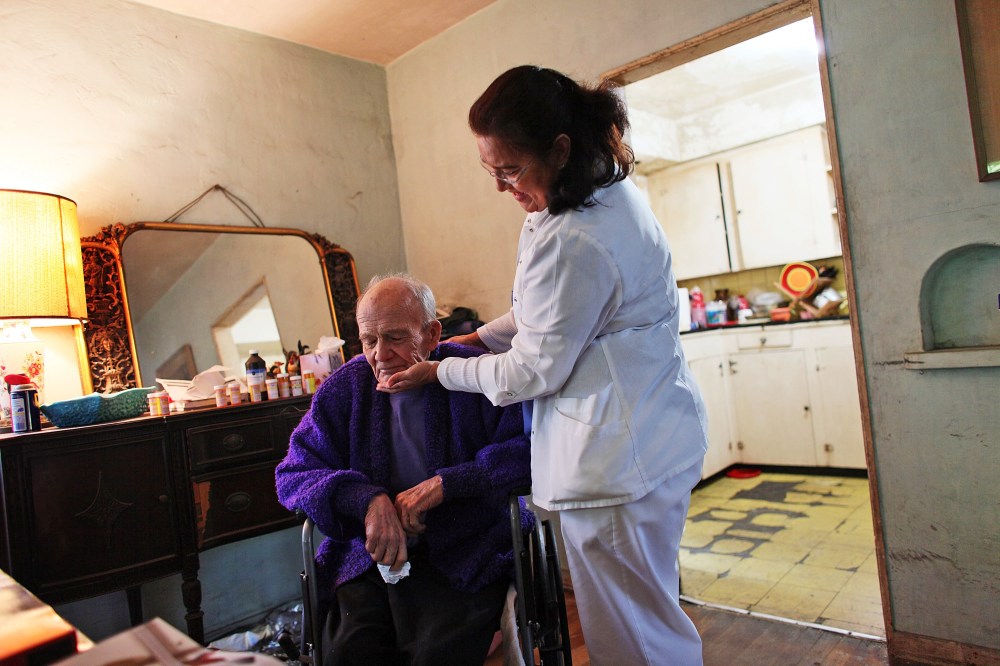
With Congress finally beginning post-shutdown budget talks this week, advocates are trying to put a face on the huge, disparate range of domestic programs that have fallen under sequestration’s axe. The cause has drawn together thousands of advocates battling the automatic cuts to a mind-boggling range of federal spending, from mental health care on Native American reservations, to public defenders, to Census data collection.
The automatic cuts affect all programs that must have their funding renewed every year, in contrast to “mandatory” spending that’s automatically doled out to Medicare, food stamps, and the like. They are equally divided between defense programs and “non-defense” discretionary spending (NDD)—the catch-all term for everything else.
“No one knows what NDD is—it’s a very wonky term,” says Emily Holubowich, a health-care lobbyist at CRD Associates who founded NDD United, a coalition of more than 3,000 organizations.
NDD United was founded just as Congress turned its focus to spending cuts after the 2010 Republican takeover of the House. With no budget and an all-volunteer staff of veteran lobbyists and advocates, NDD United meets with Congressional staff and lawmakers, holds briefings, and circulates letters to present a united front against sequestration.
Beginning in March, sequestration was supposed to be so terrible it would force Congress to come together and pass a $1.2 deficit reduction deal that dealt with the real drivers of spending: not discretionary cuts but entitlement spending, as well as revenue.
But it hasn’t turned out that way: The automatic cuts have become the status quo—now in place until mid-January—and the politics of sequestration haven’t treated everyone equally. Defense lobbyists have presented a united, vocal front on Capitol Hill—and it’s politically risky to be seen to weaken the nation’s defenses. A few domestic programs have received attention from lawmakers as well: Head Start, cancer research, and law enforcement. All are perennial favorites in Washington with broad public support, making them attractive poster children for the battle against budget cuts.
Other sequestered programs have fallen under the radar. Federal agencies and local programs have tried to mitigate the impact, reducing their exposure to the cuts for at least this year. But many programs will feel the pain: groups that help low-income families pay for their heating bills; job training to help the unemployed retool for new professions; personal care services that help poor seniors bathe and dress themselves.
Early in the budget fight, before sequestration was created, “we were at risk of cannibalizing each other. Each category of spending was scrapping to protect itself,” says Rachel Gragg, federal policy director for the National Skills Coalition and a co-chair of NDD United.
A major test came during the shutdown, when Republicans pushed piecemeal bills to open certain agencies but not others. But the domestic funding advocates held together. “We were very united in the response to the shutdown, from National Parks to medical research to Head Start to the tribal community. All of them said, ‘this is not the answer, we need to open the government,’” says Holubowich.
While Democrats have made the reversal of the cuts a priority, sequestration has failed to elicit the kind of public outrage that many advocates had anticipated. A recent National Journal poll showed that 74% of Americans had not “seen any impact of these cuts” in their personal lives or in their communities.
That’s partly because agencies and local programs have been able to cushion the blow for now—efforts that made some of the White House’s early, dire claims about sequestration ring false. But both officials and advocates warn many of those maneuvers were one-time budgeting measures that won’t be available if sequestration continues another year. “People were looking for ‘a blood in the streets’ reaction that didn’t happen, but that doesn’t mean the cuts haven’t been significant,” says another lobbyist.
But general awareness of what the cuts mean is still low. “I don’t think they understand the word ‘sequestration,’” says Rep. Nita Lowey, ranking Democrat on the House Appropriations committee and a member of the bipartisan budget conference that’s trying to reach a deal. Even if ordinary Americans support programs like Head Start, “They may not know the laws, and they may not have a clear idea of the pot of money it comes from,” she said. Advocates have tried all kinds of strategies to draw attention to the cuts on and off Capitol Hill. Joel Packer, an education lobbyist with the Raben Group and another NDD organizer, helped the Committee for Education organized a mock bake sale on Capitol Hill to raise money for sequestration-hit school programs, delivering cookie crumbs to Congressional offices. Others have tried to highlight real-people stories about the pain that sequestration has inflicted and what’s still to come. The phrase “non-defense discretionary spending” can give lawmakers cover to cut spending indiscriminately, so individual stories can help puncture that defense, advocates say. “It becomes the easiest thing if you’re not actually cutting a specific program,” says Packer. “It gives members the opportunity to say, ‘I’m voting to lower this pot of money, but of course I don’t want to cut fill-in-the-blank.’” But capturing the breadth of the cuts remains a challenge when you’re representing everyone from the Alliance for Biking & Walking and the Council of State and Territorial Epidemiologists to the Manufactured Home Owners Association of America. And those Americans who are hardest hit by the cuts might not be in a position to make their case on Capitol Hill. “If I’m a single mom working three jobs, I don’t have time to go to town hall meetings. I don’t have time to call my member of Congress,” says Holubowich. And even the most poignant anecdotes don’t seem to have moved Republicans who view sequestration as guaranteed spending cuts—at least one step towards shrinking the government. “I would be surprised if they have resonated with GOP members, who seem loathe to undo sequester cuts,” says Tevi Troy, a former Bush administration official. NDD United’s first big test will come on December 13, when the budget conference has to produce a top line for total discretionary spending in 2014. “We’re focused on getting that number as big as possible,” says Packer. After then, each group will have to make its own case for getting a piece of the 2014 budget. But until then, NDD United is encouraging individual coalition members “not to seek carve outs” while legislators deliberate a path forward on sequestration, explains Holubowich. “In the short term, it’s rearranging decks chairs on the Titanic. To get rid of it we need to work together.”
Suzy Khimm Recommended


