








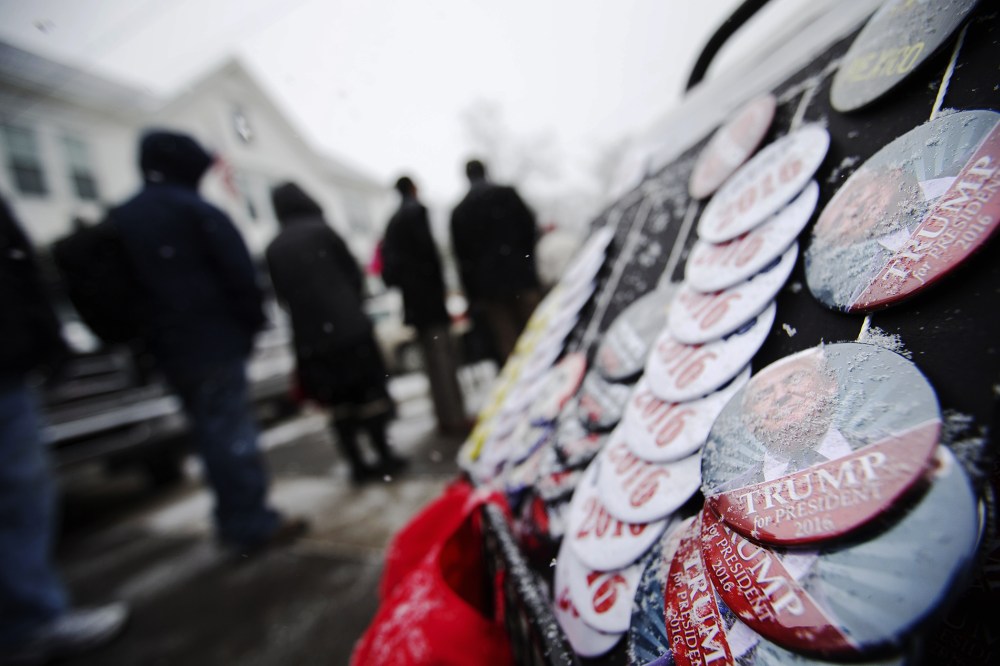
For months, the political world has been consumed by the question of whether Donald Trump — that guy??? — could really win the GOP nomination. Now Republicans and Democrats alike are starting to ask the next question: What happens if he makes it to the general election?
Approaching Trump as his party’s nominee is difficult because he’s already confounded so many political expectations to get to the point he is now. What is clear, however, is that the wealthy real estate mogul has not had to face the type of attacks that are likely to come his way in a general election, nor has he weathered anything close to the scale of negative ads he’d have to endure to succeed. For a variety of reasons, rival GOP candidates and their donor allies have overwhelmingly spent their ad money bashing each other rather than Trump, hoping to winnow down the field before taking the on the front-runner one-on-one.
For the latest news from New Hampshire click here
Conversations with strategists in both parties reveal two tough angles in particular that Trump will have to overcome should he go up against Democrats in the general election.
Puncturing the populism
Trump’s biggest superpower in the GOP primaries, the one that may propel him to the nomination, is his ability to connect with blue-collar white voters. He’s promised to lift those voters up while waging war on their perceived enemies: China abroad, immigrants at home, and elites everywhere.
RELATED: Trump calls supporter’s use of epithet a ‘great moment’
To some Democrats and Republicans, the obvious play then is to try and wreck the myth of “Donald Trump: Working Class Hero.” That means an onslaught of ads casting him as a heartless businessman stomping on the weak: Things like trying to kick veteran vendors off his street, suing an elderly widow to turn her home into a parking lot, applying to bring in foreign workers while decrying them on the trail for stealing jobs. He’s also complained during the campaign that “wages [are] too high” in America to compete with China.
It took awhile, but you’re starting to see this angle from some Republican groups and candidates. Liz Mair, the GOP strategist behind the anti-Trump Make America Awesome PAC, told MSNBC it’s the only angle that works in focus groups. The group’s current slogan in New Hampshire ads: “He’s For Trump: Not Us.”
This is only half of the attack Trump would face from Democrats, however. The critical second part is something Republicans can’t deploy for ideological and political reasons: Trump’s policies would make him personally a whole lot richer.
Trump’s sweeping multi-trillion dollar tax plan would massively benefit him, his business empire, and especially his globetrotting safari-hunting heirs who would pay zero taxes on their inheritance. Why don’t the other candidates bring it up? They’re promising similarly lavish tax breaks for the one percent.
It didn’t attract much notice at the time, but Bernie Sanders has already targeted Trump with this exact frame.
“This is a guy who does not want to raise the minimum wage,” the Democratic candidate said in a CBS interview in December. “In fact, he has said that he thinks wages in America are too high. But he does want to give hundreds of billions of dollars in tax breaks to the top three-tenths of 1 percent.”
That line touched a nerve with Trump, who responded on Twitter by abandoning his “wages” remark (which he made on camera at two separate points) and claiming it was misinterpreted. He can expect to face a crush of ads with those clips as well as him boasting “I fight like hell to pay as little as possible” when he debuted his tax plan.
Prominent Clinton allies are predicting an offensive along these lines, according to a Politico report, which they liken to the ferocious attacks on layoffs and bankruptcies at Bain Capital that helped drag down Mitt Romney in 2012.
Obama campaign veterans always insisted that the special sauce to the attacks against Romney was the broader argument that Republican policies would only enrich people like him. Romney anticipated the attacks and pledged early on not to use loopholes to try and lower his own tax bill, which created problems of its own. Trump has left himself wide open and relied on his “authenticity” to repel attacks, but there’s no telling if it will work outside of his base.
Building a backlash
Others within the Democratic Party put less stock in a Bain-style attack targeting Trump’s blue-collar white support. The more important task, they argue, is using Trump’s words and positions to fire up the Democratic base.
The top goal for Democrats in 2016 is to keep up their margins and turnout with the Obama coalition: Single women, Latinos, and African Americans. If they show up, Republicans will have to push their share of the white vote to new heights, giving them only a narrow path to victory. Trump has antagonized every single group in the Obama coalition. All Democrats have to do, the thinking goes, is remind them with a series of parallel campaigns narrowly aimed at each group. RELATED: Why a Donald Trump win in New Hampshire would be big “I truly believe these targeted demographic attacks are going to be the most important ones,” one top Democratic strategist told MSNBC. “It’s hard to imagine who he’s left uncovered at this point.” While Republicans have castigated Trump for bigotry at points, minority voters are mostly a bit player in GOP primary contests and rivals’ attacks against him have been far more muted than anything that would come his way in a general election. Expect Trump calling undocumented immigrants “rapists” to play on Hispanic media 24/7, his flirtations with apparent white supremacists to run on black radio stations, and a greatest hits of his most sexist moments everywhere. Surrogates would blitz the news making the same case to each slice of the electorate individually. “Trying to win a primary in primary campaign where the base of the party votes is very different than winning a general election,” Clinton strategist Joel Benenson told MSNBC, citing the significant demographic differences. About 89 percent of all Republican voters in the 2012 presidential election were white, per exit polls, but the overall electorate was only 72 percent white and that number is projected to drop another two points in 2016 thanks to population trends. Moreover, Trump’s support is most concentrated among non-college educated white voters, a group whose share of the electorate is on the decline. Trump’s boasted that he’ll win the majority of Latinos and African Americans come November, but current polling supports the notion that he’s isolated himself even as he’s driven his own support up within the GOP. Recent Gallup polling found 60 percent of Americans had an unfavorable view of Trump, far higher than previous nominees in either party. He’s been a bogeyman in Spanish-language news for months and his poll numbers with Latino voters are poisonously low even at a point when most Americans usually don’t tune in closely to the election. The caveat is that Trump was similarly unpopular in polls of Republican voters when he started his campaign and he managed to clean up his image. Reintroducing himself to the broader public will be tougher when he’s been the top news story in the country for months, but he’s proven his doubters wrong plenty of times already. He’s also proven competitive in some early general election polls. Make no mistake, though: The toughest hits have yet to come.
Benjy Sarlin
Alex Seitz-Wald Recommended


