








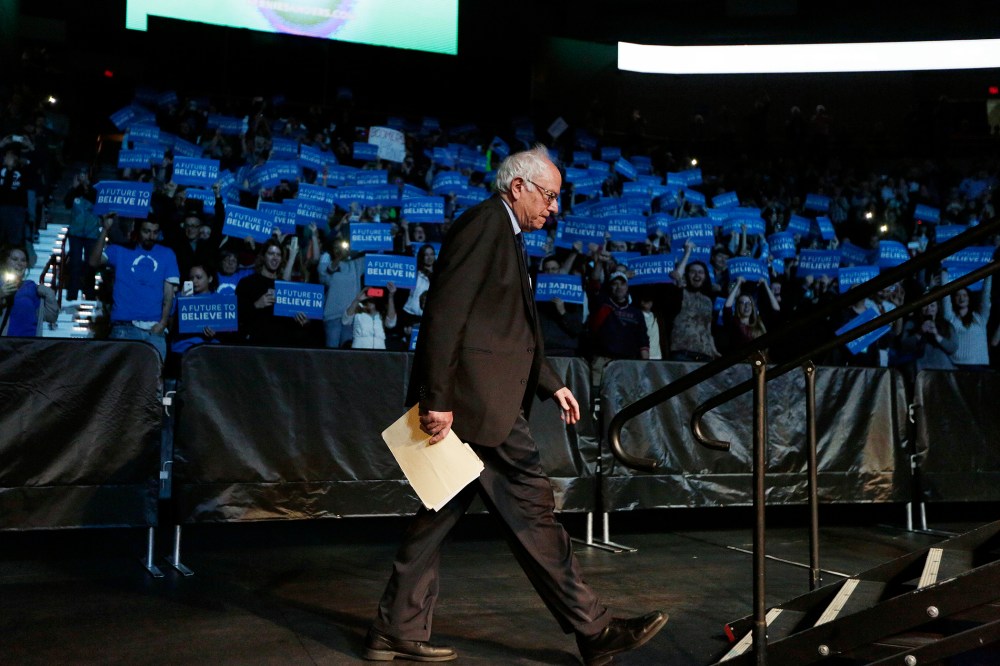
Bernie Sanders isn’t going anywhere, despite Hillary Clinton’s prohibitive delegate lead, and last Tuesday night offers a hint why. But the underdog’s path forward carries risks as well as challenges.
Even though Sanders came up short in Arizona, where his campaign invested most heavily, the Vermont senator ended up netting 17 delegates over Clinton Tuesday, thanks to lopsided wins in the Idaho and Utah caucuses.
He ended up taking away a tidy 57 percent of the pledged delegates up for grabs that day. And as it happens, 58% is the percentage of outstanding pledged delegates Sanders needs to win from now on in order to finish the primary calendar with more pledged delegates than Hillary Clinton, according to an NBC News analysis.
On Saturday, Sanders is hoping to win an even larger portion of the delegates in Washington state, which holds the largest caucus of the entire year, with 101 delegates at stake. Alaska and Hawaii will also hold caucuses, which Sanders also hopes to win Saturday.
RELATED: Sanders wins overshadowed by Arizona loss
Getting 58 percent of remaining pledged delegates is a tall order. And it wouldn’t get him to the nomination necessarily, since Clinton holds a huge lead among superdelegates.
But it’s at least doable. “We’re trying to win more pledged delegates by the end,” Sanders senior strategist Tad Devine told MSNBC Friday. “If we can demonstrate that he is the strongest candidate by defeating her in these states, a lot of superdelegates are going to take a step back and say, ‘What’s the right thing to do?’ And that’s when we will try to persuade them.”
Getting a majority of all delegates, including superdelegates, and winning the nomination outright would require Sanders to win two out of every three remaining pledged delegates through the end of the race, according to the NBC News analysis.
That’s virtually impossible, Sanders allies acknowledge. Winning a majority of pledged delegates is difficult. “The first half of the calendar favored Secretary Clinton. The second half will favor Bernie,” said Joe Dinkin, the communications director of the Working Families Party, which backs Sanders. “If that continues, Bernie can win the majority of pledged delegates.”
To get there, Sanders is relying heavily on caucus states like Washington, as they offer his best chance to eat into Clinton’s delegate lead.
Sanders has won seven out of nine caucus contests held so far, and he lost Iowa by only the thinnest of margins. And his victory margins have generally been larger in caucuses than in primaries, winning Idaho and Utah by roughly 80 percent to 20 percent. Big margins are crucial to racking up delegates in the party’s proportional allocation system.
But while the caucus format tends to favor Sanders, it also imposes barriers to voter participation that could be seen as at odds to his core message.
In fact, Sanders does well in caucuses largely because they’re more time intensive and complicated than primaries, requiring voters to assemble at one of a relatively small number of locations at a certain time and stay for several hours.
The added hassle favors candidates with the most enthusiastic supporters, since less dedicated voters tend to stay home. In Kansas for instance, some people had to drive 100 miles to get to their caucus locations.
In 2008, when Barack Obama focused on caucuses as a means to beat Clinton, caucus turnout reached all-time highs. But the average caucus attracted less than a quarter the number of participants as did the average primary that year, according to a Harvard University study.
In Iowa, for instance, where participation shattered all previous records, turnout was still only 16.3 percent of eligible voters for both parties. And that was high for caucuses: “It was easily the highest percentage ever recorded for a presidential caucus, and about eight times the average for such contests,” according to the study. Across all 12 states that held caucuses for both parties, the average turnout rate was just 6.8 percent. This year, about 80,000 more people participated in New Hampshire’s primary than in Iowa’s caucus, even though the Granite State’s population is two-and-a-half times smaller. Utah, which Sanders dominated this week, did away with its primary and held a caucus this year. Despite long lines and anecdotal reports of high turnout, statewide turnout actually dropped from 428,000 in 2008 to 280,000 Tuesday for both parties. Sanders’ campaign is all about fomenting a popular political revolution that gets more people involved in politics. “When we began this campaign, we talked about the need for millions of people to become involved in the political process,” he said Tuesday night, repeating a common refrain. This week especially, Sanders has focused on breaking down barriers to voting, after major problems in Arizona kept lots of people from voting. “We need to make it easier to vote, not more difficult,” Sanders said in a fundraising email Thursday. The reliance on caucuses complicates the messages, critics say. “Caucuses are profoundly undemocratic,” said Rick Hasen, an elections law expert at the University of California Irvine. “For those who care about expanding democracy, caucuses are problematic.” “They can disenfranchise the poor who have to work, the disabled who cannot get to a physical polling site, and our military and other overseas Americans who are not in a state for caucus day. They are often run by party amateurs, leading to vote counting and other problems that can inadvertently disenfranchise more voters,” Hasen said. Of course, Sanders didn’t create caucuses or have any role in states’ decision to adopt them. And has never said they are a better form of election than a primary. He’s only taking advantage of the system as he found it, the same way Obama did in 2008. But he also hasn’t spoken out against them, which perhaps he would if he didn’t have to depend on them.
Alex Seitz-Wald Recommended


