








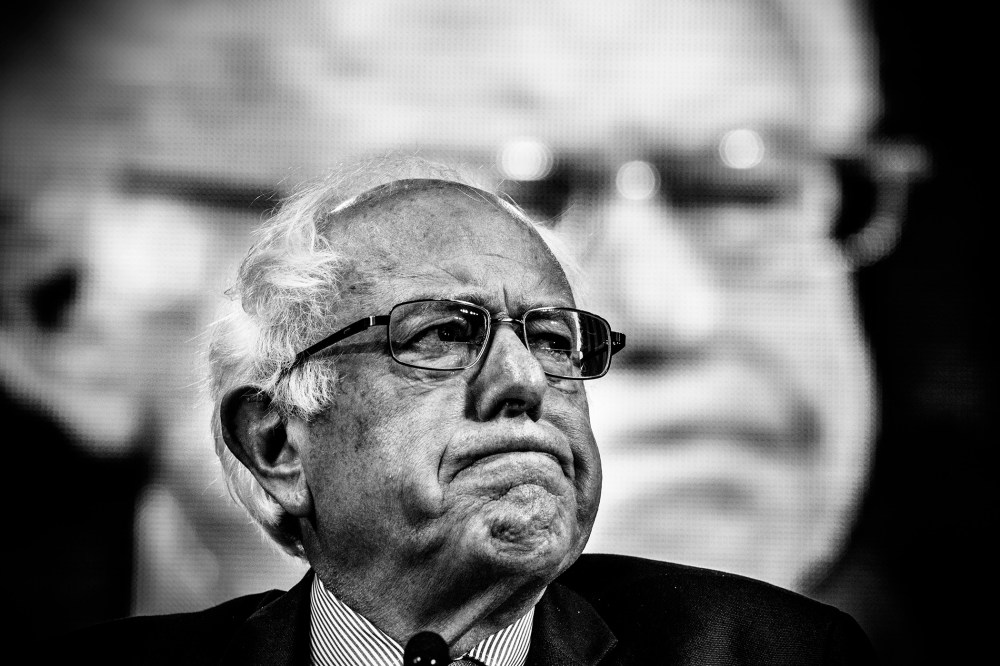
KEENE, New Hampshire — Declaring that his campaign “made history” Monday night in Iowa, Democratic presidential candidate Bernie Sanders refused to concede the state’s caucuses Tuesday in New Hampshire as he claimed momentum in the homestretch before the Granite State’s first-in-the-nation primary next week.
Sanders didn’t win Iowa’s caucuses, but he closed an enormous gap to come within just 0.2 percent short of the Democratic front-runner Hillary Clinton. Meanwhile, in New Hampshire, Sanders has been leading the polls for months, thanks in part to hailing from the state next door.
RELATED: Clinton ready to compete in Bernie’s ‘backyard’
“Last night in Iowa, we took on the most powerful political organization in the country,” Sanders said to almost 1,200 excited supporters at a theater in Keene, N.H. “Last night we came back from a 50 point deficit in the polls. And last night we began the political revolution, not just in Iowa, not just in New Hampshire, but all over this country.”
Sanders insisted that he “slept like a log last night,” despite taking a redeye charter flight to New Hampshire from Iowa, and addressing supporters from the back of a flatbed truck at a pre-dawn rally.
His campaign and outside allies were eager to paint the narrow loss in Iowa as win, even as Clinton’s forces raised doubts as to whether Sanders could win elsewhere if he lost a state so tailor-made to his candidacy.
“In this case, it’s a virtual tie, and to the campaign and to me, that’s a win,” Rep. Raul Grijalva, one two members of Congress backing Sanders, told MSNBC. “Any question of legitimacy is gone.”
Speaking with an unusually large scrum of reporters Tuesday evening after his speech, Sanders touted the outcome in Iowa, which saw the narrowest margin of any Democratic presidential caucus in history.
Asked by MSNBC if he was going to contest the results, he said he was considering it: “We haven’t had the time to analyze it, but our people in Iowa are taking a look at that.”
His campaign has been raising doubts about process for days, and he said he thought it was “unfortunate” that some county-level delegates were assigned by the toss of coin. Coin tosses almost certainly did not influence the outcome of the race: The Iowa Democratic Party now says Sanders won six out of seven coin-flips in the state, but a count by Des Moines Register reversed that number in Clinton’s favor.
There is no formal process for contesting Iowa caucus results, since it is not an official election run by the state, but the private business of political parties. A Sanders aide said they were exploring their options, but a source outside the campaign said the only way to contest the results may be to sue the party.
WATCH NOW: Iowa results a ‘significant victory’ for Sanders
Sanders’ team in Iowa has also been investigating videos posted to social media allegedly showing precincts where recounts were denied, according to an aide.
Earlier in the day, Sanders called on the Iowa Democratic Party to release the raw vote total of caucus-goers who supported each candidate. The party only reports how many delegates each candidates won, which is determined by a complex mathematical formula, not raw support. It’s theoretically possible for a candidate to have more supporters but lose on delegates, which are what helps determine who gets the nomination.
The Democratic Party quickly batted down the idea of releasing the raw vote. “The Iowa Democratic Caucuses are not a primary — candidates are awarded delegates, not raw votes. In fact, because of our realignment process, raw vote totals are not recorded. As we have always done, and as we have always told the campaigns we would do, we have released state delegate equivalents earned by each candidate,” Iowa Democratic Party spokesperson Sam Lau said in a statement to MSNBC. Meanwhile Sanders was noncommittal about whether he would attend an MSNBC debate scheduled for Thursday, saying his participation was dependent on Clinton agreeing to host another debate in New York. “I am a little bit amazed that Secretary Clinton does not want to have a debate in the state she represented for seven years in the Senate,” Sanders told reporters. The MSNBC debate was added last week to the six debates previously sanctioned by the Democratic National Committee. But Sanders, as the front-runner in New Hampshire, is clearly reluctant to participate and risk jeopardizing his lead. He demanded three additional debates ahead of contests where he is the underdog, saying he wants to join Clinton on stage in California, Michigan, and New York, which each have a large number of nominating delegates. “I hope and expect this thing will be resolved,” he added with just two days to go before the New Hampshire debate. “But that’s not definite yet… We’re still working on the details.” Clinton on Tuesday presented herself as the underdog in New Hampshire, telling MSNBC’s Chris Matthews it was “Senator Sanders’ backyard,” since he represents neighboring Vermont in the Senate. RELATED: Sanders celebrates virtual tie with Clinton With polls showing Sanders holding a double digit lead over Clinton in the Granite State, an otherwise bullish Sanders tried to temper expectations a bit. He said that Clinton had a very “formidable” organization in the state in 2008, noted that she unexpectedly won the state eight years ago and that it was also the state that gave Bill Clinton critical leg up when it made him the “comeback kid” of 1992 presidential run. Sanders showed he came ready to compete with Clinton. Asked by MSNBC’s Kasie Hunt if he thought Clinton was a progressive, Sanders did not mince words. “Some days, yeah [she’s a progressive],” he said, “except when she announces that she is a proud moderate. And then I guess she’s not a progressive. I think, frankly, it is very hard to be a real progressive and to take on the establishment in the way I think it has to be taken on. When you become as dependent as she has other super-PAC and in other ways on Wall Street and drug companies.”
Alex Seitz-Wald Recommended


