








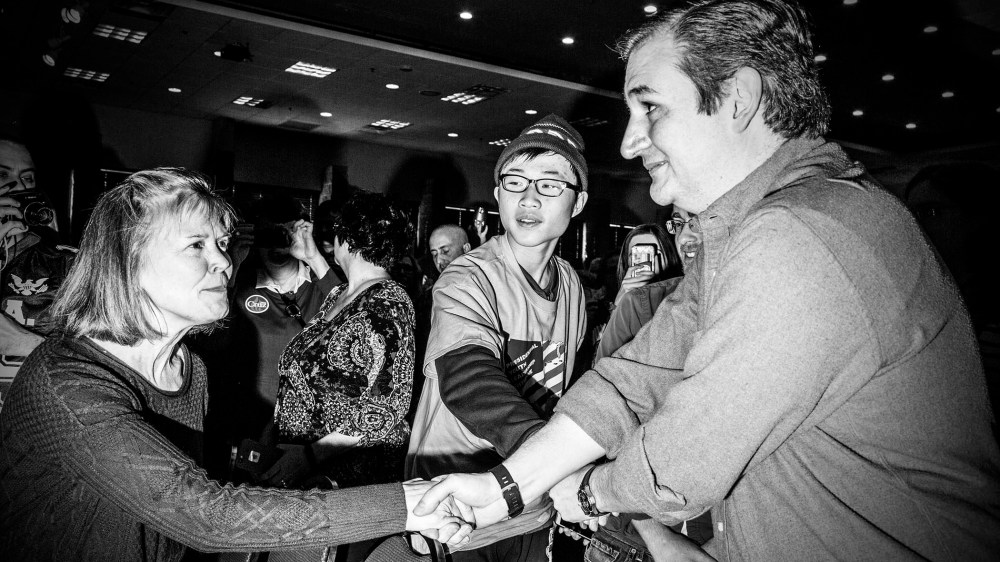
DES MOINES, Iowa – Texas Sen. Ted Cruz won the hotly contested Iowa Republican caucus on Monday night, fending off a tough challenge from Donald Trump and Florida Sen. Marco Rubio.
With 99% of precincts in, Cruz led with 28% of the vote versus 24% for Trump, 23% for Rubio, and 9% for fourth-place Dr. Ben Carson.
Iowa Caucus: Click here for complete coverage and live updates
The caucus was the first battle in a bitter civil war within the Republican Party over competing ideologies and general election strategies.
Cruz ran on a pledge to faithfully represent the grassroots right, who he argued would respond by turning out in greater numbers in the general election. Rubio, solidly conservative himself, argued he could bring voters who had backed Democrats in the past into the GOP field with a more universal message that emphasized his son-of-immigrants biography.
Trump took a completely different path, ignoring GOP tradition in favor of a swaggering populist appeal that targeted independents and loose partisans who are disillusioned with politics entirely.
The candidates will move on to New Hampshire next, which votes on February 9. Polls for months have shown Trump with a dominant lead there with Rubio and Cruz competing with a handful of candidates for a distant second. Rubio may have the most to gain from his performance as he’s struggled to distinguish himself in the Granite State from Florida Governor Jeb Bush, New Jersey Governor Chris Christie, and Ohio Governor John Kasich, all of whom have positioned themselves as mainstream alternatives to Cruz and Trump. The three governors each finished in the low single-digits in Iowa on Monday.
The results represented a personal triumph for Cruz, who appeared to have lost his lead in polls to Trump in the race’s final days. The billionaire real estate mogul mercilessly attacked Cruz in speeches across the state over his use of a $1 million loan from Goldman Sachs to fund his 2012 Senate race as well as his Canadian birthplace, which Trump said cast a cloud over his eligibility for president.
In the end, however, Cruz’s grunt work in the state paid off. He visited all 99 counties in the state, built a volunteer army, and corralled key endorsements from the state’s most prominent social conservative leaders.
Elected in 2012, Cruz distinguished himself within the GOP by rallying conservatives to pressure party leaders into a scorched earth campaign against Obama’s agenda, culminating in the 2013 government shutdown over health care. The effort won him few friends in the Senate, who derided his efforts as cynical grandstanding, but raised his profile among the hardline conservatives who form the backbone of his candidacy.
He carried a similar message into Iowa, where he touted himself as the most consistent conservative in the race and pledged an all-out effort to undo President Obama’s policies, including repealing the Affordable Care Act, ending the Iranian nuclear deal, and reversing executive orders shielding some undocumented immigrants from deportation.
Trump’s second-place performance was a disappointment given that a number of surveys, including the prestigious Des Moines Register poll, showed him with a lead over Cruz. His reliance on non-traditional voters raised questions about his ability to turn out supporters, questions that will follow him past Iowa given the results.
At the same time, the New York billionaire finally demonstrated substantial support from actual voters — and not just poll respondents — for his platform of building a border wall, deporting all undocumented immigrants, renegotiating trade deals, temporarily banning Muslims from entering the country, and challenging “political correctness” in all forms.
In a departure from his usually derisive tone, Trump conceded the Iowa race to Cruz in a brief speech to supporters in West Des Moines on Monday night. “I’m just honored, I’m really honored and I want to congratulate Ted and I want to congratulate all of the incredible candidates,” he said. His unorthodox approach to the race defied political convention in almost every way. In a state known for its deeply Christian voters, Trump was a thrice-married casino billionaire who previously identified as pro-choice and told Iowans he refused to pray for forgiveness. He flouted conservative orthodoxy on issues like health care, where he called for universal coverage. He feuded with the right’s most dominant news outlet Fox News, even skipping a debate hosted by the network just days before the Iowa caucus. In a party known for its emphasis on national security, Trump said former Republican nominee John McCain was “not a war hero” because McCain was captured by the Vietcong. Republican leaders are anxious about the party’s appeal to immigrant communities, minority voters, and women, all of whom broke heavily for President Obama in 2012 and all of whom Trump seems uniquely positioned to antagonize. He claimed, against all evidence, that the Mexican government was deliberately flooding the country with “rapists” and “criminals.” He claimed, again without evidence, that he personally witnessed “thousands” of Muslim Americans cheering the 9/11 attacks on television. In the final days before the caucus, he derided his Hispanic opponent Cruz as an “anchor baby.” His Twitter account, followed by millions, regularly passed on disturbing messages from supporters that included a blatantly racist hoax, misogynist slurs against women who provoked his ire, and recently a tweet from a neo-Nazi user named “White Genocide.” For Rubio, the results were the biggest triumph of the night relative to expectation. Polls showed him performing substantially worse in the days, weeks, and months leading up to the caucuses but he nearly overtook Trump in the initial vote count. He was buoyed by a strong debate performance Thursday and an aggressive effort to win over evangelicals with faith-based appeals in the final days of the race. Rubio, the son of Cuban immigrants in Florida, became a tea party icon in 2010 when he upset the moderate then-Republican Governor Charlie Crist to win the GOP Senate nomination. He broke with supporters on the right in 2013 to co-author a legislation that would have granted a path to citizenship to undocumented immigrants. It passed the senate, died in the House thanks to conservative opposition, prompting Rubio to abandon his own proposal in favor of an incremental approach. Rubio gradually rebuilt his image within the party and campaigned as a fresh face who could appeal to the party’s “three-legged stool” of social conservatives, foreign policy conservatives, and business conservatives while winning new supporters to the party. While pundits and Republican insiders have long pegged him as a serious threat to win the nomination, his candidacy had yet to catch fire either in polls or with smalls donors. The results in Iowa are the most concrete sign yet that his efforts may be paying off and bolster his case to voters in New Hampshire that he’s the strongest alternative for voters wary of Cruz and Trump. With Iowa’s results banked, the GOP’s historically large field could begin to winnow. Mike Huckabee, the Iowa caucus winner in 2008, suspended his campaign Monday night after a poor showing this time. Dr. Ben Carson also put a strong emphasis on Iowa and his campaign had to issue a statement Monday denying he would drop out after the candidate surprisingly revealed he was going home to Florida for a rest before hitting the campaign trail again.
Benjy Sarlin Recommended


