








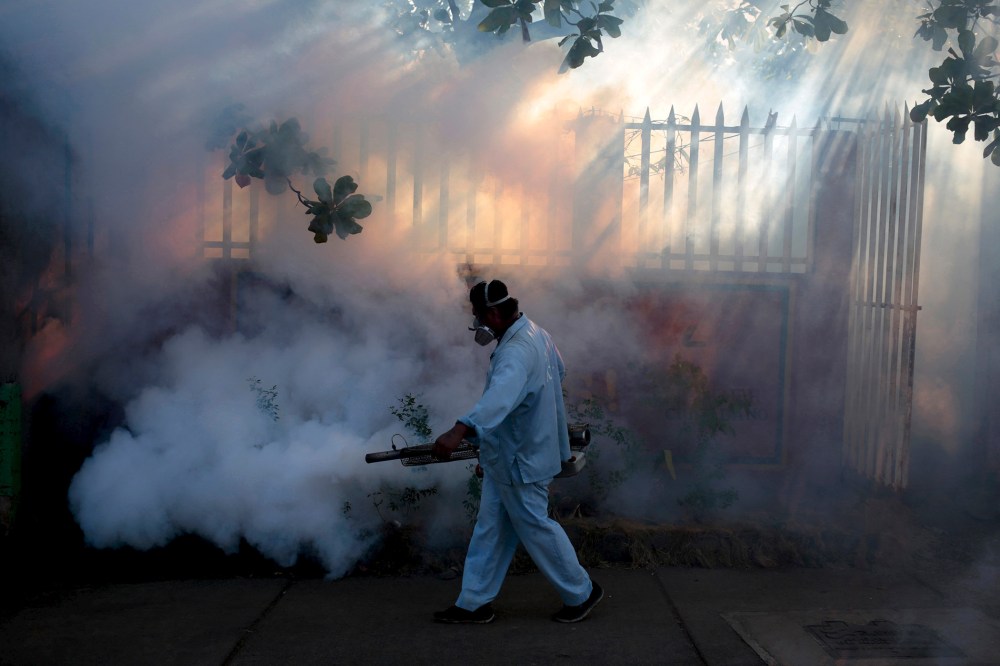
The World Health Organization is calling a top-level meeting about Zika virus next week, to decide whether the fast spread of the virus is a global emergency.
Here are five important facts about the virus:
It’s likely to spread fast and far
Zika’s already in two dozen countries in the Americas and WHO says the virus is likely to end up in almost every country in the Americas.
Anyone curious about how far Zika will spread need only look at chikungunya. Chikungunya had never been seen outside Africa and parts of Southeast Asia until about 2005. It spread quickly after that and once it hit the western hemisphere it took just months to spread across the Caribbean to central and then South America. Experts fully expect chikungunya to establish itself in the southern U.S. at some point. One piece of good news for the U.S. is that Zika is not likely to spread as fast as West Nile virus did. West Nile virus, which has reached all of continental North America since it was first seen in New York in 1999, lives in birds and infects many more different species of mosquitoes, giving it more places to lurk. Zika doesn’t do that.
It rarely causes serious symptoms
Zika has flown under most people’s radar until now because it usually causes such mild symptoms that 80 percent of infected people don’t even notice it. Symptoms include a rash, a fever, sometimes conjunctivitis and headache. It may occasionally cause a rare neurological condition called Guillain-Barre syndrome that’s sometimes seen after an infection.
It’s spread by mosquitoes
Zika is spread by the Aedes genus of mosquitoes, mainly the Aedes aegypti mosquito, which also spreads dengue virus, yellow fever virus and Chikungunya. It can also in theory be spread by Aedes albopictus mosquitoes, commonly known as the Asian tiger mosquito. Aedes aegypti are restricted to tropical and subtropical regions but that’s a broad area – as far north as Georgia and South Carolina in the United States.
The Asian tiger mosquitoes have an even bigger range and are found across the entire southeastern U.S., into Missouri and Oklahoma and as far north as New York and into temperate areas of South America.
People infected with Zika virus don’t infect one another directly — with the rare possibility that semen may carry the virus. But, just as with malaria, people are the source for spreading the virus. A female mosquito bites an infected person and then can carry the virus to the next person she bites, so when people travel, they can bring the virus with them. The virus can take hold if enough people become infected for it to become endemic — a word meaning it’s in a region permanently.
As with all mosquito-borne infections, the best way to control Zika is to control mosquitoes. It’s suspected of causing birth defects U.S. officials have issued a travel advisory saying pregnant women might want to postpone travel to Zika-affected regions. Zika’s strongly suspected of causing a severe birth defect called microcephaly, which causes underdevelopment of the head and brain. Babies with microcephaly often miscarry before they are born, or they die at birth. Those who survive are usually very disabled. Other viruses are known to cause microcephaly if a pregnant woman is infected — rubella is the most notorious. But a rise in birth defects had not been noticed in countries that had Zika previously. Something’s definitely causing more cases in Brazil; 3,800 cases were seen in recent months. There are some smoking guns — the virus has been found in some babies born with microcephaly or in their mothers. But it’s hard to test for Zika and there’s no quick, on-the-spot test, making research difficult. no one knows if certain mothers are more vulnerable and it’s not clear what stage in pregnancy might be the most dangerous for an infection to occur. There’s no treatment and no vaccine As with so many viruses, there is no specific treatment for Zika. Antibiotics can treat a range of bacterial infections but the same is not true of antiviral drugs. There had not been any market for a drug to treat Zika since it did not seem to cause severe health problems. There’s also no vaccine, for the same reason. But experts say it should be easy to make a vaccine against Zika. This story originally appeared on NBCNews.com
Maggie Fox Recommended


