








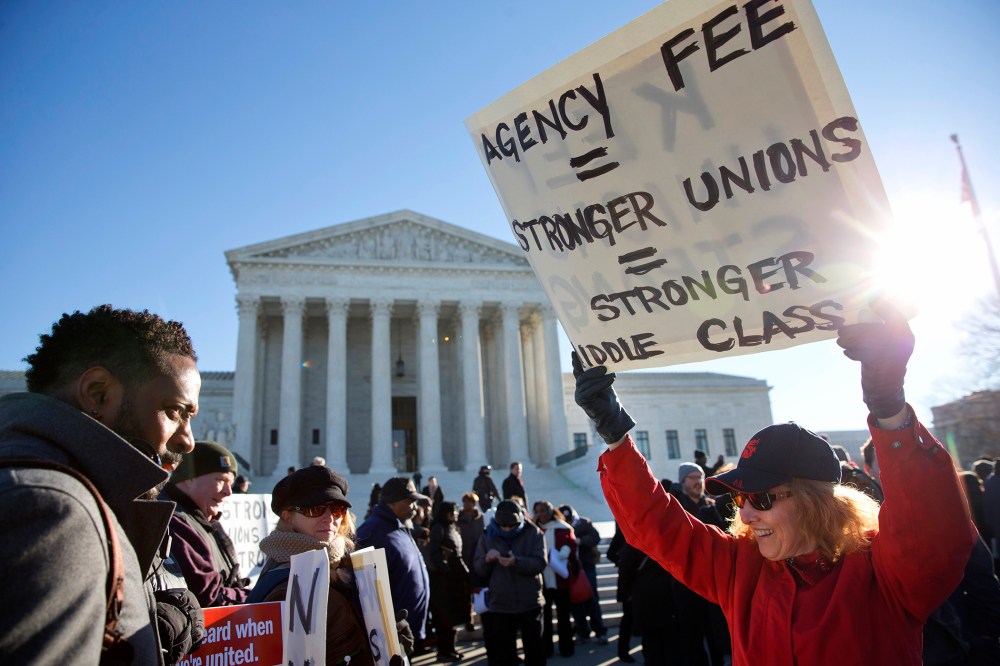
WASHINGTON — For the California teachers’ unions pleading their case at the Supreme Court Monday morning — in a case that could impact public sector unions across the country — the math just didn’t add up. All five conservative justices expressed their exasperation at the argument that unions should be able to charge non-members for collective bargaining, and showed sympathy for the teachers who went to court to say such fees violate their First Amendment rights.
Justice Anthony Kennedy, who sometimes votes with the Democratic appointees, but rarely on issues he perceives to be First Amendment-related, seemed the most sympathetic of all to the plaintiffs.
RELATED: Will SCOTUS gut public sector unions?
“The union basically is making these teachers compelled riders for issues on which they strongly disagree,” he said, essentially adopting the plaintiffs’ argument. “Many teachers think that they are devoted to the future of America, to the future of our young people, and that the union is equally devoted to that, but that the union is absolutely wrong in some of its positions. And agency fees require, as I understand it — correct me if I’m wrong — agency fees require that employees and teachers who disagree with those positions must nevertheless subsidize the union on those very points.”
Some reports speculated before the argument that, based on comments Justice Antonin Scalia had made in previous union-related oral arguments, he might be willing to vote on the unions’ behalf. The 80-minute argument swiftly refuted that theory. He did not sound persuaded by the unions’ and the federal and California governments’ argument that collective bargaining isn’t political activity because it simply governs workplace conditions.
“The problem is that everything that is collectively bargained with the government is within the political sphere, almost by definition,” Scalia said. “Should the government pay higher wages or lesser wages? Should it promote teachers on the basis of seniority or on the basis of — all of those questions are necessarily political questions.” He did add the qualifier, “That’s the major argument made by the other side,” but that comment and others implied he was persuaded by it.
The plaintiffs in the case, backed by business and libertarian groups, have asked the Supreme Court to outright overrule its 1977 precedent Abood v. Detroit Board of Education, which said that public sector unions could charge fees to non-members without violating the First Amendment if they separated out collective bargaining for labor conditions from their political or lobbying activities. If the Supreme Court reverses itself on the question, it is expected to vastly dilute the resources and power of public sector unions, as non-members will have no reason to pay them fees even if they reap benefits from the unions’ negotiations. In about half of states, known as right-to-work states, this is already the case.
On Monday, several of the more liberal justices were mostly reduced to arguing that the teachers’ case doesn’t meet the court’s traditional standard for overruling its own precedent, and that overruling Abood would be too disruptive. “It would require overruling a host of other cases, I think, at least two or three that I can find, and that’s quite a big deal,” said Justice Stephen Breyer. The court is supposed to adhere to stare decisis, a deference to its own precedent that ensures continuity and predictability. “What is it, in your mind, that you can say from the point of view of this court’s role in this society,” Breyer later asked, “in that if, of course, we can overrule a compromise that was worked out over 40 years and has lasted reasonably well — not perfectly. I guess people could overrule our decisions just as easily … You start overruling things, what happens to the country thinking of us as a kind of stability in a world that is tough because it changes a lot?” On this matter, in a term in which the court will also consider abortion rights, affirmative action, and competing claims of religious liberty and women’s health, changing a lot seems pretty certain.
Irin Carmon Recommended


