








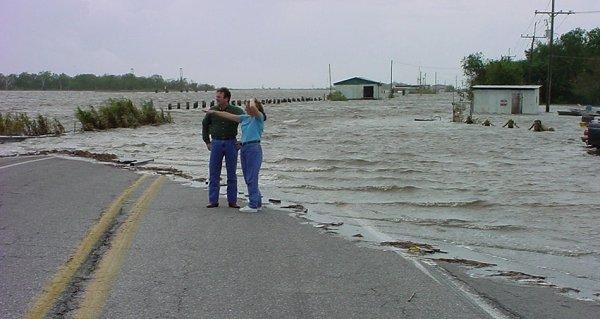
Jeff Goodell recently had an item in Rolling Stone that caught my attention. Goodell wrote a piece on rising sea levels that will very likely, in years to come, drown South Florida — a problem that cannot be solved with sea walls and fresh sand. “Miami, as we know it today, is doomed,” Harold Wanless, the chairman of the department of geological sciences at the University of Miami, told Goodell. “It’s not a question of if. It’s a question of when.” As a Miami native, I found it rather terrifying.
And I thought of the article after seeing this report.
A rise in sea levels threatens the viability of more than 1,400 cities and towns, including Miami, Virginia Beach and Jacksonville, unless there are deep cuts in heat-trapping greenhouse gas emissions, says an analysis out Monday.
Prior emissions have already locked in 4 feet of future sea-level rise that will submerge parts of 316 municipalities, but the timing is unclear and could take hundreds of years, according to the paper in the Proceedings of the National Academy of Sciences. If global warming continues at its current rate through the year 2100, at least an additional 1,100 cities and towns will be mostly under water at high tide in the distant future.
“It’s like this invisible threat,” says author Benjamin Strauss, a scientist at Climate Central, a non-profit, non-advocacy research group based in Princeton, N.J., that’s funded by foundations, individuals and federal grants.
That joke about rising sea levels at the Republican National Convention last year looks even less funny as time goes on.
Indeed, the political angle to this, unfortunately, matters quite a bit.
Last year, state Republican lawmakers in Virginia insisted on changing the “sea level rise” study in the General Assembly to one on “recurrent flooding.” Why? Because according to one GOP official, “sea level rise” is a “left-wing term” that people shouldn’t use. That same month, state Republican lawmakers in North Carolina went even further. A state-appointed science panel warned officials that sea levels will rise 39 inches over the next century and said North Carolina needs to prepare. Republicans balked — officials would be prohibited from relying on the scientific evidence, and would instead have to use a historical model to set expectations. North Carolina would prepare for only 8 inches of sea level increase, since that’s what happened over the last century. I realize that the Strauss report is just one study, and that there’s competing research that offers different results. But the evidence pointing to rising sea levels is overwhelming no matter which source you rely on, and it’s a reminder of just how serious the climate crisis really is. The risk posed by those who’d prefer to stick their heads in the sand is hard to overstate.
The place for in-depth analysis, commentary and informed perspectives. Recommended


