








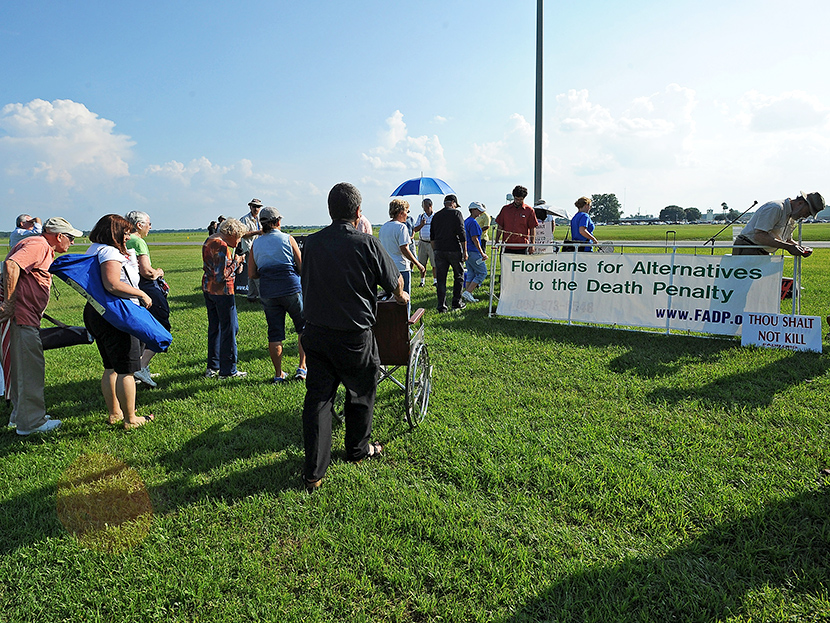
No legal intervention halted the execution of the “Prince of God,” convicted killer and diagnosed paranoid schizophrenic John Errol Ferguson Monday.
Florida executed the convicted mass murderer at 6:17 p.m ET Monday after the U.S. Supreme Court opted not to get involved. After more than 30 years on death row and back-and-forth legal wrangling, Ferguson died by lethal injection at Florida State Prison.
The 65-year-old was found guilty of murdering eight people, including two teenagers, in two different incidents in 1977 and 1978 following his release from a state mental hospital.
In a last-ditch attempt to block the execution, Ferguson’s legal team appealed to the nation’s highest court. His lawyers argued executing Ferguson, who has suffered from a long history of severe mental illness, violates the Eighth Amendment’s ban on cruel and unusual punishment. Ferguson believed that he was a “Prince of God” and, upon his death, would rise up to save Americans from a communist plot.
Working through the final hours, Ferguson’s attorney Christopher Handman maintained his client was “insane and incompetent for execution.”
“We are gravely disappointed that the U.S. Supreme Court denied John Ferguson’s request to clarify the standard for evaluating an individual’s competence to be executed and denied his request to invoke the Court’s categorical bar on the execution of the insane,” Handman said Monday in a written statement. “Mr. Ferguson has a documented 40-year history of severe mental illness diagnosed repeatedly by state doctors in state institutions. Mr. Ferguson has been profoundly mentally ill for four decades, pre-dating the crimes for which he is scheduled to be executed, but is now deemed suddenly and inexplicably cured.”
In the 2007 case Panetti v. Quarterman, the Supreme Court ruled that a convicted killer must have a rational understanding of why he or she is being put to death and the ultimate impact of execution: that is, death.
The American Bar Association and The National Alliance on Mental Illness (NAMI) along with three Florida mental health organizations, filed amicus briefs in support of Ferguson, urging the Supreme Court to grant a stay of execution. But the deadline for the Supreme Court came and went.
“The death penalty is not constitutionally allowable as a punishment for John Ferguson because his delusions prevent him from understanding the nature of what is happening to him,” said Ron Honberg, J.D., NAMI’s national director of policy and legal affairs in a press release. “The constitutional principle does not excuse his crimes, but it does point to life without parole as the appropriate sentence.”
In May, the 11th U.S. Circuit Court of Appeals sided with an earlier ruling by Florida’s State Supreme Court, declaring that the 65-year-old still had a rational comprehension of the crimes and the reasons for the execution, and therefore, could still be eligible for execution. The federal appeals court wrote in its 65-page opinion, “That most people would characterize Ferguson’s Prince-of-God belief, in the vernacular, as ‘crazy’ does not mean that someone who holds that belief is not competent to be executed.” The court stated that he was “mentally competent to be executed despite his mental illness and the presence of a delusional belief.” Baylor Johnson, a spokesman for the ACLU of Florida, told msnbc in a statement, “This execution comes at a time when there is already growing doubt about the accuracy, legality and morality of Florida’s death penalty system. Our state putting a severely mentally ill person to death in spite of the constitutional prohibition only serves to feed that doubt.” He noted, “Constitutional law is clear on this point: killing the severely mentally ill violates the Eighth Amendment’s protection against cruel and unusual punishment. And John Ferguson’s history makes it clear that he [was] severely mentally ill.” Florida Gov. Rick Scott approved the death warrant last fall, which initially scheduled Ferguson‘s execution for October 16, 2012. But legal proceedings at the state and federal level delayed the execution. In June, Scott signed a bill into law, dubbed the “the Timely Justice Act,” aimed at speeding up the death penalty process. Ferguson became the fourth inmate to be executed in Florida during the 2013 calendar year.
Sarah Muller Recommended


