








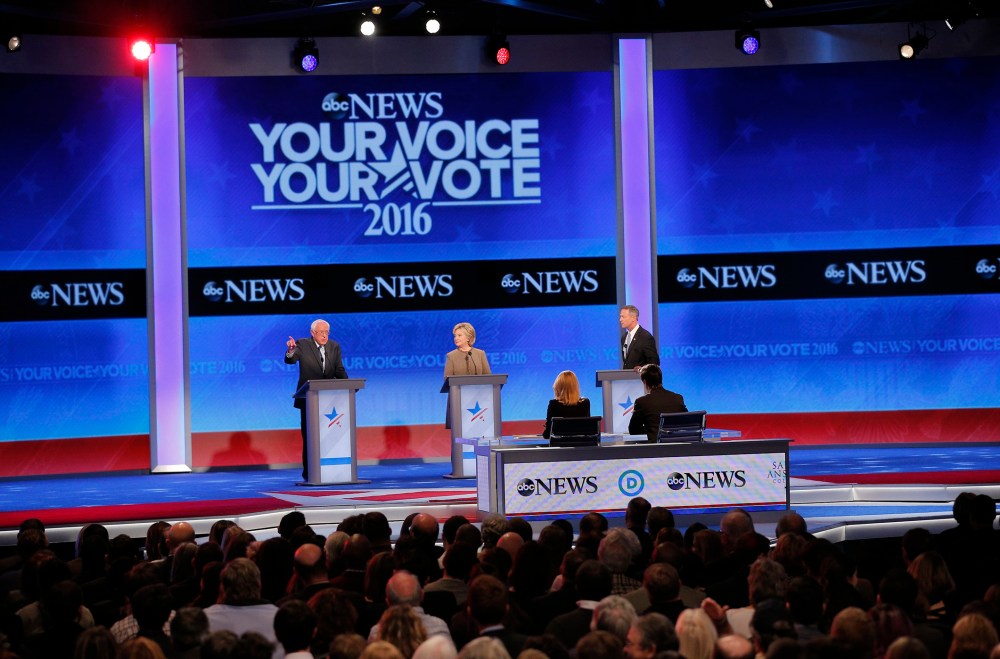
Hillary Clinton, Bernie Sanders and Martin O’Malley were unified on one topic during the last Democratic presidential debate of the year Saturday night: The toxicity of Donald Trump’s proposed temporary ban on Muslims entering the United States. Each candidate seized on the opportunity to decry racial and religious bigotry — and encouraged the rest of America to follow their example.
O’Malley set the tone in his opening statement when he discussed a recent visit to a mosque in Northern Virginia and talked about “the danger that democracies find themselves susceptible to when unscrupulous leaders try to turn us upon each other.”
Clinton picked up on the theme of anti-Muslim discrimination, stating that “we must work more closely with Muslim-American communities.” The former secretary of state repeatedly warned against “the rhetoric coming from the Republicans, particularly Donald Trump, [that] is sending a message to Muslims here in the United States and literally around the world that there is a ‘clash of civilizations,’ that there is some kind of Western plot or even ‘war against Islam.’”
RELATED: Sparks fly at Democratic debate in New Hampshire
At one point the Democratic front-runner even praised George W. Bush over his contemporary Republican counterparts, pointing out that “one of the best things that was done, and George W. Bush did this and I give him credit, was to reach out to Muslim Americans and say, we’re in this together. You are not our adversary, you are our partner.” Jeb Bush was the only GOP candidate to attack Trump on his ban during the Republican debate last week — and he denounced the Republican front-runner as “a chaos candidate” who would be “a chaos president.”
Sanders urged Americans to ignore candidates like Trump who “divide us by race or where we come from,” by saying “the answer is that all of the Mexicans, they’re criminals and rapists, we’ve got to hate the Mexicans, those are your enemies” or “we hate all the Muslims, because all of the Muslims are terrorists. We’ve got to hate the Muslims.”
The Vermont senator returned to this subject again near the end of the debate, responding to a voter’s question about the lack of trust between law enforcement and citizens by emphasizing the need to “come together as a country and end institutional racism,” especially “police officers shooting unarmed people, predominantly African-Americans” and the United States putting “more people in jail than any other country on earth, 2.2 million people, predominantly African-American and Hispanic.” Clinton touched on these themes as well, likewise speaking out against “systemic racism and injustice and inequities in our country.”
There are sound political reasons why the Democratic candidates have been so outspoken about the importance of pluralism and tolerance. Since the days when the Democratic Party was rebranded by Franklin Roosevelt, the Democrats have depended on appealing to the diverse range of marginalized groups who have turned to political institutions for protection against discrimination. During the twentieth century, this took the form of fighting the Great Depression or racist Jim Crow laws in the South; today it involves protecting Muslims from Islamophobia, Mexican immigrants from xenophobia, and African-Americans and Hispanics from law enforcement excesses.
Regardless of the time period, however, the strategic advantage of this approach is that the number of affluent white voters (i.e., the GOP’s base) has continued to shrink while the number of non-white and working class voters (i.e., the Democrats’ base) continues to grow. As a result, appeals to bigotry that helped Republicans win general elections in the past – from Richard Nixon’s “Southern Strategy” to Ronald Reagan’s rhetoric about “welfare queens” – are now statistically imprudent. The minorities, after all, are now the majority.
RELATED: Democrats rumble over ISIS, future of Syria That said, the Democrats did more to advance the cause of civility than simply advocate that it be displayed toward minority groups; they also did so by displaying it toward each other throughout the course of the debate. The most notable instance of this occurred in the very beginning, when Sanders apologized to Clinton for several staffers from his campaign who illegally accessed data from her electronic voter registry. In addition to accepting his apology, Clinton echoed Sanders’ famous declaration from the first Democratic debate that he was “sick and tired” of hearing about her “damn emails,” calling for the party to “move on” because the American people are “more interested in what we have to say about all the big issues facing us.” Clinton and Sanders struck a stark contrast between themselves and the most recent Republican debate, one that was dominated by bickering between Donald Trump, Jeb Bush, Marco Rubio, and virtually every other major candidate on that stage in Las Vegas. Perhaps the most telling quote of the night came from the Democrat least likely to win the nomination, former Gov. O’Malley himself. “My friend Kashif, who is a doctor in Maryland… was putting his 10 and 12-year-old boys to bed the other night – and he is a proud American Muslim – and one of his little boys said to him, ‘Dad, what happens if Donald Trump wins and we have to move out of our homes?’” Even as Trump and other Republicans promote a message that can so easily be interpreted as deliberately excluding marginalized racial and religious groups, the Democrats have used their mistakes to place themselves in the best possible light for the upcoming presidential election.
Matthew Rozsa Recommended


