








There’s more evidence that Obamacare is starting to work in the ways that its biggest proponents hoped it would: Hospitals are seeing more patients with insurance, reducing their costs, and more health insurers are joining the Affordable Care Act’s exchanges, according to two reports that the Obama administration released this week.
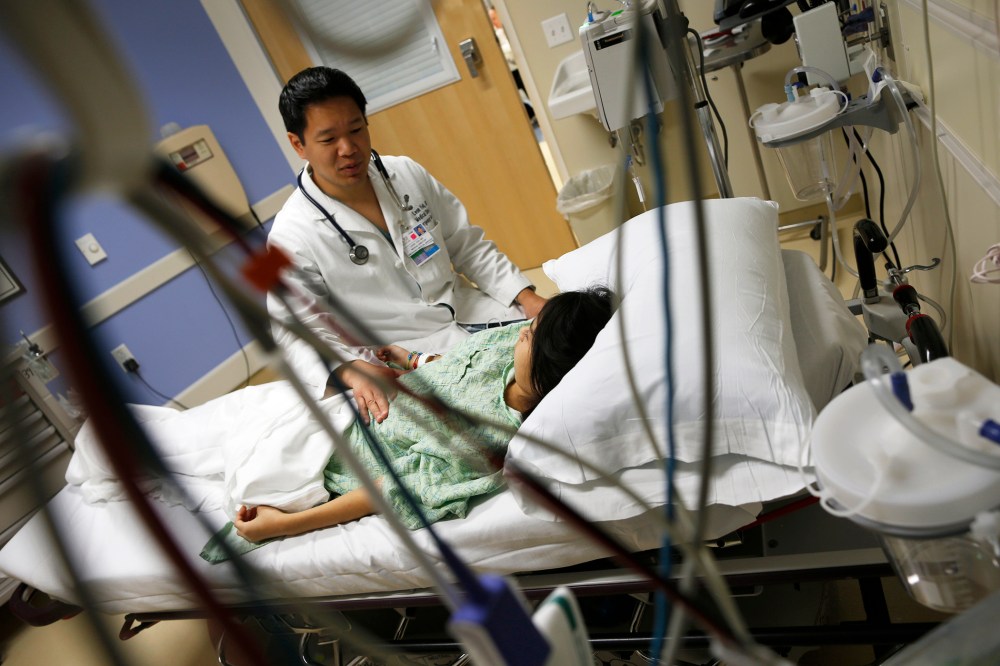
Hospitals in states that expanded Medicaid saw a big decrease in the number of uninsured patients admitted, which fell about one-third on average compared to the previous year, according to a White House report that compiled hospital earnings reports and surveys conducted by outside groups. There was a particularly dramatic drop in ER visits by uninsured patients in Medicaid expansion states—one of the major drivers of uncompensated care at hospitals, who in turn pass on the cost to the government and taxpayers.
By comparison, hospitals in states that declined to expand Medicaid did not on average see a decline in uninsured patient admissions, the report noted.
By the end of the year, the cost of uncompensated care is expected drop by $5.7 billion in 2014, the report added, which would be a 16% drop from the previous year. The vast majority of those savings—74% overall—will come from states that chose to expand Medicaid.
Such findings are likely to increase the pressure on the states that opted out of the Medicaid expansion. “It’s more evidence of the degree to which states are leaving money on the table by not expanding the program. Their residents are seeing an outflow of tax dollars to fund the expansion in other states,” says Sara Collins, vice president for Health Care Coverage and Access program at the Commonwealth Fund, a non-partisan research foundation.
Hospital groups welcomed the news, though they cautioned that it was too early to draw conclusions about the long-term impact of Obamacare on costs. “We are encouraged thus far by the coverage expansions as envisioned by the ACA. The ACA is accomplishing its objective in some but not all states,” says Marie Watteau, a spokesperson for the American Hospital Association. She adds, “As the report states, it’s too early to know what the impact will be on a national level.”
Anticipating that uncompensated care would fall as coverage expanded, the architects of Obamacare also included Medicaid provider cuts to hospitals that serve a high proportion of low-income, uninsured patients, which are scheduled to take effect in 2017. “Some of the sources to pay for uncompensated care were considered less necessary when more people had insurance,” explains Gary Claxton, vice-president at Kaiser Family Foundation.
America’s Essential Hospitals, which represents the country’s public hospitals, called the report “promising news” but said the cost of uncompensated care is still a problem, particularly given the scheduled Medicaid cuts.
“Essential hospitals still face high levels of uncompensated care and looming cuts to disproportionate share hospital (DSH) funding,” said America’s Essential Hospitals, which represents public hospitals. “Even in states that have expanded Medicaid, our members continue to face the burden of Medicaid payment rates that fall well short of the true cost of care.”
Insurance companies, for their part, are growing more enthusiastic about their new customer base. In 2015, there will be 25% more insurers participating in Obamacare’s health care exchange, according to data that the White House has collected from 44 states.
At least four states—Indiana, Missouri, New Hampshire, and West Virginia—will have twice as many insurers participating in the exchanges, according to the report. California, however, will have fewer insurance companies in the exchange next year, falling from 12 to 10. Next year, at least 14 insurers will be leaving the marketplace, but there will be a net increase of 63 issuers overall, the report found.
“It does reflect new confidence in this approach to health insurance coverage,” says Collins. “It reflects a market that’s turning out to be stable, ti’s turning out to be a robust market, and it’s turning out to be a market that’s quite competitive.” Insurers are also having a hard time finding new customers elsewhere. “Part of the reason that insurers are coming in is that they don’t have a lot of other markets,” says Claxton. Despite the uncertainty and risks surrounding Obamacare, these insurers have concluded that “a lot of people have signed up, a lot of people bought insurance, and we think this is worth it,” he added. Obamacare has enrolled 7.3 million customers who are paying their premiums as of August, and the number of uninsured fell by 3.8 million in early 2014. Right now, it’s too early to tell whether this will mean lower costs for customers. “It probably doesn’t mean much for prices right now—it’s not clear that these players are offering lower prices,” Claxton notes, but added that “over time, more competitors tend to drive down prices.” The White House proudly touted this week’s news. “When consumers have more choices, we all benefit,” Health and Human Services Secretary Sylvia Burwell said in a statement. “In terms of affordability, access, and quality, today’s news is very encouraging. It’s a real sign that the Affordable Care Act is working.” Obamacare still isn’t popular: A recent NBC News/Wall Street Journal poll shows that only 34% support the health care law and 48% are opposed to it. While the health care website has overcome most its early technical challenge, recent reports of security weaknesses have raised new concerns. But it’s also not a major concern for voters, according to surveys, the encouraging news about the law may be also be weakening its political impact. As the WSJ points out, Republicans are broadening their attacks beyond Obamacare, and more Democrats are stepping out to defend it.
Suzy Khimm Recommended


