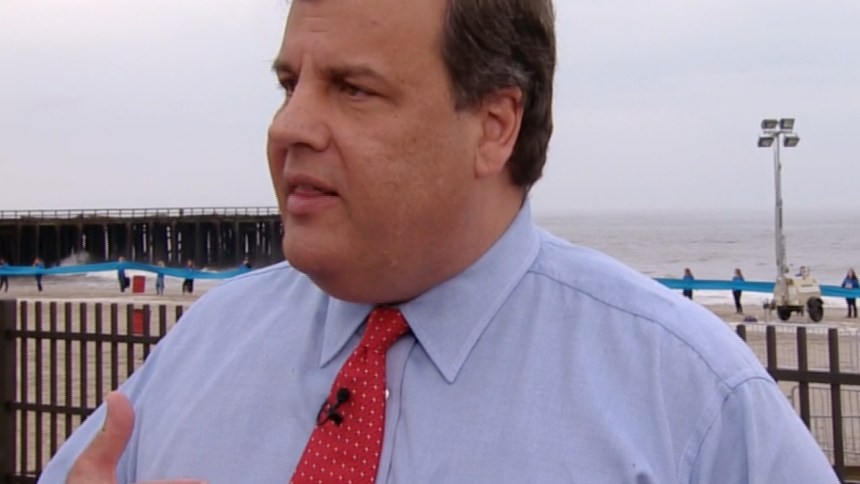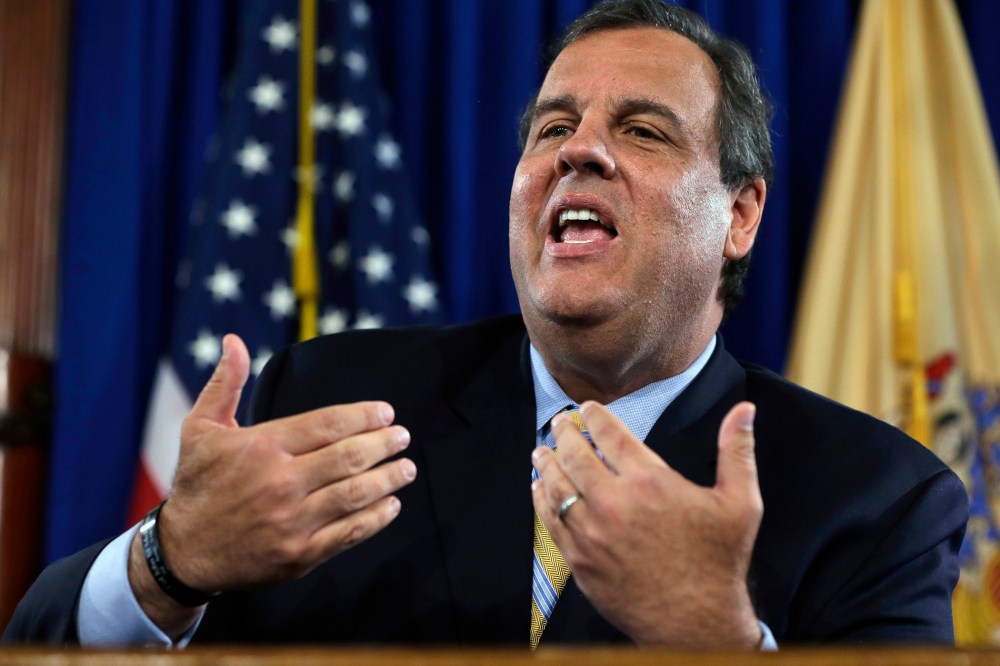
Climate change is taking center stage once again — at the United Nations on Tuesday, and on the streets of New York City Sunday, where hundreds of thousands of activists marched to demand action.
But across the Hudson River in New Jersey, there’s an environmental battle of a different kind being waged.
Gov. Chris Christie is coming under fire for refusing to rejoin a regional cap-and trade program to combat climate change that his state withdrew from three years ago. The move — highlighted last week by The New York Times — has opponents charging that the Republican governor doesn’t want to alienate conservatives in advance of a potential 2016 presidential bid.
“It’s all because of a four letter word: K-O-C-H,” said Democratic state Sen. Bob Smith, the chairman of the state’s Environment and Energy Committee, referring to the billionaire Koch brothers who bankroll many GOP campaigns, and who favor conservative stances on environmental issues. “They don’t want to see any candidates for president who have the slightest green tint to them. If the governor was green at all, he would lose their support.”
It’s not just donors. Polls show Republican base voters emphatically opposed to the idea that climate change is even a threat.
%22It%E2%80%99s%20all%20because%20of%20a%20four%20letter%20word%3A%20K-O-C-H.%22′
Christie has said he’s thinking of making a bid for the Oval Office but won’t make a decision until sometime next year. The governor –once considered a moderate—has lately shifted right, vetoing gun control legislation, declaring the gay marriage debate isn’t over, and taking a more hard-line stance on Israel.
And now there’s climate change.
Earlier this month, the state Senate environmental committee approved a measure aimed at reversing Christie’s 2011 decision to pull New Jersey out of the Regional Greenhouse Gas Initiative (RGGI), a cap-and-trade system aimed at reducing global warming pollution from factories and power plants. Next, the legislation will head to the Democratic-controlled state legislature, where it’s expected to pass. While the legislation would not force New Jersey to join the pact, it would provide a pathway where the situation could be litigated, said Smith.
RELATED: What happened to Chris Christie the moderate?
The governor has twice vetoed the state legislature’s bipartisan vote to rejoin the RGGI. Proponents argue the program—which caps emissions and creates financial incentives for more environmentally friendly power sources—creates jobs, brings money into the state and saves the Earth. Nine northeastern states are participating.
Under RGGI, a cap on the amount of carbon dioxide that is to be emitted by participating states is set. That amount is then divided into permits, each allowing for one ton of emissions per year. Those permits are then sold off to firms. The hope is that companies will have a financial incentive to cut emissions because they must buy permits or sell off the ones they don’t require.
Environmental groups say since the state withdrew from the program in 2011, New Jersey has passed up more than $114 million in potential revenue. By 2020, that could amount to an additional $387 million. The state first joined RGGI in 2005 under then-Gov. Richard Codey, a Democrat.
Christie – who has said in the past that global warming is partially man-made—has called the program “gimmicky” and ineffective. Last week, Christie declared at a news conference that the state would not rejoin the group “on [his] watch.”
Christie’s office did not return requests for comment. But Larry Hanja, a spokesman at the New Jersey Department of Environmental Protection said the state has “no intention” of rejoining RGGI. Hanja insisted the state has made positive strides in reducing carbon emissions without “what, in effect, is a major tax on energy providers.” Doug O’Malley, the director of advocacy organization Environment New Jersey, said, “The governor’s agenda has changed drastically since his White House ambitions were hatched,” especially in regards to environmental policy. O’Malley said he thinks Christie is worried about appealing to the Koch brothers, who have made much of their fortune in energy, and believe cap-and-trade programs will hurt their bottom line. “He’s trying to court the conservative wing of the Republican Party,” said O’Malley. It’s quite a turnaround. Running for governor ion 2009 as a moderate, Christie touted the need for solar power and talked up offshore wind—two initiatives that O’Malley says the state has made little headway on. And back in 2011, Christie said, “When you have over 90% of the world’s scientists who have studied this stating climate change is occurring and that humans play a contributing role, it’s time to defer to the experts.” Since then, the governor has largely kept quiet on the issue. Brigid Harrison, a political science professor at New jersey’s Montclair State University, said for the majority of New Jerseyans, the state’s participation in RGGI is a “no-brainer” because it brings money into the state with very little impact on the bottom line for state residents. “The fact that the governor would be willing to sacrifice over $100 million in fees demonstrates his desire to win over the support from groups like Americans for Prosperity,” she said. And it worked. In July, Americans for Prosperity issued a press release praising Christie’s Department of Environmental Protection for trying to repeal the cap-and-trade regulations, calling the policy “foolish.” Other potential GOP 2016 candidates, meanwhile, are veering even further right on climate change. In May, Florida Sen. Marco Rubio flat out said he doesn’t believe human activity is causing climate change. Sen. Ted Cruz of Texas said this year that “the last 15 years there has been no recorded warming.” Former Florida governor Jeb Bush said in 2011 that “it is not unanimous among scientists that it is disproportionately man made.” That same year, former Pennsylvania senator Rick Santorum called global warming a “beautifully concocted scheme” by the left.Recommended