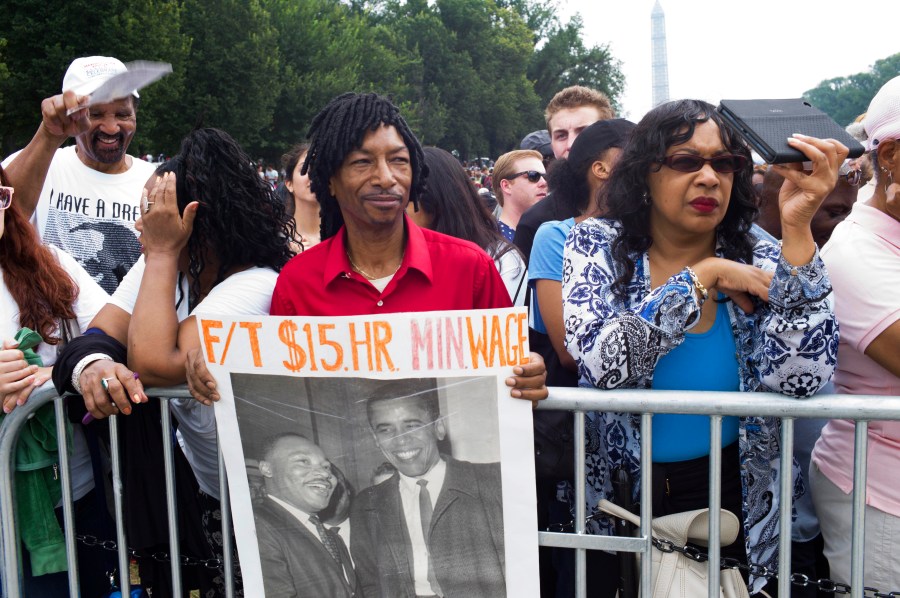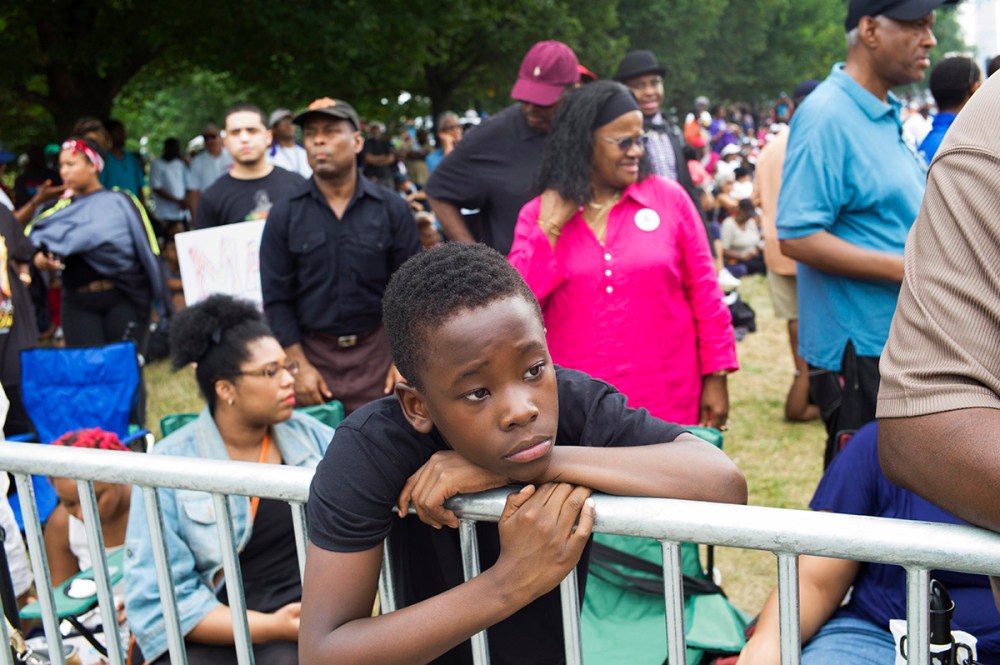
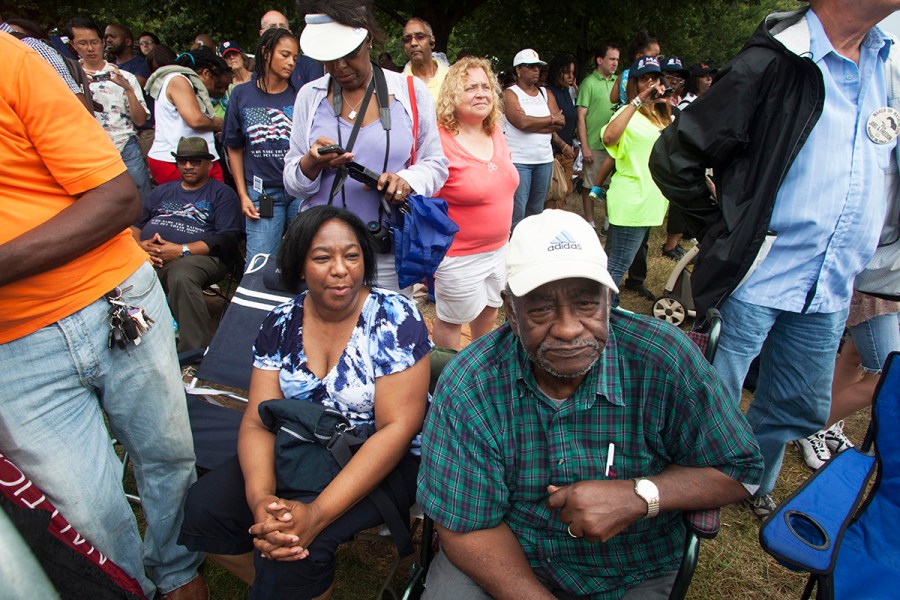
Photos by Bruce Davidson
President Barack Obama marked the 50th anniversary of Martin Luther King’s “I Have a Dream” speech at the March on Washington by honoring the work not just of the civil rights leader, but of the everyday footsoldiers who fought for their rights.
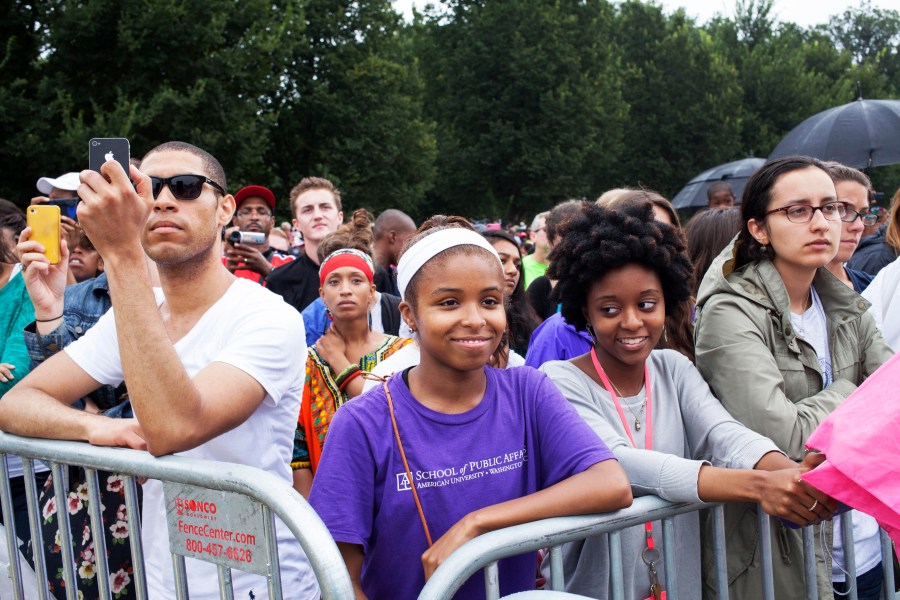
“Because they kept marching, America changed,” Obama said Wednesday at the Lincoln Memorial where King had delivered his speech. “Because they marched, the city councils changed, and state legislatures changed, and Congress changed, and, yes, eventually the White House changed.” The president went on to say that this generation of Americans owed a debt to the porters, maids, and secretaries who “kept on keeping on” for equal rights.
“We rightly remember Dr. King’s soaring oratory that day, how he gave mighty voice to the quiet hopes of millions, how he offered a salvation path for oppressed and oppressors alike” Obama said. But he also sought to remember “that day itself also belonged to those ordinary people whose names never appeared in the history books, never got on TV,” Obama said. “They had every reason to lash out in anger or resign themselves to a bitter fate. And yet, they chose a different path. In the face of hatred, they prayed for their tormentors. In the face of violence, they stood up and sat in, with the moral force of nonviolence.”
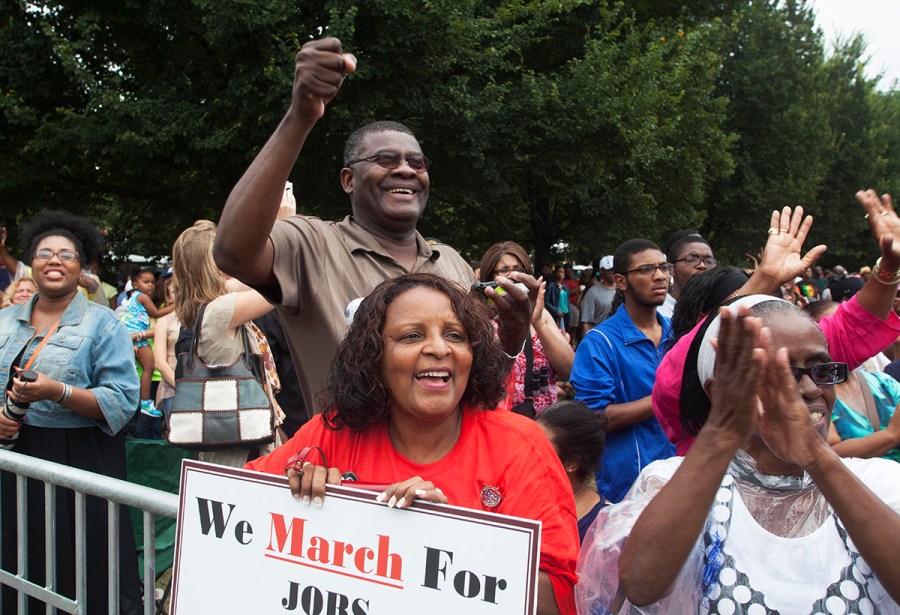
Hundreds of thousands flocked to the Washington Mall Wednesday to pay tribute to that moment 50 years ago when Americans marched for racial equality and economic justice, and a little known clergyman from Georgia would emerge as the most powerful voice in the movement for black rights. As they did so, speaker after speaker, touching on topics from voting rights to criminal justice to joblessness, said despite progress the dream of equality had yet to be realized.
“The movement was radical, it was unprecedented for there to be such a mass demonstration, an interracial mass demonstration in Washington, D.C. The climate was tense at the time,” Urban League President Marc Morial said on MSNBC Wednesday. “There were critics both from Dixiecrats and Southern right-wingers, as well as those in the civil rights movement and President Kennedy who feared the march would backfire. History tells us another story.”
That march was radical, both in the marchers’ demands for racial equality and their display of interracial solidarity, particularly in the nation’s capital, which had only recently officially desegregated. No presidents or politicians would speak, but Southern Christian Leadership Conference leader Martin Luther King Jr. gave his speech envisioning a society free of racism, a dream of a society where people would “not be judged by the color of their skin but by the content of their character.”

A different crowd gathered Wednesday morning, for a different set of speakers. Most of America accepted, at least in principle, the idea of racial equality under the law. Where in 1963 even liberal politicians like Kennedy kept their distance from the march, today President Obama was also joined by two other former presidents, Jimmy Carter and Bill Clinton. John Lewis, who spoke in 1963 as a young nonviolent activist, returned as a U.S. Congressman from the state of Georgia. Celebrities like Jamie Foxx and Oprah Winfrey spoke alongside activists like NAACP President Benjamin Jealous, Children’s Defense Fund president Marian Wright Edelman and Sofia Campos of United We Dream.
King’s speech described a dream of a society to come, but it also spoke of one deferred. He described the Constitution as a “promissory note,” for “the inalienable rights of life, liberty and the pursuit of happiness,” one that came back “marked ‘insufficient funds’” when black Americans came to cash it.
Though the edifice of Jim Crow has been torn down and the campaign of racist terror that protected it is now a thing of the past, speakers at the 2013 commemoration proclaimed that there was still more work to do to secure equality for all Americans regardless of race.
“Fifty years later, we’re still here trying to cash that bad check,” said former Ambassador Andrew Young, one of King’s closest lieutenants, Wednesday morning. “Fifty years later, we’re still dealing with all kinds of problems. And so we’re not here to claim any victory. We’re here to simply say that the struggle continues.” Throughout the day speakers struck the same theme, pointing to voting rights, criminal justice, and education as areas where equality has not been realized. Obama, whose presidency is often cited as a high water mark of racial progress in America, continued the theme by warning that King’s dream was about more than symbolic victories. “Yes there have been examples of success within black America that would have been unimaginable a half century ago,” Obama said. “The very significance of these victories may have obscured a second goal of the march. for the men and women who gathered 50 years ago were not there in search of some abstract idea, they were there seeking jobs as well as justice.” Despite the abolition of de jure segregation, racial disparities in wealth and household income remain almost as wide now as they were in 1963. It was that second goal, Obama said, where the country had fallen short. “For what does it profit a man, Dr King would ask, to sit at an integrated lunch counter if he can’t afford the meal.” Fifty years after he shot the iconic images of the March on Washington, photographer Bruce Davidson returned to the National Mall to record the anniversary of the protest movement that defined the civil rights era. Davidson, a Magnum photographer who began chronicling the civil rights struggle with the Freedom Rides, said of his work, “I was looking at the fear and the oppression. Also, the change…if the Washington march didn’t work, then they would go back to Birmingham and march.”
Adam Serwer Recommended