








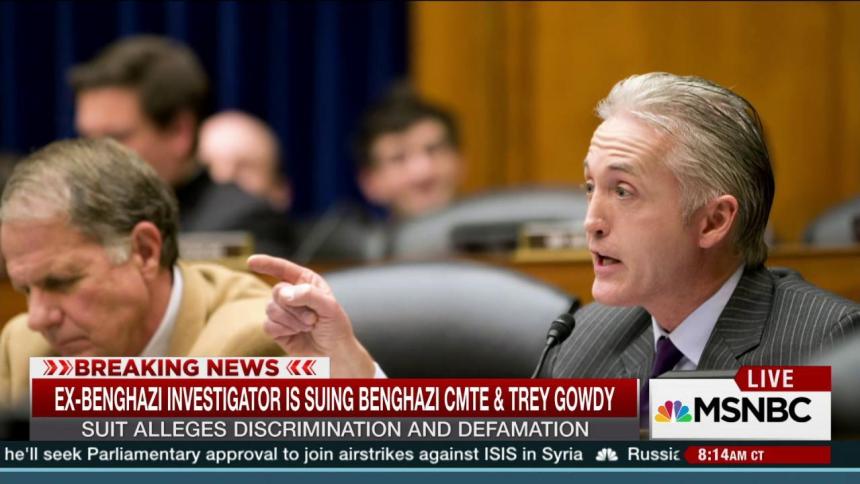
A former investigator for the House Benghazi Committee filed a federal lawsuit against the committee Monday, opening a new chapter in legal skirmishes over the Benghazi attacks and subsequent investigations.
Last month, Brad Podliska, an Air Force Reserve major, alleged the Benghazi committee terminated him based on his military obligations and his refusal to advance an agenda targeting Hillary Clinton. Now, Podliska is detailing those charges in court in a new filing that alleges Committee Chairman Trey Gowdy broke the law by defaming him in their public battle over Podliska’s firing.
Gowdy previously said Podliska was terminated partly for mishandling classified information.
The suit cites Gowdy’s claim from a press release and an interview with NBC News, and argues it was a damaging line of attack, since allegations of such a “serious crime” have “ended the careers of many professionals in national security-related industries.”
But the charge was totally false, the suit says, because the information Podliska handled was drawn entirely from “sources from the Internet.” Podliska adds that the committee staffer who made the allegation later admitted the material “was not classified.” The committee has not withdrawn the allegation.
RELATED: Ex-Benghazi investigator alleges Rep. Gowdy violated federal law
In a statement to MSNBC, Jamal Ware, a spokesman for the committee, called Podliska’s complaint “meritless,” adding: “[T]he committee did not and does not discriminate or retaliate based on military service, military status or any other unlawful factor.”
Suing Gowdy for defamation reflects a confrontational legal strategy, as Podliska is moving beyond the details of his termination – a largely staff-level issue – to directly impugning Gowdy’s conduct afterward. It also means that Monday’s filing goes further than expected, not only suing the Committee, but naming Gowdy as an individual defendant.
The filing emphasizes Podliska is not seeking money for the defamation claim. Instead, he is calling for a statement establishing that Gowdy’s allegation was false, and asking the Court to bar Gowdy from repeating it.
It is an unusual request against a member of Congress, given the wide legal latitude for legislators’ public comments, though the suit focuses on Gowdy’s role as an employer. Podliska’s complaint also seeks lost pay, benefits, damages, and reinstatement in his old job on the committee.
Gowdy and the committee have denied all of Podliska’s allegations, casting his suit as the selective complaints of a disgruntled former employee. Last month, Gowdy told NBC News’ Kristin Welker that Podliska’s criticism of the committee was a “lie,” that his work was “lousy,” and that the Committee’s top investigator was “a three star general,” undermining a claim of military discrimination.
Podliska’s experience has made him hard to dismiss, however, as a matter of both politics and law. He is a registered Republican, and he told CNN he plans to vote for the GOP next year.
Legally, his status in the military secures him a place in court that aggrieved House staffers don’t usually have. Congress passed “whistleblower” protections for most federal employees, but exempted its own staff in a self-interested loophole. Yet Podliska argues he is able to sue under The Uniformed Services Employment and Re-employment Rights Act (USERRA), a 1994 law that protects service members from employment discrimination.
Under the law, employees in government and the private sector are protected from any retaliation for their military duties. While one might expect employers to be deferential and careful regarding an employee’s service, Congress found that long or unpredictable reserve obligations sometimes result in a backlash against reservists.
RELATED: Another Republican admits: Benghazi panel is political
That is the picture Podliska paints in his new filing – House staffers were upset he would be leaving the high-profile committee for over a month. The suit states that when Podliska first announced a reserve assignment in Germany, Gowdy’s top staffer, Staff Director Phil Kiko, emailed back, “wow.” The suit says another committee staff was later heard questioning whether Podliska “really needs to go to Germany,” and alleges “a significant change in Kiko’s attitude and demeanor the moment [Podliska] returned from military duty.” According to the suit, this was when the situation broke down. Kiko no longer acted “cordially,” he singled out Podliska negatively, and tensions rose over what Podliska says was his refusal “to go along with the hyper-focus on Department of State and Secretary Clinton.” So in Podliska’s theory of the case, his core legal reason for getting into court – military discrimination – is inextricably linked to the politically explosive charge that the committee was out to get Hillary Clinton. The suit presses that point by arguing: “During the month that [Staff Director Phil] Kiko and [Deputy Director Christopher] Donesa began to treat Plaintiff differently, the Committee’s investigation changed significantly to focus on Secretary of State Hillary Clinton and the State Department, and deemphasize the other agencies that were involved in the Benghazi attacks and the aftermath of the attacks.” Beyond the legal claims, the filing includes some other detailed accusations sure to draw attention in Washington. The suit says Gowdy conveyed to staff that he thought his Staff Director and Deputy “were incompetent,” that senior Republican committee staffers regularly drank alcohol together in the “office during the workday,” and that a nonpartisan security staff member deleted documents to avoid detection by Democratic committee members. Podliska is seeking a jury trial, raising the prospect of one of the most high profile Washington courtroom dramas since the 2007 prosecution of Scooter Libby, a senior aide to former Vice President Dick Cheney. The House Benghazi Committee, which has to contend with the suit, has drawn less attention since Hillary Clinton completed her testimony last month. Its investigation into the attacks and their aftermath remains open, however, and it will continue operating until 30 days after it issues a final report, under rules the House passed. The full statement from committee spokesman Jamal Ware in response to the lawsuit is below: The committee understands that a lawsuit has been filed by Bradley Podliska asserting claims pursuant to the Congressional Accountability Act, among others. We disagree strongly with those claims, which are meritless and which improperly strike at the heart of the committee’s legislative functions. Further, we reiterate that the committee did not and does not discriminate or retaliate based on military service, military status or any other unlawful factor. We look forward to responding to the allegations in due course and in the appropriate forum. And we are confident that once all the facts are known—should this case be permitted to proceed—we will be fully exonerated.
Ari Melber
Ari Melber, an Emmy Award-winning journalist, writer and attorney, is the host of “The Beat with Ari Melber” airing nightly at 6 p.m. ET on MSNBC. He also serves as MSNBC’s chief legal correspondent and an NBC News legal analyst. Before joining MSNBC, Melber practiced First Amendment law and served as a legislative aide in the U.S. Senate. He received a J.D. from Cornell Law School and is a member of the New York Bar. Recommended


