








“I don’t know. I wasn’t there,” Burck was saying to Bush, tempering his “he did it” judgment just a bit. “But if I were on that jury, I would probably have agreed with them. You have to follow the law, and the law says if you say something that is untrue, knowingly, to a federal official in the context of a grand jury investigation and it is material to their investigation, that’s a crime.”
Libby had been convicted of lying to federal investigators about whether he had divulged to journalists the name of a CIA officer married to a critic of the vice president. Libby insisted he simply remembered events differ- ently from other witnesses. However, his story clashed not just with that of one person but with those of eight other people, including fellow administra- tion officials. To believe Libby, the lawyers concluded, would be to believe that all those other people were wrong in their recollections or that Libby’s memory was so faulty that he did not remember repeated conversations about a topic that clearly consumed the office of the vice president.
“All right, all right,” the president said finally, which his aides took to mean he would not grant the pardon. “So why do you think he did it? Do you think he was protecting the vice president? ”
“I don’t think he was protecting the vice president,” Burck said. “So why do you think he did it? ” Bush asked.
Burck said he thought Libby assumed his account of events would never be contradicted because prosecutors would not force reporters to violate vows of confidentiality to their sources. “I think he thought that would never be broken, and I think also Libby was concerned because he took to heart what you said back then, which is that you would fire anybody that you knew was involved in this,” Burck said. “I just think he didn’t think it was worth falling on the sword.”
Bush took that in but did not seem convinced. “I think he still thinks he was protecting Cheney,” the president said. He did not say so, but it seemed that Bush believed that Cheney had a personal stake in this, that in effect it was a conflict of interest. Now the vice president was just one more sup- plicant trading on personal connections in the pardon process, in this case seeking forgiveness for the man who had sacrificed himself for Cheney.
Bush sighed. “Now I am going to have to have the talk with the vice president,” he said gloomily. That was the sort of unpleasant business that for eight years he had left to Cheney. It was the vice president who had deliv- ered the bad news to people like Paul O’Neill and Donald Rumsfeld when they were fired.
Bolten spoke up. “I can do it,” he volunteered. “Nah, nah, I can do it,” Bush said.
But he was dreading it.
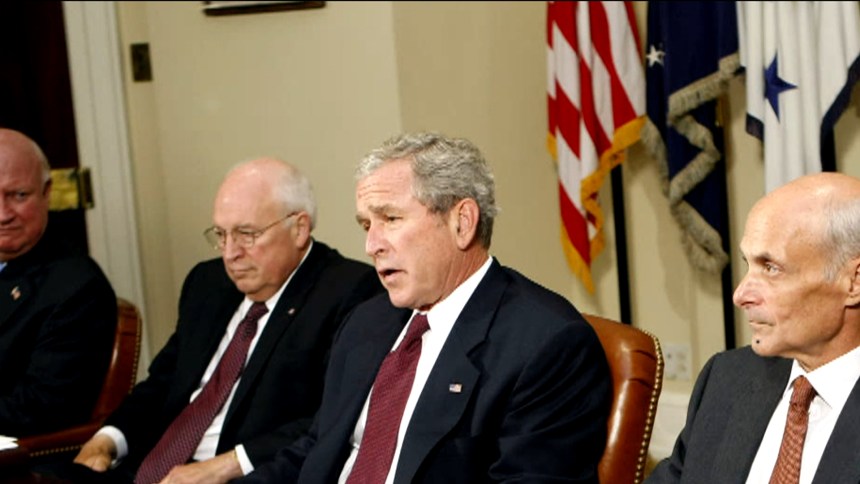
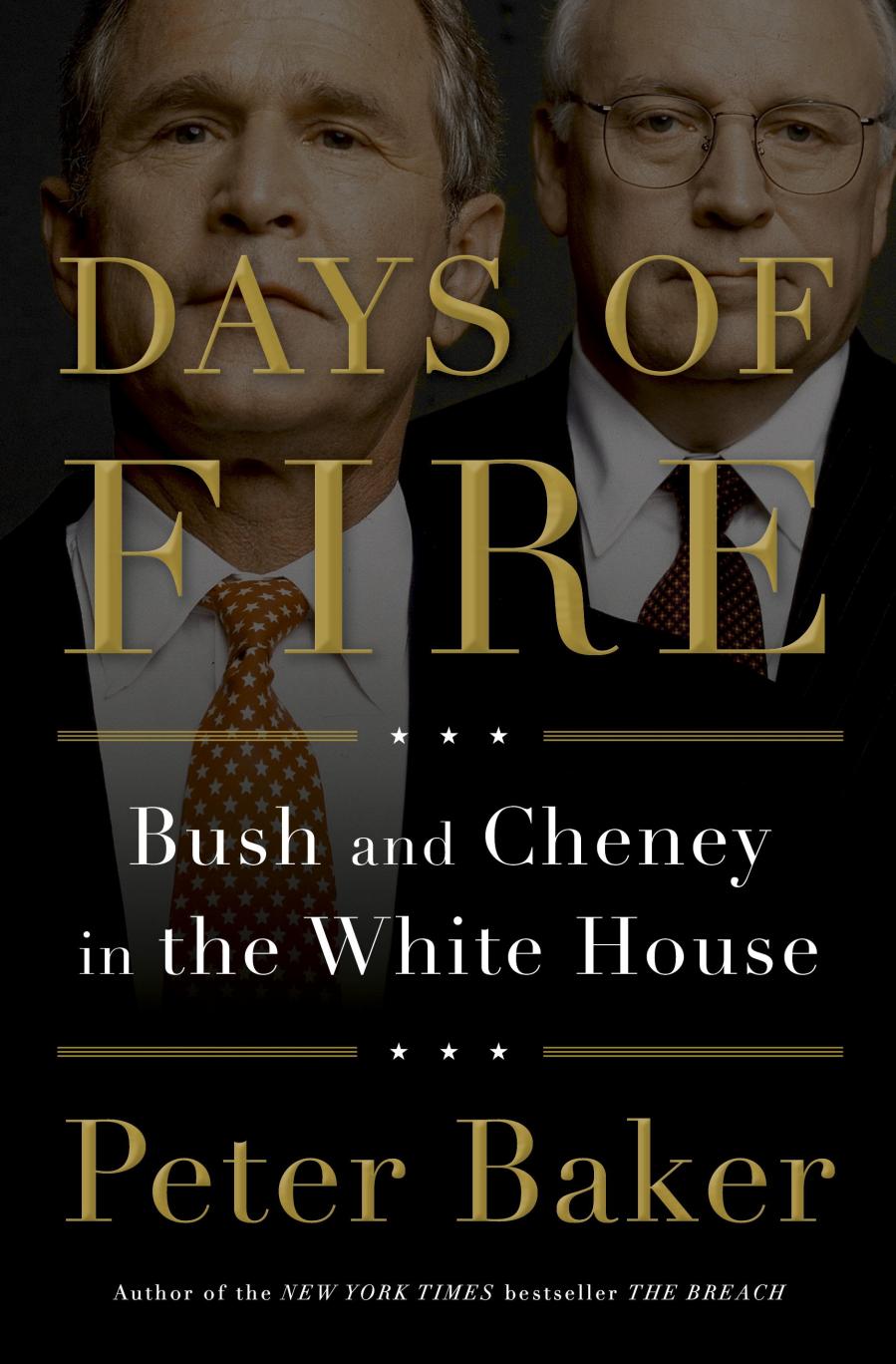
FOR EIGHT YEARS, George Walker Bush and Richard Bruce Cheney had been partners in an ambitious joint venture to remake the country and the world. No two Americans in public office had collaborated to such lasting effect since Richard M. Nixon and Henry Kissinger.
Together they had accomplished significant things. They lifted a nation wounded by sneak attack on September 11, 2001, and safeguarded it from further assault, putting in place a new national security architecture for a dangerous era that would endure after they left office. At home, they insti- tuted sweeping changes in education, health care, and taxes while heading off another Great Depression and the collapse of the storied auto industry. Abroad, they liberated fifty million people from despotic governments in the Middle East and central Asia, gave voice to the aspirations of democracy around the world, and helped turn the tide against a killer disease in Africa. They confronted crisis after crisis, not just a single “day of fire” on that bright morning in September, but days of fire over eight years.
Yet for all that, their misjudgments and misadventures left them the most unpopular president and vice president in generations. They had unwit- tingly unleashed forces that led to the deaths of perhaps a hundred thousand Iraqis while squandering America’s moral authority, failing to rescue a great American city from a biblical flood, presiding over the worst financial crisis in eight decades, and leaving behind a fiscal mess that would hobble the country for years. For good or ill, theirs was a deeply consequential admin- istration that would test a country and play out long after the two men at its center exited the public stage.
That their final hours together would be consumed by their private argument over the pardon underscores the distance the two men had trav- eled. Theirs is a story that may seem familiar on the surface, but in fact the real tale of Bush and Cheney and their eight years together is far more com- plicated than the simplistic narrative that developed over time. Hundreds of interviews with key players, including Cheney, and thousands of pages of never-released notes, memos, and other internal documents paint a rivet- ing portrait of a partnership that evolved dramatically over time. Even in the early days, when a young, untested president relied on the advice of his seasoned number two, Bush was hardly the pawn nor Cheney the puppeteer that critics imagined. But if the vice president won most of the fights in the first term, he had grown increasingly marginalized by the second. Restless and disaffected, Bush sought out new paths to right his presidency and no longer paid as much heed to his vice president on everything from North Korea to gun rights. Cheney became alienated sitting in his West Wing office watching their efforts in his view run off course, undermining much of what he had accomplished. His fight for Libby was in a sense, then, a fight for redemption from a president who had turned away from him. In pressing for clemency, Cheney was seeking one last validation of their extraordinary tandem—one that Bush was ultimately unwilling to give.
“Friendship” is a word that does not fully capture the relationship between Bush and Cheney. They did not see each other out of the work- place. Cheney did not spend social weekends at Camp David, and they did not dine together with their wives. They did not typically exchange birthday gifts. Bush did not go hunting with Cheney, and the vice president visited the president’s ranch in Texas only for official meetings, although the two men would occasionally slip out to fish for bass in a pond on the property. On election night in 2000 and again in 2004, they watched the returns sepa- rately, coming together only late in the evening when they thought they were about to head to a public party to claim victory. “They weren’t personally close,” reflected Ari Fleischer, the president’s first White House press secre- tary. “They didn’t go bowling together or to Camp David. Cheney didn’t go jogging with George Bush. He was everything that Bush designed when he chose Dick Cheney to be counselor.”
Cheney thought of their relationship as a business one. “It was profes- sional, more than personal,” Cheney said after leaving office. “We weren’t buddies in that sense.” Bush had a hard time defining their relationship. “You know, I would, I would say friends,” he finally concluded. “But on the other hand, we run in separate circles. Dick goes home to his family, and I go home to mine. I wouldn’t call him a very social person. I’m certainly not a very social person either. So we don’t spend a lot of time socially together. But, uh, friends.”
Partners might be a more apt description, although even that is freighted. Some Bush advisers objected because in their view partnership implied an equal footing, and the vice president was, in the end, the vice president. Cheney never forgot that and made a point of showing nothing but deference to Bush. While Bush called him “Dick,” Cheney always called Bush “Mr. President.” Even out of his presence, Cheney referred to him as “the Man,” as in “Let’s take this to the Man.” Bush, more irreverently, sometimes referred to Cheney as “Vice.” Karl Rove came to call Cheney “Management,” as in “Better check with Management.”
Cheney was just five years Bush’s senior but carried himself with the gravitas of a much older man, and Bush treated him with more respect than anyone else in the inner circle. Yet in any meeting, it was clear who was in charge: Bush led the discussion, asked the questions, and called on people to speak, while Cheney largely remained quiet. “If you spent any time around
President Bush, you quickly realize he’s not a guy who can be led around in that way, not at all,” observed Matthew Dowd, his campaign strategist. “And Cheney’s not the type who operates that way, not at all.” Still, that silence seemed to connote a power all its own; everyone else in the room under- stood that when they left, Cheney stayed behind, offering advice one-on- one when nobody could rebut him. What Cheney actually thought, at times, remained mysterious. “He was a black box to a lot of us,” said Peter Wehner, the White House director of strategic initiatives.
They were, of course, starkly different men, Bush an outgoing former college cheerleader from a privileged family background who delighted in bestowing nicknames, conquered his own demons with a ferocious midlife discipline, and preferred the big picture; Cheney a onetime electrical line- man who worked his way up to some of the most important jobs in Wash- ington by mastering the intricacies of governance, ultimately becoming the grim eminence of a wartime White House.
But they shared more in their backgrounds than many recognized. Both were raised in the West and identified with its frontier spirit. Both made their way east to the halls of Yale University, only to become disenchanted by what they found to be an elitist culture. Both partied robustly as young men and had run-ins with the law, only to get their acts together after the women in their lives finally put their feet down. Both admired Winston Churchill to the point of displaying busts of the legendary prime minister, seeking to emulate his relentless strength in the face of overwhelming odds.
They both had a sense of humor too, though of markedly different brands. Where Bush was jocular and sometimes goofy, making faces on his campaign plane or enjoying an aide’s whoopee cushion prank, Cheney was dry and understated, slipping in an ironic comment and then lifting the corner of his mouth into his trademark crooked grin. As it happened, they shared the same target for their humor: Cheney. Bush enjoyed poking fun at his vice president’s bad aim and penchant for secrecy. “Dick here sent over a gift I could tell he’d picked out personally,” Bush said when his daughter Jenna got engaged to be married. “A paper shredder.” Cheney embraced his own dark reputation. Once his friend David Hume Kennerly greeted him teasingly by saying, “Hi, Dick. Have you blown away any small countries this morning? ” Without missing a beat, Cheney replied, “You know, that’s the one thing about this job I really love.” At one point, he puckishly tried on a Darth Vader mask his aides had bought and posed for a picture. When Cheney later tried to put the picture in his memoir, Lynne Cheney talked him out of it.
Popular mythology had Cheney using the dark side of the force to manipulate a weak-minded president into doing his bidding. The image took on such power that books were written about “the co-presidency” and “the hijacking of the American presidency.” Late-night comedians regularly turned to the same theme. Conan O’Brien joked that Cheney had told an interviewer, “I’ll really miss being president.” Jimmy Kimmel joked that Cheney “doesn’t regret any of the decisions he made, and if he had to do it all over again, he would order President Bush to do exactly the same thing.” Cheney did not seem to mind, but it got under Bush’s skin. When he published his own memoir after leaving office, Bush disclosed that Cheney had volunteered to drop off the 2004 election ticket. “Accepting Dick’s offer,” Bush mused, “would be one way to demonstrate that I was in charge.” Yet while Bush stewed, Cheney came to see the reputation as an advantage. “Am I the evil genius in the corner that nobody ever sees come out of his hole? ” he once asked sardonically. “It’s a nice way to operate, actually.”
The cartoonish caricature, however, overstated the reality and missed the fundamental path of the relationship. Cheney was unquestionably the most influential vice president in American history. He assembled a power base through a mastery of how Washington worked and a relationship of trust with Bush, who viewed him as his consigliere guiding him through a hostile and bewildering capital. Cheney subordinated himself to Bush in a way no other vice president in modern times had done, forgoing any inde- pendent aspiration to run for president himself in order to focus entirely on making Bush’s presidency successful. In return, Bush gave him access to every meeting and decision, a marked contrast to his predecessors. Harry Truman as vice president met alone with Franklin D. Roosevelt just twice after Inauguration Day. When asked in 2002 how many times he had met privately with Bush, Cheney reached into his suit pocket and pulled out his schedule. “Let me see,” he said. “Three, four, five, six, seven—seven times.” Then he paused for effect. “Today.”
As a result, Cheney played an outsized role in driving decisions in the early years of the administration, expertly employing a network of loyalists placed strategically throughout the government. When he ran into opposi- tion, Cheney instituted controversial environmental, energy, and counter- terrorism policies by circumventing the internal process. He pressed, and even badgered, an inexperienced president to go after Saddam Hussein in Iraq over any reservations Bush might have harbored. “Are you going to take care of this guy or not? ” Cheney demanded impatiently at one of their private lunches.
For all that, Cheney was largely pushing on an open door, taking Bush where the president himself was already inclined to go. The president’s clos- est friends and advisers do not recall him ever complaining that Cheney had convinced him to do something he would not have done otherwise. “He never did anything in his time serving George W. that George W. didn’t either sanction or approve of,” said Alan Simpson, a former Republican sena- tor from Wyoming and a close friend of Cheney’s. “So when people say that Cheney was running the show, that is bullshit.” General Richard Myers, who as chairman of the Joint Chiefs of Staff was on hand for some of the most critical moments, agreed. “This whole notion that the vice president was the puppet master I find laughable,” he said. “He was an active vice president because I think he was empowered, but he wasn’t a dominant factor. The alpha male in the White House was the president.”
Even in the first term, Bush rebuffed Cheney on more than one occa- sion. While agreeing to confront Iraq, Bush refused to attack in the spring of 2002, when Cheney first pushed him to do so, nearly a year before the eventual invasion. He accepted Colin Powell’s recommendation to first seek UN support and rejected a plan to create a post-Hussein government led by Iraqi exiles like Ahmad Chalabi. By the second term, Bush had moved even further away from Cheney. Frustrated by the failure to find weapons of mass destruction in Iraq and the crescendo of violence that greeted the “libera- tors,” unhappy to find the United States isolated from its allies, and eager for breakthroughs that would shape his legacy, Bush increasingly turned not to his vice president but to Condoleezza Rice, who as secretary of state sup- planted Cheney as the president’s most influential lieutenant.
That’s not to say he was neutered. Cheney managed to preserve much of what he had started. But he was on defense more than offense in the second term, trying to fend off changes that he thought would weaken the coun- try or unravel the policies he had brought to pass. “Perhaps my clout was diminished,” he conceded after leaving office. “That’s possible. I wouldn’t quarrel about that.” Indeed, by the time Bush and Cheney stepped out of the White House for the final time, they had disagreed on North Korea, gun rights, same-sex marriage, tax cuts, Guantánamo Bay, interrogation prac- tices, surveillance policy, Iran, the auto industry bailout, climate change, the Lebanon War, Harriet Miers, Donald Rumsfeld, Middle East peace, Syria, Russia, and federal spending.
All of that came before the Scooter Libby pardon.
THE VICE PRESIDENT’S lobbying campaign started in earnest after the 2008 election that picked their successors. With the final weeks of the administra- tion now at hand, Cheney decided he would invest whatever fading capital he had left in winning a pardon for his onetime right-hand man.
To Cheney, it was simple justice. Libby had been pursued by an unprin- cipled prosecutor bent on damaging the White House. Neither Libby nor anyone else had been charged with the leak that precipitated the investiga- tion in the first place, and it turned out the special prosecutor had known virtually from the start that someone else had been the original source. The fact that the prosecutor kept investigating anyway made Cheney feel that he was the real target and Libby collateral damage. In the end, he felt, the charges against Libby were built on nothing more than a faulty memory. Libby had loyally served Cheney and Bush, and for that matter his country, only to be made into a criminal.
Cheney brought up the case incessantly. In eight years, he had never pushed Bush as hard on any other matter. Cheney raised it with Bush dur- ing a meeting before a Thanksgiving round of pardons, then again before a Christmas round. Bush told Cheney he would hold off more controversial pardons until near the end of their term, a comment the vice president took as an indication that Libby would be among them. But Bush never believed he had made any commitment, and he was skeptical of a pardon from the start. He had already commuted Libby’s prison sentence after it was handed down in 2007 so the former aide never had to spend a minute behind bars. But at the time, Fred Fielding had written a public statement for Bush saying he was not substituting his judgment for the jury’s on the question of guilt or innocence. How could he change his mind two years later?
That was the argument Cheney heard from Ed Gillespie, the presiden- tial counselor and top political adviser who came to see the vice president one day to explain why he was advising Bush against a pardon. As with many in the White House, the Libby case had proved personally painful for Gil- lespie. He had been among the first to contribute to Libby’s legal defense fund. But given what Bush had said in commuting the sentence, Gillespie told Cheney he did not think the president should now grant a full pardon. “On top of that, Mr. Vice President, the lawyers are not making the case for it,” Gillespie said. “We’ll be asked, did the lawyers recommend it? And if the lawyers didn’t, it’s going to be hard to justify for the president.” Cheney said he thought Gillespie was wrong and shared his views about why the prosecution was illegitimate. The two agreed to disagree, and Gil- lespie got up and left after what he thought was the hardest thing he had had to do while in the White House. THE CONTROVERSY THAT surrounded Cheney’s role invited a question that would mark his time in office: Had he changed? What happened to the sensible, moderate Republican people thought they knew? Brent Scowcroft, who had served as national security adviser to two Republican presidents, famously said he no longer recognized his friend. Others wondered whether the vice president had somehow been affected by his multiple heart attacks or by the trauma of September 11, 2001. Perhaps so many thought he had changed because they mistook his low-key demeanor, friendships across party lines, and service for moderate presidents as indications that he was more moderate than he really was. The record suggests he was always more conservative than his reputation. In Gerald R. Ford’s White House, he was at odds with Secretary of State Henry Kissinger and Vice President Nelson Rockefeller. In Congress during the 1980s, he compiled one of the most conservative voting records; when the Washington Post referred to him as a moderate, Cheney instructed an aide to call for a correction. As defense secretary for George H. W. Bush, he was deeply suspicious of the reformist Soviet leader Mikhail Gorbachev. After all this, Cheney scoffed at the notion that he was any different than he had been as a young man. “I didn’t change,” he said. “The world changed.” Having participated in doomsday war-game scenarios in the 1980s map- ping out the consequences of catastrophic attack, Cheney had long nursed dark views about the world’s dangers, views that seemed ratified on Septem- ber 11. He spent the rest of his time in office consumed not with another September 11 but with a much worse scenario where terrorists would be armed with nuclear or chemical weapons instead of box cutters. By the end of his tenure, the country had largely forgotten its fears from the days after the World Trade Center fell, but Cheney had not. What happened on Sep- tember 11 was a wrenching tragedy, but ultimately survivable for a nation; an attack with weapons of mass destruction could pose a much more exis- tential threat. In that view, almost anything it took to protect the country seemed justified. While some Americans began thinking they had overre- acted to September 11, Cheney lived in the shadowy world of intelligence reports that projected threats around every corner, the “dark side,” as he memorably put it. What was the moral cost of waterboarding three terrorists against the chance of a mushroom cloud in Manhattan? If anything transformed, it was Cheney’s public persona. “He went from the wise man, the Yoda character, to Colonel Jessup from A Few Good Men,” said Adam Levine, who worked in the White House in the first term. Levine then channeled Cheney as the gravelly voiced Jack Nicholson playing the you-can’t-handle-the-truth colonel lecturing the lawyer played by Tom Cruise on a rough-and-tumble world: “ ‘You want me on that wall. Who is going to do it? You, Colin Powell? You, Condi Rice? I don’t have the time or inclination to explain myself to somebody who rises and sleeps under the blanket of freedom I provide and then questions the manner in which I provide it.’ Cheney embodied that feeling of it—‘I don’t have to fucking explain to you what I am doing. I am saving the country, you asshole. I am saving lives. As much as you might hate me, you need me here.’ Bush was never like that.” From the days after September 11 at least, it was Cheney who did not change. He remained focused unwaveringly on the threat he perceived. It was Bush who changed, not in his core beliefs or his general personality, but in his approach toward the same goals. By the latter half of his presidency, he had grown more confident in his own judgments and less dependent on his vice president. He was willing to compromise on his most controversial terror policies in order to build a bipartisan foundation that would outlast his administration. He was more interested in rebuilding alliances and trying diplomacy than in preemptive wars. Condoleezza Rice, the architect of the shift, said Bush viewed it not as a sharp pivot but as more of a natural evolu- tion along a continuum following the necessarily aggressive actions of the first term. “We had broken a lot of china,” she reflected. “But at that point, you have to leave something in place. That is true with allies. It is true with the Middle East. It is true in putting together an international consensus on North Korea and international consensus on Iran. And I don’t think that is how the vice president saw it. I think he would have liked to have kept breaking china.” Bush and Cheney headed into their final months in office resigned to their differences. Bush remained respectful of his number two and was rarely heard to utter a disparaging word, although there were occasions when he was known to roll his eyes at something Cheney did or said. Cheney seemed tired, perhaps physically spent after four heart attacks on his way to a fifth and politically spent after eight years in the trenches. When it came to one of the last major foreign policy decisions of the administration—what to do about a secret Syrian nuclear reactor—Cheney’s isolation was made plain when he urged an American air strike. “Does anyone here agree with the vice president? ” Bush asked at the critical meeting. Not a single hand went up. A few weeks before the inauguration, even as Cheney was lobbying Bush for the Libby pardon, Joshua Bolten invited all of his living prede- cessors as chief of staff to his West Wing office to meet with his successor, Rahm Emanuel. Thirteen of the sixteen men to have served in that unique role attended, including Cheney, who had been Ford’s top assistant. They went around one by one to offer advice. When it came to Cheney, a devilish look crossed his face. “Whatever you do,” he said, pausing for effect, “make sure you’ve got the vice president under control.” AS HE HEADED into his final days in the White House, it was clear to Bush that he did not exactly have his vice president under control. The president had decided he would not pardon Scooter Libby, and he now had to break the news to his estranged partner. Bush welcomed Cheney into the small private dining room off the Oval Office for their final one-on-one lunch on January 15, culminating a tradi- tion they had kept up for their entire time in office. Around this table, they had discussed some of the epic decisions of their tenure, war and peace, life and death. They had bonded over family talk, personal observations, and political gossip. But this lunch would go like none of the others before. There would be no pardon for Libby, Bush announced to Cheney. It was a hard choice, but that was his decision. “You are leaving a good man wounded on the field of battle,” Cheney snapped at the president, abandoning eight years of deference. Bush was taken aback. It might have been the harshest thing Cheney had ever said to him, and in language designed to attack Bush’s self-identity, his sense of loyalty to his own troops in a time of war. “The comment stung,” Bush wrote in his memoir. “In eight years, I had never seen Dick like this, or even close to it. I worried that the friendship we had built was about to be severely strained, at best.” He had reason to worry. To Cheney, this was the final evidence that Bush had lost his will. The president who had been buffeted by critics for so long would not stand up for what was right and jeopardize the relatively pos- itive media attention he was receiving for a smooth transition with Barack Obama, his successor. Perhaps it was even one last attempt to show who was actually in charge after all. “Scooter was somebody, you know, he didn’t have to be there,” Cheney said years later. “He came to serve. He worked for me before at the Pen- tagon. He had done yeoman duty for us.” The conviction, he added, was a deep scar. “He has to live with that stigma for the rest of his life. That was wrong, and the president had it within his power to fix it, and he chose not to. It is obviously a place where we fundamentally disagree. He knows how I felt about it.” Cheney suggested the president did not want to take the heat. “I am sure it meant some criticism of him, but it was a huge disappointment for me.” Wounded, the president wondered if he had made the right decision. Famed for never second-guessing himself, Bush began reconsidering. Maybe he should grant the pardon after all.Recommended



Morning staff