








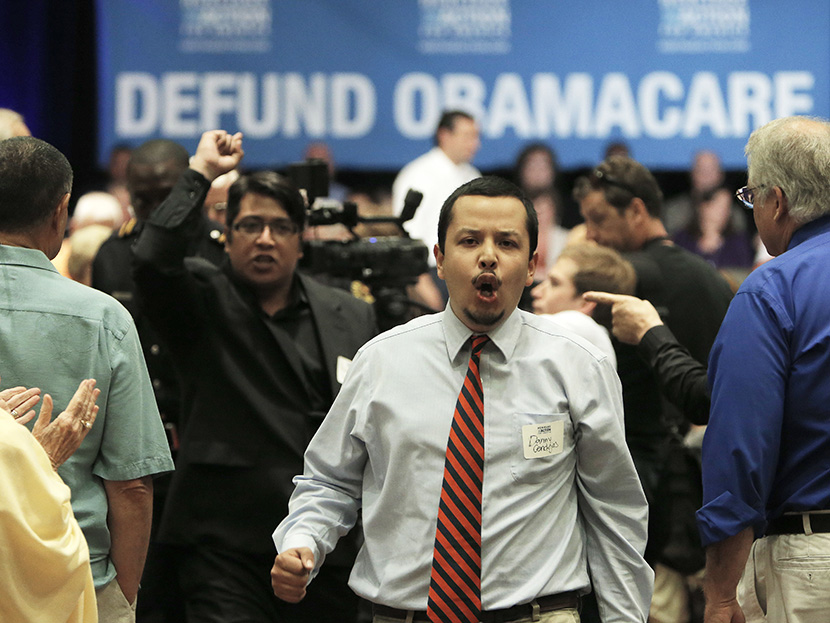
The Heritage Foundation is desperate for Congress to strangle Obamacare in the crib. Prevent the program’s major provisions from taking effect on Oct.1, the conservative Washington research foundation advises, by threatening to shut down the government. Heritage President Jim DeMint just launched a nine-city “Defund Obamacare” tour, sponsored by Heritage’s advocacy arm, Heritage Action. It’s all very scholarly.
Obamacare must be stopped, according to Heritage, because it’s expensive, imposes new taxes, and tramples on individual liberty.
But the punchline is that Obamacare is largely Heritage’s own invention.
It may not be news that a conservative Washington think tank is going to great lengths to defeat a Democratic policy proposal. But this may be the first instance where the policy being opposed was incubated at the very same think tank. Look out, donors: the policies you pay Heritage to develop today may be policies you pay Heritage to defeat tomorrow. It’s like Victor Frankenstein stumbling over the frozen tundra to defeat the creation he was so proud of but now despises.
In this instance Dr. Frankenstein is Stuart Butler, then director of domestic policy research at Heritage and, since 2010, director of Heritage’s Center For Policy Innovation. (No, they didn’t fire him.) Butler’s greatest claim to fame is that he developed the idea of “enterprise zones,” i.e., lowering taxes in certain low-income areas to promote economic development. But his greater accomplishment—shhhh!—is that he developed two central ideas in Obamacare: an individual mandate requiring everyone to purchase health insurance, and expansion of Medicaid coverage to the working poor.
Butler wrote a 1989 pamphlet titled A National Health System For America in collaboration with Edmund Haislmaier (then a health care policy analyst at Heritage and now a senior research fellow there—no, they didn’t fire him, either). The pamphlet is not currently available on Heritage’s Web site (it can be purchased online), but a 1989 lecture by Butler (“Assuring Affordable Healthcare For All Americans”) is, and a more readable version is available on the Web site HealthCareReform.ProCon.org.
In the lecture, Butler said:
Many states now require passengers in automobiles to wear seatbelts for their own protection. Many others require anybody driving a car to have liability insurance. But neither the federal government nor any state requires all households to protect themselves from the potentially catastrophic costs of a serious accident or illness. Under the Heritage plan, there would be such a requirement.
That’s the individual mandate. Butler didn’t invent the idea—it was, according to Butler’s assistant, also promoted three years earlier in a paper by Randall R. Bovbjerg and William G. Kopit—but that doesn’t get Butler off the hook. Bovbjerg was then (and remains) a scholar at the Urban Institute, a mildly liberal Washington think tank. (In fairness to Butler, something like an individual mandate was also favored by the conservative economist Milton Friedman. Conservatism has shifted dramatically rightward during the past two decades.)
In the 1989 lecture, Butler also said
a new index of eligibility would be developed to link Medicaid coverage to poverty instead of welfare. This is an important distinction, because many poor families struggling to keep off welfare currently risk enormous and uncovered medical bills because they are not eligible, or do not seek, to go on to the welfare rolls.
That’s the Medicaid expansion—though, to be fair, Butler wasn’t the only person then calling for loosened Medicaid eligibility requirements. Many conservatives at that time were looking for ways to reward the working (“deserving”) poor as distinct from the welfare-dependent poor—a concern that faded after the 1996 welfare-reform bill eliminated long-term dependence on cash payments, making many more of the poor “deserving.”
One significant departure Butler makes from Obamacare is that he does not (at least in the 1989 lecture) favor “community rating,” i.e., a requirement that insurers take all comers regardless of pre-existing conditions and charge them approximately the same premium. But this is not a difference Heritage is likely to advertise now, because community rating is the one part of Obamacare so popular that most conservatives dare not openly oppose it.
In the lecture, Butler repeatedly called his proposal “the Heritage plan”– not “my plan.” He elaborated these ideas in a 1990 backgrounder and in a 1993 paper titled “Why Conservatives Need A National Health Plan.” In none of these writings did Butler make explicit mention of government-run insurance exchanges. But Butler favored severing health insurance entirely from the workplace—a good idea that was too far left for Obama to favor—by eliminating the tax deduction that employers receive for it. Under Butler’s (whoops, make that Heritage’s) scheme, everyone would have to purchase his or her own health insurance. Butler proposed a consumer-choice system in which the government “set broad rules of the ‘game,’” and the context strongly suggested that by “government” Butler meant “federal government.” That sounds an awful lot like insurance exchanges, which President Obama has used similar language to describe. Butler also mentioned as one model the Federal Health Employee Benefits Program, which was one model for Obamacare. A decade later, when Massachusetts Gov. Mitt Romney was putting together a state-level health reform plan that was another model for Obamacare, Heritage “helped us construct an exchange,” according to Romney’s 2010 book, No Apology. In a 2012 op-ed, Butler emphasized some hair-splitting differences on the individual mandate (his was motivated by a desire not to protect the policyholder but to “protect others”) and added for good measure that he’s since changed his mind. Meanwhile, Heritage, in a 2011 amicus curiae brief submitted in support of the legal challenge to Obamacare, stated, “Heritage has stopped supporting any insurance mandate.” Heritage also said it had come to believe the individual mandate was unconstitutional—an interpretation later rejected, of course, by the Supreme Court. Mainly, though, Heritage denies that it ever favored a health plan that remotely resembled Obamacare. Conceding this point too conspicuously would compromise its splashy campaign to defeat Obamacare by any means necessary. How can Obamacare be the work of the devil if much of that work was done at Heritage? A subject, perhaps, for future scholarly inquiry.
Timothy Noah Recommended


