








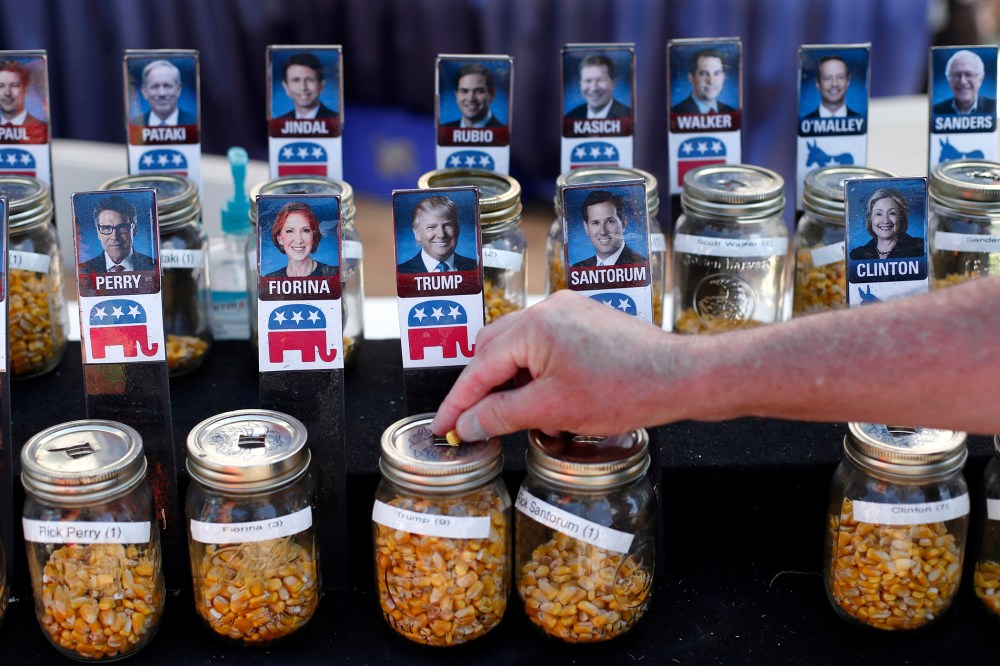
The presidential election is still a year away and the actual voting doesn’t even begin until Iowans head to caucus sites three months from now. There’s plenty of inevitable twists and turns in store between now and Election Day in 2016.
Consider what has happened so far that few would have guessed: The entrance of nearly two dozen candidates into the race, almost half a dozen have already dropped out (including one-time front-runner Scott Walker), one highly anticipated campaign never came to be (Joe Biden) and the rise of a reality television star and a pediatric neurosurgeon.
But there are some take-it-to-the-bank parts of a presidential campaign, including the process of a presidential cycle. Here’s a viewers guide to help understand the rhythms of campaign 2016:
RELATED: How Democrats can keep the White House in 2016
The fall of 2015: The winnowing
The fall before an election year is a critical time for presidential campaigns. Most of the candidates have been on the trail in Iowa and New Hampshire for months at this point and have spent countless hours raising money and hashing out the issues. Now it’s time to use all that preparation as more voters begin to tune into the race.
So the fall is busy with candidates visiting early nominating states, participating in debates, raising money, retooling strategy and staff and fulfilling requirements to appear on state ballots — all critical components to building a successful and long-lasting campaign. It doesn’t seem different from their summer days but the stakes are growing ever higher.
The polls begin to roll in and each one is given more weight than the last. Some candidates are already out of the race while others fight to remain relevant. Move forward or get lost in the shuffle, it’s the winnowing season for the field.
Winter 2016: The contests
February 1 is the first nominating contest. It takes place in Iowa and that’s why the candidates spend so much time there, appealing to the active members of the party to spend an Iowa winter night to support candidates of choice. The caucuses aren’t as easy as pushing a button on a voting machine. It’s a process where you stand in a room with as many as several hundred of your neighbors and coral in the corner designated for your candidate.
The onus on the campaign is to not only campaign in the state but to teach Iowans how to caucus for them. And the candidate with the most loyal — and largest — following does the best.
After Iowa is the New Hampshire primary on February 10. Also known as the First In The Nation primary, it’s a coveted position to Granite State voters who relish their ability to influence the race. What about Iowa you ask? Technically First In The Nation is an accurate term because while Iowans caucus, New Hampshire voters head to the voting booth: an actual primary.
After the first two states, the Democratic and Republican calendars diverge. Democrats in Nevada hold their caucuses on Saturday, February 20, while South Carolina Republican voters head to the polls on that same day.
Then Republicans turn their attention to Nevada on February 20 and Democratic focus goes next to South Carolina for a primary on February 27.
By February 27 the first four states will have weighed in for both Republicans and Democrats.
Then March is a busy month with caucuses or primaries every Tuesday and half of the Saturday. By the end of the month voters in nearly 30 states will have had their say.
RELATED: How the Republicans can win the White House in 2016
The spring of 2016: A nominee?
In many presidential years, the nominee is usually decided by the time 30 states vote. To achieve the nomination, candidates have to win a majority of delegates. Most delegates are awarded to candidates who win the primary or caucus in each state.
Mitt Romney clinched the nomination on March 29 in 2012. In 2008, John McCain won the nomination on March 4 after Romney dropped out.
In 2008, then-Senator Barack Obama beat Hillary Clinton after a drawn-out primary that lasted into June.
The more populous the states the more delegates are awarded. For instance, on the Republican side, New Hampshire awards only 23 delegates while Texas awards 155.
Republicans must win 1,236 delegates out of 2,470. Democrats need about 1,200 delegates to win of around 2,383 available — a number that could change slightly between now and the convention. That math works out that a candidate can shore up enough delegates after the March 15 primary where Florida, Illinois, Missouri, North Carolina and the Northern Mariana Islands votes. The first four nominating states — Iowa, New Hampshire, South Carolina and Nevada — only offer about 10% of the number of delegates needed for a candidate to win. Why is so much attention paid to those first states then? Momentum. If a candidate can win early states, the candidate receives a lot of media attention and interest from donors which turns feeds a perception of strength which influences voters in succeeding states. Politics is a game of perception. Those who play it best win. The summer of 2016: The season of pomp and circumstance Washington, D.C. is the last to hold its primary, which will take place on June 14. By that point nominees in both parties are very likely to be determined. After the states and territories vote in the primary, the parties hold their nominating convention. While the conventions used to be the place where the party faithful chose their nominee, in modern day politics the conventions are mostly pep rallies for the nominee: an opportunity to rally around a candidates. Conventions do have one practical — and traditional — role: They signify the start of the general election, which means candidates must use a different pot of money raised and adhere to another set of campaign finance rules. The Republican convention in Cleveland is July 18 – 21 and the Democratic convention in Philadelphia is July 25 – 28 in Philadelphia. The fall of 2016: The home stretch Candidates are in the final throngs of campaigning: visiting key battleground states, blanketing the airwaves with advertisements and participating in debates. The debates are critical junctures in the general election that have impacted campaigns. In 2012, for instance, President Barack Obama’s bad debate performance could have hindered his reelection chances except he had a much better subsequent debate against Mitt Romney, helping to salvage his campaign. Election Day is November 8 — the first Tuesday after the first Monday in November, which was set by Congress in 1845. But candidates must take into consideration that Election Day for many is long before November 8. Millions of Americans in 36 states are able to vote during periods of early voting or can mail in their ballots.
Leigh Ann Caldwell Recommended


