








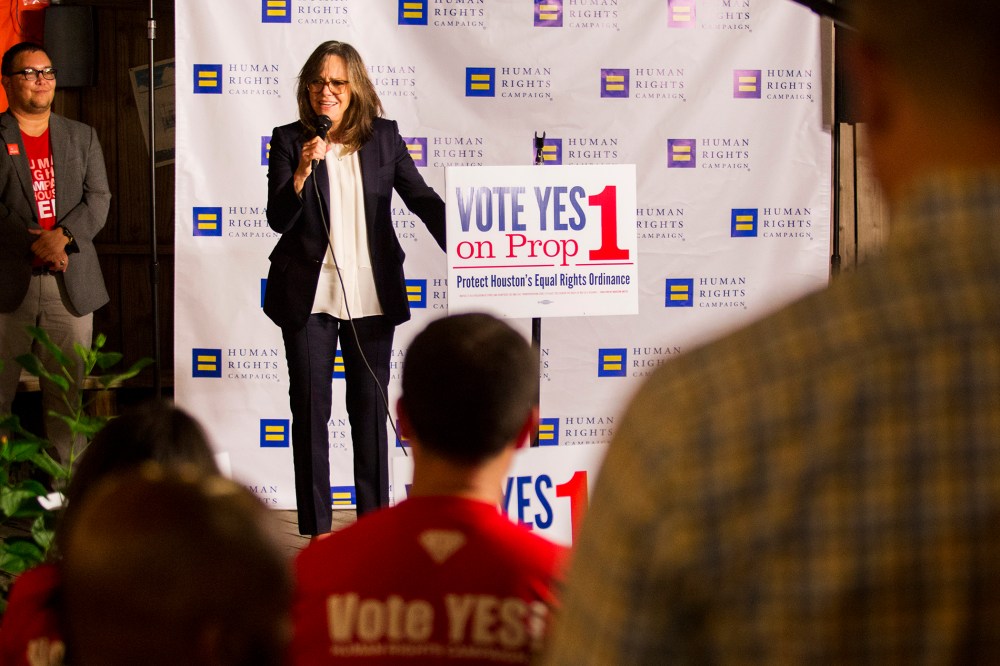
In what will be the grand finale of the season’s marquee political showdown over LGBT rights, Houston voters are set to decide Tuesday whether to ban discrimination in employment, housing, and public accommodations on the basis of sexual orientation and gender identity.
The vote on Proposition 1, otherwise known as the Houston Equal Rights Ordinance (HERO), stands to settle more than a year of contentious campaigning on both sides of the issue and potentially signal to the rest of the nation how similar battles for nondiscrimination protections — the centerpiece of the LGBT equality agenda now that same-sex marriage has been legalized — will play out.
RELATED: Transgender rights gives rise to a new kind of ‘potty problem’
If adopted, HERO will prohibit discrimination in city employment, city services, city contracting practices, housing, public accommodations, and private employment on the basis of 15 protected characteristics, including sexual orientation and gender identity — thus going further than both federal and state law. The ordinance would also establish explicit prohibitions in the city’s code against discrimination based on sex, race, color, ethnicity, national origin, age, familial status, marital status, military status, religion, disability, genetic information, and pregnancy — characteristics already protected under federal law.
HOUSTON: Vote Texas values, not @HillaryClinton values. Vote NO on City of Houston Proposition 1. No men in women's bathrooms.
— Greg Abbott (@GregAbbott_TX) November 2, 2015HERO has won numerous supporters, ranging from local business leaders to Hollywood celebrities and presidential candidates (the Democratic ones, at least). But opponents have a different nickname for the measure: “the bathroom ordinance,” capturing their central concern that HERO will allow male predators to prey on women and girls in the restroom.
“Any man at any time could enter a woman’s bathroom simply by claiming to be a woman that day,” states a TV spot paid for by the anti-HERO group, Campaign for Houston. “No one is exempt. Even registered sex offenders could follow women or young girls into the bathroom. And if a business tried to stop them, they’d be fined.”
That narrative has stretched all the way to the top of Texas’ government. On the eve of Tuesday’s referendum, Republican Gov. Greg Abbott took aim at the ordinance on Twitter, urging Houstonians to “vote Texas values, not @HillaryClinton values.”
“No men in women’s bathrooms,” the tweet said. But LGBT advocates insist such warnings are baseless.
“We don’t know of a single documented instance in which a person committing sexual assault or harassment in a restroom was transgender or pretending to be transgender,” said Matt McTighe, executive director of the LGBT advocacy group Freedom for All Americans, in an email. “What we do know is seventeen states and more than 200 cities have already passed nondiscrimination laws similar to HERO — including Dallas, San Antonio, and El Paso — and the laws have been put into place successfully, with no increase in public safety incidents. This ordinance doesn’t change the fact that it’s already illegal to assault someone in a restroom or anywhere else.”
Richard Carlbom, campaign manager of the pro-HERO group Houston Unites, went even further, calling claims that nondiscrimination ordinances could lead to bathroom harassment or assault “an outright lie.” A spokesman for the Campaign for Houston did not respond to MSNBC’s request for evidence to the contrary.
HERO’s journey to the ballot has been long and litigious. The ordinance actually cleared the City Council back in May 2014, but was only in effect for a brief period of three months. Immediately after its passage, opponents submitted a petition to have HERO struck from the books and put to the voters.
The city rejected that petition, however, concluding that HERO’s opponents — mainly Christian pastors — hadn’t collected enough valid signatures. Opponents sued. And as part of the case’s discovery phase, city attorneys subpoenaed “all speeches, presentations, or sermons related to HERO, the Petition, Mayor Annise Parker, homosexuality, or gender identity prepared by, delivered by, revised by, or approved by” five local pastors who were tied to the repeal referendum. Houston attorneys eventually rescinded their request amid national public outcry. But for religious freedom advocates, the damage had already been done. On Monday, Texas Sen. Ted Cruz, who’s campaigning for the Republican presidential nomination in large part on a platform of protecting religious liberty, announced that one of the pastors whose sermons were subpoenaed would be featured at his religious liberty rally later this month in South Carolina. Last year, Cruz blasted the subpoenas as “both shocking and shameful.” His father, meanwhile, recently said it was “appalling” that Houston even elected a lesbian mayor. (Parker is the first openly lesbian mayor of a major U.S. city.) The case eventually reached the Texas Supreme Court, which ruled in July that Houston must hold a vote on HERO or repeal it entirely — a decision that paved the way for Tuesday’s showdown. While recent polling conducted by KHOU found 43% of likely voters in favor of HERO with 37% against it, one in five voters said they were still undecided. Based off early voting, meanwhile, which ended Friday and saw particularly high turnout in precincts likely to oppose the ordinance, at least one pollster now predicts HERO will fail. RELATED: Cruz warns of ‘war on faith’ at religious freedom rally If that happens, LGBT advocates warn dire consequences for Houston, the nation’s fourth largest city and one of its most diverse. In the past couple years, states such as Arizona, Arkansas and Indiana experienced massive backlash for advancing religious freedoms laws viewed as anti-LGBT, and HERO supporters anticipate Houston could face a similar fate. More than 60 businesses throughout the city have so far endorsed Proposition 1, according to Houston Unites, as have major companies such as Hewlett Packard, General Electric and Apple. In one of the worst case scenarios, the National Football League could decide to pull the 2017 Super Bowl from Houston, a move that would cost the city millions in revenue. The NFL hasn’t directly addressed HERO, but the organization played a major role in killing Arizona’s religious freedom measure when that state was slated to host the Super Bowl in 2014. “If this fails tomorrow, the city of Houston is going to have to do some work to ensure to people that Houston is a safe place for people to attend conferences and major events and be free from discrimination,” Carlbom of Houston Unites said Monday. “Houston is the only city in the top 10, population-wise, that doesn’t have this local [ordinance.]” Still, Carlbom quickly tamped down any cause for concern. “We are counting on winning tomorrow,” he said.
Emma Margolin
Emma Margolin is a reporter at MSNBC.com. Recommended


