The Rachel Maddow Show WEEKNIGHTS 9PM ETMorning Joe WEEKDAYS 6AM ETDeadline: White House with Nicolle Wallace Weekdays 4PM ETThe Beat with Ari Melber Weeknights 6PM ETThe Weeknight Weeknights 7PM ETAll in with Chris Hayes TUESDAY-FRIDAY 8PM ETThe Briefing with Jen Psaki TUESDAYS – FRIDAYS 9PM ETThe Last Word with Lawrence O’Donnel Weeknights 10PM ETThe 11th Hour with Stephanie Ruhle Weeknights 11PM ET
Today marks the 50th anniversary of Betty Friedan’s controversial bestseller, The Feminine Mystique.
Coontz-A Strange pb
By
Abby Borovitz
Today marks the 50th anniversary of Betty Friedan’s controversial bestseller, The Feminine Mystique. The bestseller ignited an international uproar with its claim that millions of housewives were unhappy and its call for them to get out of the kitchen and into the workplace. But after 50 years where exactly do we stand.
Few can deny that there has been a revolution in gender roles. In 1962 the President’s Commission on the Status of Women documented the gender inequalities that then pervaded American society and the Equal Pay Act for woman became a law ensuring women got paid for the work that they did. But, there is still considerable debate about if men and women are treated fairly in the workplace.
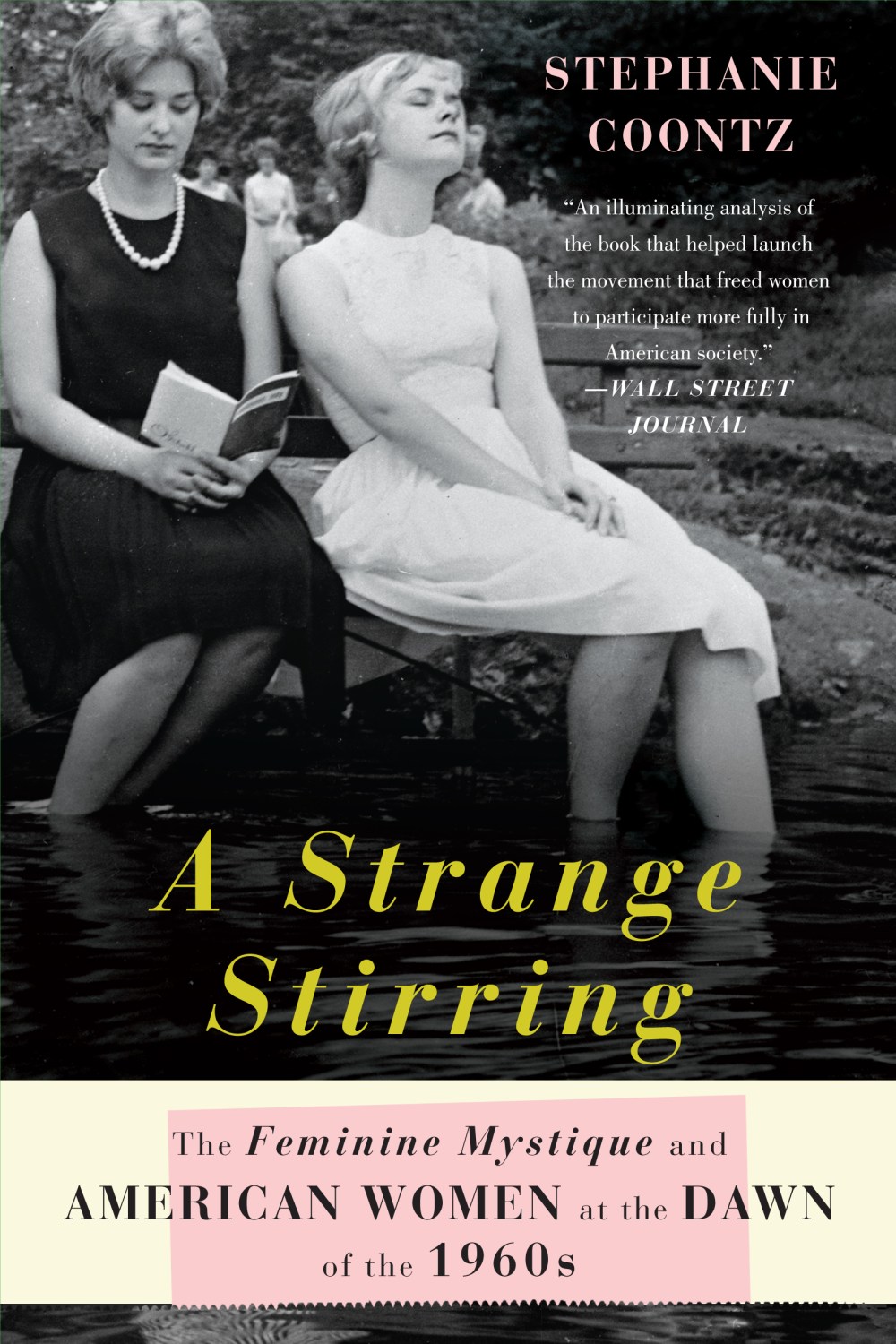
Joining today’s show is historian Stephanie Coontz author of A Strange Stirring: the Feminine Mystique and American Women at the Dawn of the 1960’s. In her book she draws on research into popular culture of the 40s, 50s, and 60s, and interviews with nearly 200 women who read The Feminine Mystique shortly after it was published.
Be sure to tune in for the full conversation at 3:40 p.m. and check out an excerpt from her book below.
NEARLY HALF A CENTURY AFTER ITS PUBLICATION, BETTY FRIEDAN’S 1963best seller, The Feminine Mystique, still generates extreme reactions, bothpro and con. In 2006, it was ranked thirty-seventh on a list of the twentiethcentury’s best works of journalism, compiled by a panel of expertsassembled by New York University’s journalism department. But whenthe editors of the right-wing magazine Human Events compiled their ownlist of “the ten most harmful books of the nineteenth and twentieth centuries”in 2007, they put The Feminine Mystique at number seven—notfar below Hitler’s Mein Kampf.The Feminine Mystique has been credited—or blamed—for destroying,single-handedly and almost overnight, the 1950s consensus that women’splace was in the home. Friedan’s book “pulled the trigger on history,” inthe words of Future Shock author Alvin Toffler. Her writing “awakenedwomen to their oppression,” according to a fellow leader of the NationalOrganization for Women, which Friedan helped establish a few yearsafter The Feminine Mystique hit the best-seller list. Following Friedan’sdeath at age eighty-five in February 2006, dozens of news accounts reportedthat The Feminine Mystique ignited the women’s movement,launched a social revolution, and “transformed the social fabric” of theUnited States and countries around the world.Opponents of the feminist movement are equally convinced that TheFeminine Mystique revolutionized America, but they believe the bookchanged things for the worse. Prior to Betty Friedan, wrote one author,middle-class women “were living in peace in what they considered to bea normal, traditional, worthwhile lifestyle.” Since The Feminine Mystique,“life has never been the same.” In her 2006 book, Women Who Made theWorld Worse, National Review’s Kate O’Beirne complained that Friedan
persuaded women that “selfless devotion was a recipe for misery.” LauraSchlessinger, of the Dr. Laura radio show, has charged that The FeminineMystique’s disparagement “of so-called ‘women’s work’ . . . turned familylife upside down and wrenched women from their homes.” And ChristinaHoff Sommers of the American Enterprise Institute wrote in September2008 that although The Feminine Mystique was correct in pointing outthat postwar America took the ideal of femininity “to absurd extremes,”the book was also the source of “modern feminism’s Original Sin”—anattack on stay-at-home motherhood. Friedan’s book “did indeed pull thetrigger on history,” Sommers concludes, but in doing so, she “took aim atthe lives of millions of American women.”Even people who have never read the book often react strongly to itstitle. In addition to interviewing people who had read The Feminine Mystiquewhen it first came out, I asked others who had never read it to tellme what they knew about it. Their responses were surprisingly specificand vehement. The book was “full of drivel about how women had beenmystified and tricked into being homemakers,” opined one woman. Anotherreported that the book explained how women’s sexuality had beencontrolled through the ages and assured me that Friedan had called foran end to marital rape and sexual harassment—ideas that do not appearanywhere in the book’s 350-plus pages. The grandmother of a student ofmine insisted that this was the book that “told women to burn their bras.”Another student’s mother told her that The Feminine Mystique documentedhow women in the 1950s were excluded from many legal rightsand paid much less than men—although in fact the book spends verylittle time discussing legal and economic discrimination against women.Interestingly, many women I talked with were initially sure they hadread The Feminine Mystique, only to discover in the course of our discussionsor correspondence that they actually had not. When they tried toexplain the gap between what they “remembered” and what I told themthe book actually said, they usually decided that the title had conjuredup such a vivid image in their minds that over time they had come to believethey had read it.
As a matter of fact, I was one such person. I first heard of The FeminineMystique when I was an undergraduate at the University of Californiaat Berkeley in 1964. But I didn’t hear about it from “Berkeleyradicals.” Instead, it was my mother, a homemaker in Salt Lake City,Utah, who told me about it. She had attended the University of Washingtonat the end of the 1930s and married my father in the early 1940s.While Dad was away during World War II, she had done her part for thewar effort, working in a shipyard. After the war ended, she quit work tofollow my dad around the country as he went to college on the GI Bill,attended graduate school, and established himself in his career.Mom spent most of the 1950s raising my sister and me. But by theearly 1960s, with me away at college and my sister in junior high school,Mom began to get involved in civic activities. Soon she took a payingpart-time job as executive secretary of a community group.Once a week she would call me at college and we would fill eachother in on what we were doing and thinking. At one point she asked anxiouslywhether I thought she could handle going back to school to gether master’s degree. At other times she proudly detailed her most recentaccomplishments. Once she recounted how bored, lonely, and insecureshe had felt as a housewife. The cause, she had recently discovered, wasthat she had succumbed to an insidious “feminine mystique,” which shehad recognized only when she read this new book by Betty Friedan.“Do you know that sociologists misrepresent research to make womenfeel guilty if they aren’t completely happy as full-time housewives?” sheasked. Wasn’t it scandalous that when a woman expressed aspirations foranything else in her life, psychiatrists tried to make her think she wassexually maladjusted? Was I aware that advertisers manipulated womeninto thinking that doing household chores was a creative act, and hadhousewives spending more time on it than they really needed to? “Theycan make a cake mix that tastes perfectly fine if you just add water. But thebox tells us to add an egg so housewives will feel we’re actually baking!”I remember listening to my mother’s grievances with a certain amountof impatience, feeling that they were irrelevant to my own life. My friends
and I certainly weren’t going to be just housewives. Looking back, I amashamed to admit that at the time I believed it was largely a woman’s ownfault if she wasn’t strong enough to defy social expectations and followher dreams. But it is even sadder to realize, as I did while conducting interviewsfor this book, that most of these women also believed their problemswere their own fault.I was vaguely aware that women had once organized a long, hard fightto win the right to vote, but that was in the distant past. Far from identifyingwith other women, I—like many other independent women myage—prided myself on being unlike the rest of my sex. In the memorablewords of feminist activist and author Jo Freeman, we grew up “believingthere were three sexes: men, women, and me.” We knew we didn’t wantto follow in our mothers’ footsteps, but it did not yet occur to us that itmight require more than an individual decision to chart our own course,that we would need an organized movement to pry open new opportunitiesand overturn old prejudices. The only movement that really meant somethingto us in the early 1960s was the burgeoning civil rights movement.It took a few years for female civil rights activists such as myself tobegin to see that we too were subject to many societal prejudices becauseof our sex. Only gradually, quite a while after the book had inspired mymother and many other housewives, did my friends and I begin to use“the feminine mystique” as a useful label to describe the prejudices anddiscrimination we encountered.In fact, it was soon so useful that at some point, long ago, the phrase“feminine mystique” became such a part of my consciousness that I wasabsolutely sure I had read Friedan’s book. So when JoAnn Miller, an editorat Basic Books, suggested that I write a biography not of Betty Friedanthe author, but of the book she wrote, I jumped at the chance. I was certainthat rereading this groundbreaking book would be an educationaland inspiring experience. I also decided that I would assign The FeminineMystique to my students to gauge how they would react to a book thathad been so influential to an earlier generation.
After only a few pages I realized that in fact I had never read TheFeminine Mystique, and after a few chapters I began to find much of itboring and dated. As it turned out, so did my students. The book seemedrepetitive and overblown. It made claims about women’s history that Iknew were oversimplified, exaggerating both the feminist victories of the1920s and the antifeminist backlash of the 1940s and 1950s.I was interested by Friedan’s account of how she had “lived accordingto the feminine mystique as a suburban housewife” and only graduallycome to see that something was wrong with the way she and other Americanwomen were being told to organize their lives. But although the storyof her journey of discovery was engrossing, her generalizations aboutwomen seemed so limited by her white middle-class experience that Ithought the book’s prescriptions for improving women’s lives were irrelevantto working-class and African-American women.And Friedan’s warnings about “the homosexuality that is spreadinglike a murky smog over the American scene” sounded more like somethingthat would come out of the mouth of a right-wing televangelist than a contemporaryfeminist. So too did her alarmist talk about permissive parenting,narcissistic self-indulgence, juvenile delinquency, and female promiscuity.My initial reaction became more negative when I went on to discoverthat Friedan had misrepresented her own history and the origins of herideas. Checking her account of the publishing history and reception ofThe Feminine Mystique against the actual historical record, I discovereddisturbing discrepancies. I was put off by her egotism, which even her mostardent admirers have acknowledged was “towering,” and disliked her tendencyto pump up her own accomplishments by claiming that the media,and even her own publisher, were almost uniformly hostile to her views.I was also indignant that Friedan portrayed all women in that era aspassive and preoccupied with their homes. What about the African-American women who had led civil rights demonstrations and organizedcommunity actions throughout the 1950s and early ’60s, standing up toracist mobs and police brutality—women such as Rosa Parks, Daisy Bates,
Ella Baker, Septima Clark, Dorothy Height, and so many more? Whatabout the female labor organizers of the 1950s or the thousands of motherswho risked arrest in 1959 and 1960, pushing their children in strollers,to protest the mandatory air raid drills that they believed taught Americansto accept the possibility of nuclear war?