








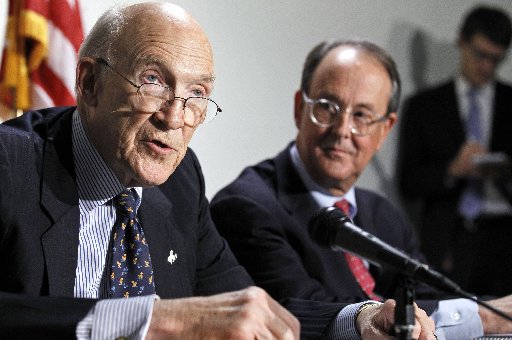
Alan Simpson and Erskine Bowles, the Washington budget sages behind the ubiquitous Simpson-Bowles plan, have released a new version of their old plan to cut the federal deficit by trillions of dollars.
“It is time for our country to put this ultra-partisanship aside and pull together, not apart,” they write in “A Bipartisan Path Forward To Securing America’s Future,” the report issued on Tuesday morning. “We must do it for our grandchildren; we must do it for ourselves; we must do it for our country.”
The plan includes cuts to Medicare and Medicaid, “reforms” to Social Security, chained CPI, and the elimination or reduction of various tax deductions. Notably, many of the most significant cuts seem to fall on programs which benefit seniors. In the report, Simpson and Bowles argue that “the aging of the population represents a significant driver of our growing debt.”
All told, the new Simpson-Bowles plan is distinguishable from the old Simpson-Bowles plan largely by the fact that it sets a higher benchmark for how many cuts are needed.
The original Simpson-Bowles plan, released by the White House’s National Commission on Fiscal Responsibility and Reform, called for $4 trillion in total deficit reduction. In his 2013 State of the Union, President Obama noted that the government had already eliminated $2.5 trillion from the deficit, leaving $1.5 trillion left to be achieved. However, according to the new Simpson-Bowles plan, the government needs to cut at least $2.4 trillion more over the next ten years, adding nearly an additional trillion dollars to the benchmark.
The new $2.4 trillion figure seems to come from a recent report by the Committee for a Responsible Budget, the umbrella organization for Simpson and Bowles’ pro-cuts lobbying group, Fix the Debt. In the report, released on February 11, the Committee for a Responsible Budget calls cutting only an additional $1.5 trillion “dangerous,” because “it would leave no margin for error, would result in slower economic growth, would leave little fiscal flexibility, and would have little chance of stabilizing the debt beyond the ten-year window.” [Emphasis theirs.]
“For these reasons,” the report goes on, “we believe the debt must be not only stable, but on a clear downward path by the end of the decade.”
Slate economics blogger Matthew Yglesias was unimpressed, suggesting that Simpson and Bowles had other reasons for scrapping the $1.5 trillion benchmark. “The reason Simpson and Bowles are moving the goalposts is that thus far none of the deficit reduction has cut spending on programs designed to bolster the living standards of the elderly,” he wrote, “and what Simpson and Bowles think America should do is cut spending on programs designed to bolster the living standards of the elderly.”
Simpson and Bowles unveiled the new plan at a Tuesday morning breakfast, sponsored by Politico, in Washington D.C.’s Newseum. During their presentation, they were heckled by protesters who demanded that they pay “[their] fair share of taxes.” UPDATE (2/20/2013): Jason Peuquet, research director for the Committee for a Responsible Budget, told msnbc over email that “total spending cuts and revenues” in the new Simpson-Bowles plan are in fact less than in the original. The savings in the 2010 plan “were against a baseline that already assumed the upper-income tax cuts … would expire,” wrote Peuquet. “Since 2010, however, most ‘current policy’ baselines have changed to assume that all the tax cuts and AMT patches [adjustments to the Alternative Minimum Tax] would be fully continued—a difference of about $900 billion through 2023.” From the current baseline, wrote Pequet, the original plan would actually call for $6.5 trillion instead of $4 trillion—meaning, he said, that the new baseline of $5.1 trillion is actually a more modest goal.
Ned Resnikoff is an urban policy analyst, researcher, writer, and editor. His byline has appeared in a variety of publications, including the New York Times, San Francisco Chronicle, Dissent, and The Nation. He writes the newsletter Public Comment, which can be found at publiccomment.blog. Recommended


