








HANOVER, New Hampshire – Laura Dunn was a college freshman living on the University of Wisconsin’s pastoral campus in Madison when she was raped. Her assailants, she said, were two males from the crew team. She filed a complaint with the school and law enforcement. No one was charged, no one was even suspended.
Close to 10 years after the assault, Dunn — now a law school graduate and founder of a survivor advocacy group — choked back tears describing the attack to a room of 200 people at a conference on campus sexual assault. “I broke the norm by actually reporting, both to my campus and to the police. I do not have justice. That is the reality of campus sexual assault as of today,” Dunn said.
Dunn said she had been drinking the night of the rape which is one reason why, she believes, no action was taken. ”It is commonplace to think that it is acceptable to sexually prey on individuals who are intoxicated.”
%22I%20broke%20the%20norm%20by%20actually%20reporting%2C%20both%20to%20my%20campus%20and%20to%20the%20police.%20I%20do%20not%20have%20justice.%22′
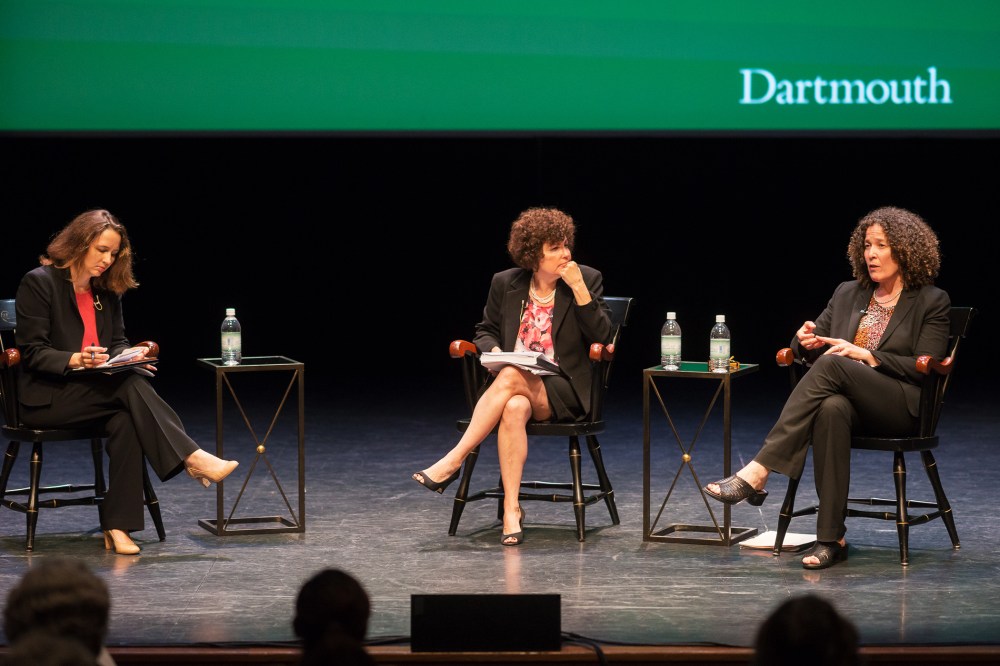
It was not lost on the room that Dunn shared her story at Dartmouth College, whose reputation has been tinged by accusations of rape, retaliation, online harassment, hazing, and bullying. The president of Dartmouth recently railed against “extreme behavior” on the campus and vowed to fight the school’s culture of fraternity-driven heavy drinking, racism and sexism.
It is experiences like Dunn’s that were at the center of every conversation that took place during the two-day Summit on Sexual Assault. Despite federal laws that require schools respond to and report sexual violence, stories from current and former college students of repeated failures to take assault and cases seriously, and promises from the White House, what happens between now and a fall semester free of sexual assault is a mystery to almost everyone.
Representatives from 64 schools, including Dartmouth, attended the four-day conference aimed at improving prevention efforts on college campuses, creating supportive response systems for victims and disciplinary systems that respect student rights and comply with federal civil rights laws.
Questions to representatives from the Department of Education, Department of Justice, and members of the White House task force dedicated to campus sexual assault made it clear that schools are simply lost when it comes to dealing with sexual assault.
Title IX, the Clery Act and the soon-to-be-implemented Campus Sexual Violence Elimination Act (SaVE) cover civil rights protections and campus crime statistics for a wide range of dating and sexual violence and harassment, but the laws often overlap.
Dartmouth, along with 63 other schools, including many represented at the summit, are currently under investigation by the Department of Education for possible Title IX violations.
Catherin Lhamon, Assistant Secretary of Civil Rights in the Department of Education, says schools don’t get points for trying hard. “If a school refuses to comply with Title IX in any respect, I will enforce” penalties, Lhamon said.
No school has ever lost federal funding for violating Title IX.
New data suggests that the schools represented at the conference, many of which are under investigation for Title IX violations for bumbling sexual assault cases, are actually doing better than many of the some 7,000 higher education institutions around the country. A survey conducted by Sen. Claire McCaskill, D-Missouri, found that some 10% of schools don’t have Title IX coordinators, one of the most basic parts of the law.
Since a White House task force convened by President Obama issued recommendations in April, anonymous surveys of campus climates have emerged as a way to gather reliable, honest data. And when McCaskill announced the results of her own survey, she found that only 16% of schools conduct anonymous surveys.
Lynn Rosenthal and Bea Hanson, two members of the White House’s Council on Violence Against Women, talked about climate surveys at the conference Tuesday and suggested that schools could keep the results secret. But when John Kelly, a Tufts University student and assault survivor, testified before a Senate committee in June, he said the lack of transparency on accurate information prevents students from making informed decisions about their educations.
There are no clear models for schools to follow if administrators are looking for examples. When asked what schools are doing well, Hanson singled out the University of Montana for making great strides to improve its climate and policies. A 2012 Justice Department inquiry into the county police department found that rape allegations in Missoula were regularly ignored, and the school entered into agreements with the Department of Education in 2013 to change its policies. Dr. David Lisak, one of the country’s leading researchers on sexual violence and an organizer of the summit, said Monday that without students like Dunn and Kelly and the dozens of others who have filed Title IX complaints against schools for mishandling their cases, students would still have to fight for justice alone and in the shadows. “Survivors have shifted the landscape such that we find ourselves here today,” Lisak said. “Survivors of sexual violence are not alone.” %22We%20need%20students%20and%20survivors%20to%20be%20holding%20all%20of%20us%20accountable.%22′ Dana Bolger, a founding co-director of Know Your IX, a student-led campaign to combat sexual violence did not attend the summit, and questioned how a conference held at a school with such a terrible track record on sexual violence could be taken seriously. “Having that university host a conference at which very few to zero student survivor activists spoke says to me that Dartmouth isn’t particularly interested in changing life on the ground for students,” Bolger said. The conference was open to anyone who paid a $300 registration fee and could afford to travel to New Hampshire, a cost out of reach for many. Both conference organizers and government officials mentioned the lack of funding available for sexual assault prevention and response efforts. “Survivors are the people who have no problem saying there are tensions between what the colleges need to do and survivors’ rights and well-being,” Alexandra Arnold, a Dartmouth alumna and survivor advocate told msnbc. “It’s important to have all these people coming together to talk about best practices, but we need students and survivors to be holding all of us accountable.” In Dunn’s case, the University of Wisconsin concluded that alcohol and a lack of witnesses to the crime were both factors in declining to pursue disciplinary action. The school has not commented on the case — for privacy reasons, officials have said. But the standard for proving misconduct is now preponderance of evidence rather than “clear and convincing” evidence. Seeking justice, Dunn filed a Title IX complaint in 2006 against the University for violating her civil rights. While her complaint was eventually dismissed for insufficient evidence, it spurred her to speak out. “My goal is not prevention, it is to improve response. When we actually give justice to survivors who are brave enough to report, then we will stop the problem,” she said. The author is responding to your thoughts and questions in the comments — jump in!
Meredith Clark
Meredith Clark is a freelance writer and editor. She was previously a senior news producer for "Patriot Act with Hasan Minhaj," a reporter with MSNBC.com, the digital politics and culture editor at Glamour and a senior news and politics editor at Refinery29. She has written for Vulture, Rolling Stone, Self, Marie Claire, Cosmopolitan, The Daily Beast and Bustle. Recommended


