









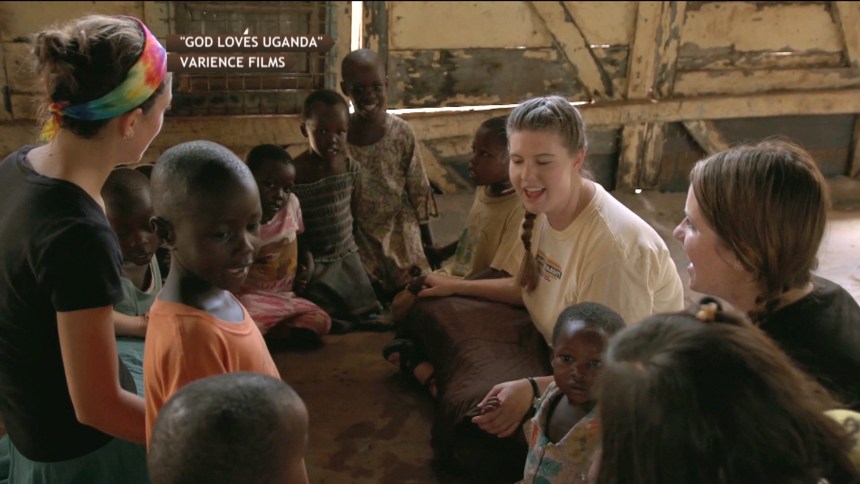
The new documentary God Loves Uganda, which premiered this week in New York, investigates the fight against “sexual immorality” by Ugandan leaders, and the impact of American missionaries on Ugandan cultures and values. Director and producer Roger Ross Williams is simultaneously launching a campaign called Keep Hate out of the Collection Plate in collaboration with AllOut.com. Williams describes the campaign as allowing “people to hold their pastors and churches accountable, so they know that the money they’re giving to feed orphans is actually going to feed orphans and do good work and not going to funding hatred and intolerance.”
Williams visited Melissa Harris-Perry on Saturday; I had a chance to interview him before the show.
MSNBC: Tell me about your background growing up in the church.
Roger Ross Williams: I grew up in the African-American Baptist church. My father was a leader in the church, my sister is a pastor, my uncle is a pastor of the church… For me, it gave me amazing sense of community, and yet also I felt not completely connected to the church as a black gay man.
MSNBC: Tell me more about the forces that drove you to make this film.
Williams: I think I first got the idea for the movie when I was shooting Music by Prudence in Zimbabwe. I noticed the hold of a type of very conservative Christianity had on Sub-Saharan Africa.
So on my first trip to Uganda I was shocked that most of the plane was filled with missionaries on the way there. And I found out that Uganda is the number one destination for American missionaries. Uganda is unique in that it’s a country that after the fall of Idi Amin, American missionaries came into that country and built a lot of schools and churches, so most of the schools, the hospitals are affiliated with American Christian fundamentalist organizations.
So they’ve done a lot of great work in Uganda, but along with that comes a certain message, and that’s a message of intolerance. Which has always been a part of my background, and my life; hearing this message that if you are a so-called “sinner,” meaning anything outside of the traditional marriage between a man and a woman, you are sort of cast out of the church.
MSNBC: What was it like being an openly gay man making this film in Uganda?
Williams: I felt uncomfortable being open and out in Uganda for obvious reasons – homosexuality is still illegal, and there’s a feeling of hostility everywhere. Homosexuals have become a scapegoat for many things in Uganda. What happened was while I was filming this I got outed. Someone sent an email to the missionaries I was following saying, “He’s gay, he’s part of the gay agenda,” and she sent it to all of the anti-gay pastors in Uganda. These pastors throw anti-gay hate rallies.
I didn’t know what was going to happen; it was a pretty scary moment. But they decided to pray for me, instead of hurt me. They decided they were going to cure me.
And I think Sub-Saharan African has become the dumping ground for these sorts of outdated ideas in America. And every American evangelical I talk to – every single one – told me the same thing: that they’re losing the cultural war here in America, but they’re winning the cultural war in the global south and in Africa.
Williams: Yeah, the way I approached it when I went to the International House Of Prayer (IHOP) I said, look… lots of people had gone to IHOP and tried to film there and they had turned people away; never let a crew of people from the outside – a non-Christian crew – come in.
I told them, “If you really believe in what you’re doing, if you believe that your work has the great commission to transform the work into your form of Christianity, then you need to stand by what you believe, stand up for what you believe in, and say it in on camera.”
And they thought about it and said, “Yeah, you’re right.” What Mike Bickle (the founder) said to me is, that people who believe what we believe will come to us, and those who don’t, we don’t care about.
The goal of the film is to have a dialogue between the two sides of faith. Sides like the Bishop Christopher side that believes that the church is open to everyone. And the Lou Engel side that believes the church is closed to those he perceives as sinners.
MSNBC: Did being an African-American play a role in your interest in making this film? Williams: This arrogant, colonialist, imperialist way of looking at Africa is as important to me as the issue around sexuality. To me, it was very upsetting to sit and watch a 20-year-old girl from America’s Midwest address a 70-year-old African woman and speak to her as though she was bringing her this knowledge and wisdom, as if this woman didn’t have her own set of beliefs and world view and history. I had a hard time gaining access because they were very uncomfortable with me filming them doing their groundwork. And it was very important for me to show the ground game. How this works. And I capture these kids who go – innocent, naïve, nice kids – who go to Africa with no concept of the culture they’re going into, and to give their wisdom to the “poor Africans.” And to me that is condescending and offensive… It was like they were so superior to these Africans they were trying to teach. MSNBC: What was your interaction like with Ugandans on the ground? Williams: I spent three years making this film, so I spent a lot of time with Ugandans. The anti-homosexuality bill, for instance, is extremely popular. But that’s not really what Ugandans really care about… It’s a wedge issue to detract from the real problems going on in the country, which are corruption, poverty, health, HIV… The list goes on and on. It’s a tool that’s used to distract people. MSNBC: Why is what is happening in Uganda important to Americans? Williams: I was a Grand Marshal at San Francisco Pride, and I said: while we celebrate the victories in America, while we are focused here, they’re winning. They’re winning the battles while we’re focused inward. It’s time for the equality movement to look beyond just your city and your state. We’re in a global environment now. If Russia or Uganda or any countries can pass these lows, it’s going to come back to bite us. So we need to be fighting the global struggle for equality, not just the local. MSNBC: Where does the Ugandan anti-homosexuality bill stand now? Williams: The bill is lingering in the Parliament, and that’s where it stands… It seems like every time the government wants to distract people they threaten to pass the bill, and the international community is in uproar, and there’s all this attention and everyone is talking about the bill, and then while everyone is looking the other way they pass things they want to pass.
Lorena Ruiz Recommended


