








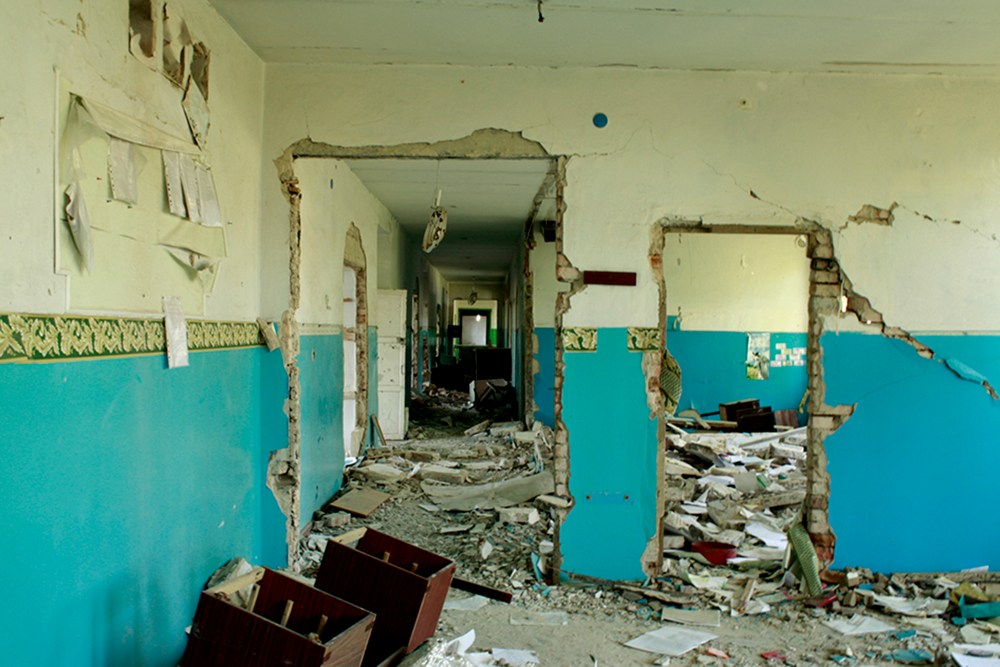
It’s September, the beginning of a new school year, but the children of the small village of Nikishine in eastern Ukraine no longer have a school to go to.
Before the war, 58 children attended the village school. Now, the ruins of the building look eerie in the blazing summer heat. There are gaping holes instead of windows, and huge chunks of the roof are missing. Inside the school, pieces of chairs and desks, mangled world maps and books are strewn across the floors, mixed with broken glass, half buried under piles of rubble. Classroom doors are shattered or torn off. Broken lights are hanging by the thread. The walls that are still standing are pockmarked by shrapnel and shell fragments.
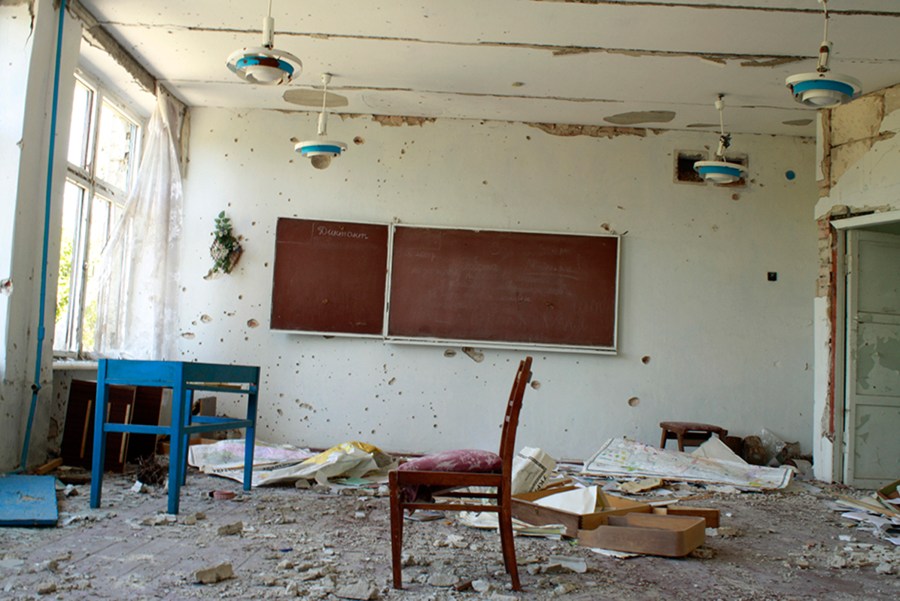
A man is resting on a pile of broken bricks in the middle of a small classroom. His name is Sergey, he says, and takes a drag of an unfiltered cigarette. Many years ago he went to this school. He has lived in Nikishine his whole life and in recent years worked as the school’s handyman.
Now, he and a couple of local teenagers have taken on the Herculean, if futile, task of cleaning it up. The boys take out the trash and the rubble and pile it onto a rough-hewn wooden platform attached to a decrepit motorcycle. When they can pile no more, one of them rides off on the bike and returns for another round.
I’m not sure whether it’s safe to go up the staircase, but Sergey says it’s OK and leads the way, pointing to the destroyed classrooms on the second floor. “This used to be a library,” he says. “And this is where they taught Russian literature.” He steps over a shell fragment, stuck in a pile of torn notebooks and broken computer screens, and we continue on to the third floor. Sergey and I are now standing under the open sky because the roof is missing.
Before the war, Nikishine, a village about 90 kilometers from Donetsk, had a population of over 800 people. With residents fleeing the fighting, it has now been reduced to 300, but more people have been coming back since May. Three more families have returned just last week, according to the village administrator.
RELATED: Ukraine, through the looking glass
A year ago, Ukrainian forces were desperately trying to hold onto Nikishine, as part of the effort to stop rebel forces from taking the strategically important town of Debaltseve close by. Between August 2014 and February 2015, Ukrainian forces and the rebels, backed by Russian forces, engaged in fierce, practically nonstop fighting. It was hell, local residents say, and all but a dozen Nikishine villagers fled. The fighting killed five local men and a woman and practically razed the village to the ground: 150 houses were burned down and 80 were severely damaged — a total of 70% of the houses in the village, which is now under rebel control.
The school was stuck right in the middle of the fighting. It is also the highest point in the village and was used by rebel fighters to exchange fire with the Ukrainian forces.
The school building is beyond repair and has been written off, the village administrator said. The plan now is to restore the Nikishine kindergarten, less damaged by the shelling. Hopefully, when it re-opens, there will be room for the other school-age children who returned to the village after the fighting stopped — 19 at this point, but more will probably return soon, together with their families. The International Committee of the Red Cross had provided building materials in June, she said, but the rebel authorities did not allow the materials to be brought in, and they are stuck somewhere on Ukrainian government-controlled territory. In the meantime, the children in Nikishine have to start the school year at the Petropavlivka village school, 12 kilometers away. No one is providing transport, leaving parents, impoverished by the war, to get the children to school and back every day. Deploying military forces in and near schools can put students at grave risk — in violation of the laws of war — and expose important education infrastructure to damage and destruction. In eastern Ukraine, government and rebel forces alike have not given schools the protection they deserve, given their importance for the children of the area. The conflict in eastern Ukraine has already been incredibly hard on civilians. It should not also deprive their children of education, whether during the hostilities or afterward. Yulia Gorbunova is the Ukraine researcher at Human Rights Watch.
Yulia Gorbunova Recommended


