








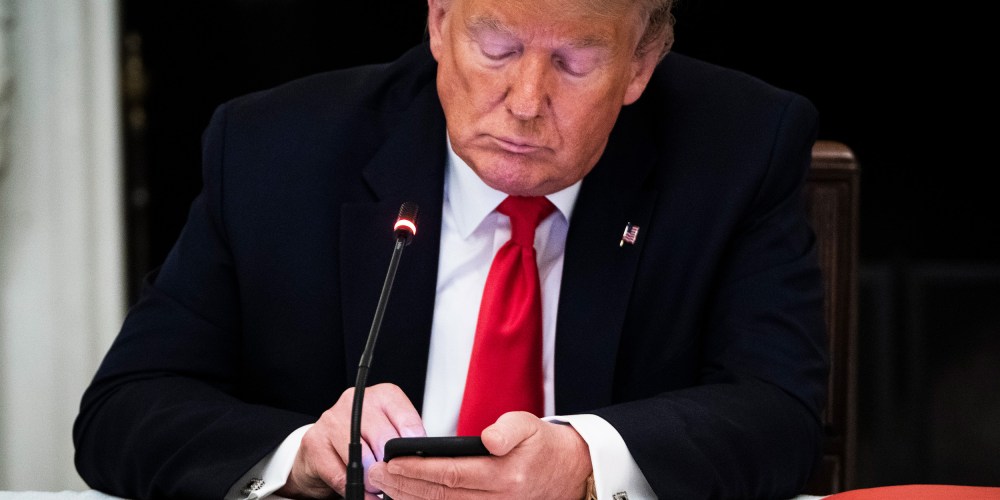
Last weekend, Twitter CEO Elon Musk reactivated former President Donald Trump’s Twitter account, which had been banned from the platform days after inciting violence at the U.S. Capitol on Jan. 6, 2021.
This would seem to be a moment of existential delight for Trump. His presidency was in many ways defined by his presence on Twitter, and he had been waging a fight in the courts demanding that his ban from the platform be overturned as recently as last week.
For now, Trump is declining to get back on his Twitter saddle, claiming that his clunky Twitter knockoff, Truth Social, is “doing phenomenally well” and that there are “problems at Twitter.” This is most likely a business play — an attempt to persuade the public that the shoddy product he personally stands to profit from is better than the social media platform he sees as a competitor.
Being active on Twitter would change the nature of Trump’s candidacy and amplify both his strengths and his weaknesses as a politician.
But in all likelihood Trump is deeply tempted to return to his favorite toy; it seems probable that he’s thinking more about when he’ll return than if. I could be wrong, but there’s little evidence that Trump voluntarily forgoes any opportunity for exerting influence and soaking in affirmation from his supporters, and Twitter is one of the biggest tools out there for those.
Separate from the question of whether or not Trump will return, though, is if it would be wise for him. Will jumping back on Twitter hurt or help his White House ambitions? I’d say both: Being active on Twitter would change the nature of Trump’s candidacy and amplify both his strengths and his weaknesses as a politician.
The primary way that Trump’s return to Twitter would help him is reach. In April, Truth Social had around half a million active daily users, far smaller than Twitter’s 200 million-plus. But Twitter isn’t just bigger than Truth Social, it’s also much more influential. Truth Social has a Cult of Trump reputation. Twitter has journalists, activists, politicians, policymakers and celebrities across the political spectrum. On Twitter, Trump can joust with opponents, make jokes, say provocative things and it’s far more likely to become a news story or dominate national discourse online. Free media attention is a big part of the story of how Trump won the White House in 2016, and it could play a role in elevating his name above 2024 competitors.
I would wager that this could be particularly important for Trump in the primary season, when conservative pundits, donors and voters will wonder if Trump still has the energy and edge that he had before. None of Trump’s potential rivals, like Florida Gov. Ron DeSantis, have a remotely comparable ability to make and break a news cycle with a tweet. And at a time when Musk is energizing Twitter as a home for right-wing political discussion and activism, Trump’s re-entry would give him exposure to some of the more buzzy parts of the online right-wing scene. But there are also some ways that Trump’s Twitter presence could hurt him. He may be more tempted to provoke his opponents and reclaim his status as a master of shock, and in the process generate a more vigilant response from centrist and liberal media. Trump is particularly impulsive on Twitter, and if he decided to turbocharge his bigotry and authoritarian signaling to garner attention, it could intensify counter-mobilization in the general election; the more the alarms sound in the news every time he says something disturbing, the more likely it is he might inspire left-leaning voters and activists to organize against him and moderates to remember Trump’s extreme traits. Remember: We saw in the 2022 midterm elections that fear of democracy under siege was highly compelling for voters in competitive states as they rejected MAGA candidates, and it likely will be in 2024 as well if Trump is on the ballot again. Regardless of whether or not it would advance his electoral viability, Trump’s return would likely have a socially corrosive effect on the country. Sadly, regardless of whether or not it would advance his electoral viability, Trump’s return would likely have a socially corrosive effect on the country. That’s because even if he loses, he has an unrivaled ability to mainstream extremism and incentivize dangerous groupthink in Republican politics. Even if he loses the primaries or the general election, his return to Twitter would likely involve posting all kinds of bigoted, violence-encouraging commentary, and using threats of retribution to cajole his caucus into great MAGA extremism. It would be a loss for the country.
Zeeshan Aleem is a writer for MS NOW. Sign up for his newsletter. 


