








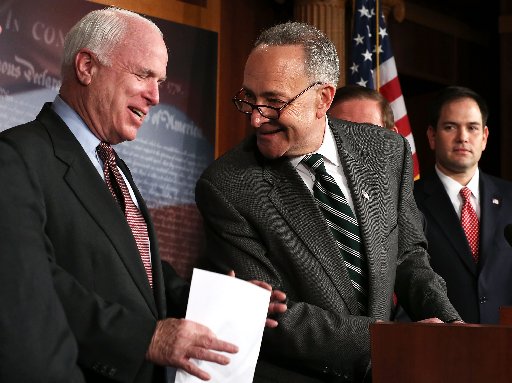
Bipartisanship is breaking out all over this week, at least where immigration is concerned. On Monday Senators from both parties unveiled what Sen. Chuck Schumer (D-NY) called “a set of bipartisan principles for comprehensive immigration reform legislation that we hope can pass the Senate in overwhelming and bipartisan fashion.” Observers noted some potential differences between the Senate group’s proposals and the president’s–mainly over border security requirements―but the two plans are largely consistent. And on the critical issue of health care, both are unfair and wasteful.
The White House plan might give undocumented immigrants a faster path to citizenship than the Senate plan, and it holds out for the recognition of same-sex couples as families. But to appease potential opponents, Obama’s plan denies health care coverage to newly legalized immigrants. It would grant some 11 million undocumented immigrants the status of provisionally legal residents. But unlike other non-citizens, the newest class would be locked out of Medicare and Medicaid, and barred from buying coverage through the state insurance exchanges that will open in 2014 under the Affordable Care Act.
Politically, the administration may be hogtied on this issue. Coverage for immigrants was a flash point throughout the debate over health care reform. As written, the Affordable Care Act allows coverage of non-citizens who are “lawfully present,” but it bars undocumented immigrants from federal health programs. Republicans may now be ready to grant undocumented immigrants a “lawful presence,” but they’re clearly not rethinking their stance on health care access. “If Obamacare is available to 11 million people,” Sen. Maco Rubio (R-Fla.) told Rush Limbaugh during a Tuesday radio interview, “it blows a hole in our budget and makes this bill undoable.” The White House has preemptively conceded the issue, noting that under its proposal, “people with provisional legal status will not be eligible for welfare or other federal benefits, including subsidies or tax credits under the new health care law.”
How is that unfair and wasteful? The fairness depends on your perspective, but there are sound practical reasons not to lock 11 million people out of the health care system. Besides eroding public health, marginalizing them could ultimately cost more than including them.
Thanks to a 1986 law called EMTALA (the Emergency Medical Treatment and Active Labor Act), hospitals are required to treat indigent patients (or refer them to someone who will), regardless of their financial means or their immigration status. So denying people insurance coverage doesn’t magically eliminate the cost of their care. It just pushes them from primary care settings into hospital emergency departments that provide less consistent care at much higher prices. Some 80% of the country’s non-citizens (legal and non) are poor enough to qualify for Medicaid or discounted coverage through state insurance exchanges. As Rubio says, it would take a big investment to open these programs to the 11 million illegals who are currently locked out. But broader coverage could ultimately reduce costs by improving quality and reducing unpaid hospital care. The price of a non-emergency hospital visit averaged $767 in 2007―more than four times that of an office visit―and the government pays for millions of them every year. The New England Healthcare Institute (NEHI) pegs the cost of emergency-room overuse at $38 billion every year. By giving newly legalized immigrants the same health care rights as other non-citizens, policymakers could cut that waste while improving the quality and consistency of their care. As NEHI notes in a 2010 research brief, episodic hospital visits lack the benefits of ongoing primary care―”particularly for the nearly half of Americans suffering from at least one chronic condition.” A more thoughtful immigration plan could also head off a looming disaster for the nation’s public hospitals. When Congress passed the health care reform law, it vastly reduced funding to help hospitals care for indigent patients. The lawmakers thought the need would decline as more people gained gained insurance coverage. But now the immigration proposals will help bankrupt hospitals that are struggling to care for the uninsured. “Most Americans agree that it’s time to fix a system that’s been broken for way too long,” the president said in his immigration speech Tuesday. For now, a critical piece of it is going to stay broken.
Geoffrey Cowley Recommended


