








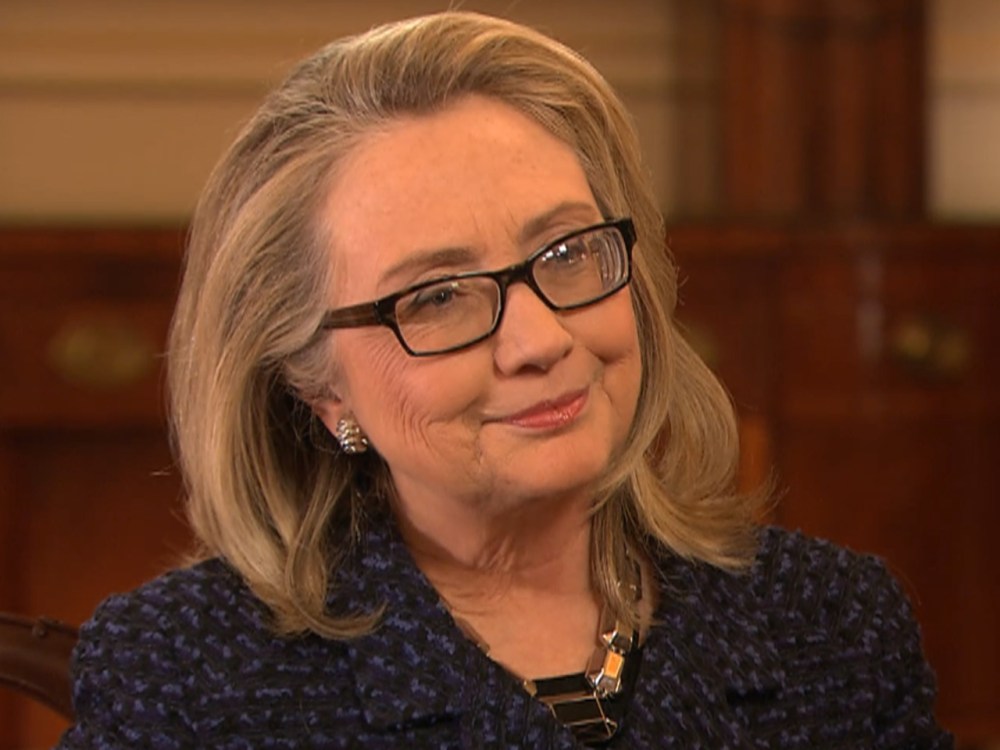
In her final days as secretary of state, Hillary Rodham Clinton sat down with msnbc’s Andrea Mitchell to look back at her four years as President Obama’s chief diplomat and discuss her future plans.
Clinton told Mitchell that when she and President Obama took office there was an “overwhelming imperative to restore American leadership.” It was in question, she said, because of the decisions of the previous administration. “Part of the responsibility I had was to go out, fly the flag, restore that confidence, make it clear that our leadership was intact,” Clinton said.
As secretary, Clinton spent 401 days traveling and logged nearly 1 million miles.
“There is no part of the world that is irrelevant to the United States anymore,” Clinton said. Global issues during the president’s first term challenged the administration. “It is a time that is testing us,” Clinton said and added, “I think we are passing the test and quite comfortably.”
Clinton pointed to the September 11th attacks on the U.S. mission in Benghazi, Libya which killed U.S. Ambassador Chris Stevens and three other Foreign Service officers, as one of the mistakes of her tenure. Clinton called the siege a “terrible example” of trying to determine the balance between having personnel in a dangerous place working to protect U.S. interests or not being there at all.
“The security professionals get it right far more than they get it wrong. We have a long list of attacks averted, assassination plots broken up and so much. So, I have a great deal of confidence in them. But, you know, it’s an institution of human beings. Nearly 70,000 of them. And as the accountability review board said, there were some wrong decisions made. And, unfortunately, we suffered grievous losses,” Clinton said referring to the accountability review board lead by Ambassador Thomas Pickering and Admiral Michael Mullen which looked into the attack.
Her tenure has been marked by the upheavals of the Arab Spring. Protests in Tunisia, Syria, Bahrain, and around the region have called for change with differing outcomes.
When people filled Tahrir Square in Cairo, Egypt, Clinton said there was a “tremendous effort made to try to work with, send messages to President Mubarak and those around him to handle the situation in a fashion that would create some openings for real reform going forward, but that turned out not to be possible.” With such large numbers of people were asking for freedom and opportunity, Clinton said the U.S. couldn’t be on the side of those who would deny that.
Secretary Clinton said her successor John Kerry will continue to work towards peace in the Middle East—something that has eluded Clinton and many of her predecessors.
“There have been decades of missed opportunities, of disappointments, but I come from the school that believes you have to keep trying. You get up every day; no matter how difficult it is, because the alternative is a vacuum which is not good for Israel and not good for those Palestinians who still believe in a two state solution,” Clinton said.
Working for equal rights for women has been a lifelong mission of Clinton’s. In 1995, when she was First Lady, Clinton traveled to Beijing, China and famously said, “Human rights are women’s rights and women’s rights are human rights.”
The secretary continued the fight for women’s empowerment during her time at State. She created new ambassadorship for global women’s issues and has continued the work of the U.S. Afghan Women’s Council, which was started during the Bush administration, among other projects and initiatives. She told Mitchell the future of Afghan women weighs on her as the U.S. prepares to end the war there.
“When it comes to Afghanistan, I worry constantly about what happens there for everyone, but in particular for women and girls. We’ve made a lot of advances. A far greater number of girls are going to school. Women are running businesses, practicing their professions, but there is a very large group of women who mostly are in the countryside or in settings where the theories and practices of including women are not accepted,” Clinton said.
Clinton also said she worries about extremist groups who would attack girls who just want to go to school, like those in Pakistan who attacked and almost killed Malala Yousafzai last year. “That is just beyond my comprehension, but I know it happens because I deal with it every day,” she said.
“We have a long way to go. And it’s not only in Afghanistan. In many parts of the world, the deprivation women face, the discrimination, the abuse, rape as a tool of war, sexual violence as a means of keeping women in their place. We have a lot of work to do and I’m determined to continue that when I leave,” Clinton told Mitchell.
After four years of non-stop travel, Secretary Clinton will step off the world stage at the end of this week, but speculation is already swirling about when and if she will return to politics and run for office in 2016. Clinton did not say whether she will run for president four years from now, and added that the American people will decide who will take office in 2016. Despite a contentious Democratic primary battle, which included an ad asking voters who they would rather have answering an emergency 3:00 am phone call— a challenge to then-Sen. Barack Obama’s experience—Clinton and the president have become great partners and even friends. Clinton said it has been an “extraordinary experience” working with the president. “I’m grateful for the opportunity and looking forward to helping him in whatever way I can as I leave this office,” Clinton said. Democratic Party insiders say if Clinton were to throw her hat into the ring in 2016, she would clear the field. Mitchell asked Clinton if Vice President Joe Biden has the right of first refusal for the nomination, or if it is an open competition. “American politics is always an open competition,” Clinton replied. As secretary of state, Clinton has vowed to stay out of politics and even missed big events like the Democratic Convention, an event that she would have attended if she were not at her post at the State Department. Holding on to that axiom even in her final days, Clinton said, “I’m still secretary of state. I can’t really engage in politics,” as Mitchell pressed her on her future political plans. Clinton, who has visited 112 countries during her tenure, stopped her overseas travel last December after she contracted a stomach virus which left her dehydrated and caused her to faint in her bathroom. The fall resulted in a concussion and subsequent blood clot in her head. Clinton still has lingering effects of the health scare and will be wearing her glasses for some time while she continues her recovery. Mitchell asked Clinton if her health will factor into an eventual decision on whether or not to seek the presidency again but she said it wouldn’t be a consideration. “Well, it doesn’t factor in at all. I have no doubt that I’m healthy enough my stamina is great enough and I’ll be fully recovered to do whatever I choose to do. But I don’t have any decisions made. I have no real plans to make any such decisions,” Clinton said. So, what does the secretary plan to do after her last day at the department on Friday? “I’m looking forward to come very quiet time, catching up on everything from sleep to reading to walking with my family. I think it’s hard to imagine—for me what it’ll be like next week when I wake up, I have nowhere to go. And maybe I’ll go back to sleep for a change,” she said laughing at the idea.
Catherine Chomiak Recommended


