








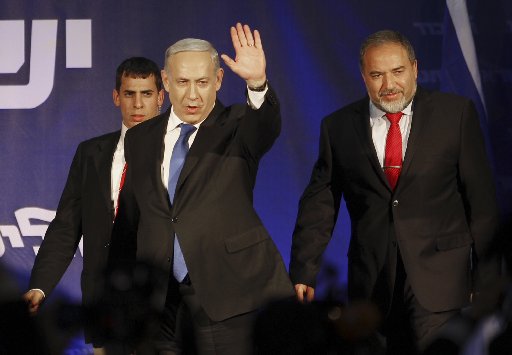
Israeli elections have left Prime Minister Benjamin Netanyahu with a razor-thin majority in parliament, dealing a heavy blow to the hawkish policies of the country’s far-right.
Netanyahu’s ticket combined his party, Likud, with the ultra-nationalist party Yisrael Beiteinu. Together, Likud-Beiteinu lost a quarter of their seats in parliament, retaining just 31 seats out of 120, down from 42. Netanyahu was widely expected to sail to victory, with pre-election polls showing him with nearly as many seats as he had before voters headed to the polls. But while Netanyahu is expected to keep his job as prime minister, the unexpected surge of a new centrist party could signal a more moderate new Israeli government. Yesh Atid, led by Israeli television journalist Yair Lapid, emerged as the second-most-powerful force after Tuesday’s elections, securing 19 seats. Prime Minister Netanyahu is widely expected to reach out to Lapid in order to form a broad coalition government.
In a nod to Lapid’s focus on religious pluralism and equality in Israel, Netanyahu said on Wednesday that his administration would pursue “a more equal sharing of the burden” – referring to the privileges awarded to Israel’s ultra-Orthodox population. Netanyahu enjoys broad support from this growing ultra-religious minority, who are at times stigmatized in Israel for being exempt from serving mandatory military service, and receiving subsidies for religious studies in place of work. Yesh Atid benefited from widespread anger over these policies, and the party’s focus on economic equality and lowering Israel’s high cost of living was a major draw for Israeli voters.
On Wednesday, Israeli Ambassador Michel Oren told Andrea Mitchell Reports, “There’s a greater emphasis on some of the social issues in our country, which are not so different than the issues in the United States.” Among them, said Oren, “a livable middle class wage, housing for young people, economic opportunities – these have been the issues that have really come to the forefront in the last elections in Israel.”
While the new coalition government is expected to be more centrist and moderate, it is unclear what the results mean for the prospects of peace with the Palestinians. Lapid’s campaign was heavy on domestic issues, light on foreign policy, but in his victory speech Tuesday night, he said “we are facing a world that is liable to ostracize us because of the deadlock in the peace process.”
Asked if the elections might alter Israel’s policies towards the Palestinians or the United States, Michael Oren told Mitchell Reports, “It’s not going to mean any major changes in terms of the peace process,” adding that “Prime Minister Netanyahu’s position calls for the renewal of direct talks with the Palestinians, without preconditions, to establish a two-state solution for two peoples, based on security and mutual recognition.” As for Israel’s relationship with the United States, which grew even more contentious after Netanyahu seemed to support President Obama’s opponent in the U.S elections, Ambassador Oren said that the election results would have no impact. “We’re committed to the closest possible alliance with the United States,” Oren insisted. “That has been the situation for the last four years, and that will continue.” One thing has certainly not changed, and that is Israel’s laser-focus on preventing a nuclear-armed Iran. “No country has a greater interest than Israel in resolving the Iranian threat through diplomatic means,” Ambassador Oren told Mitchell Reports. “We hope that a combination of crippling sanctions and a truly credible military threat will dissuade the Iranian regime from pursuing nuclear weapons.” But, Oren cautioned, if those measures fail to stop Iran from obtaining a nuclear weapon, “all options should remain on the table and containment is not an option.” Regardless of who leads Israel’s new coalition government, U.S. military support for Israel will remain as crucial as ever before, especially with the threat of a nuclear Iran. As Defense Secretary Leon Panetta prepares to leave the Pentagon, and Chuck Hagel gets ready for his tough confirmation hearing later this month, Andrea Mitchell asked Ambassador Oren for his opinion on the opposition to Chuck Hagel. “Defense relationships between the United States and Israel are better than ever,” Oren said. “I have every confidence, Andrea, that that relationship will continue to strengthen and to grow.”
Yardena Schwartz Recommended


