








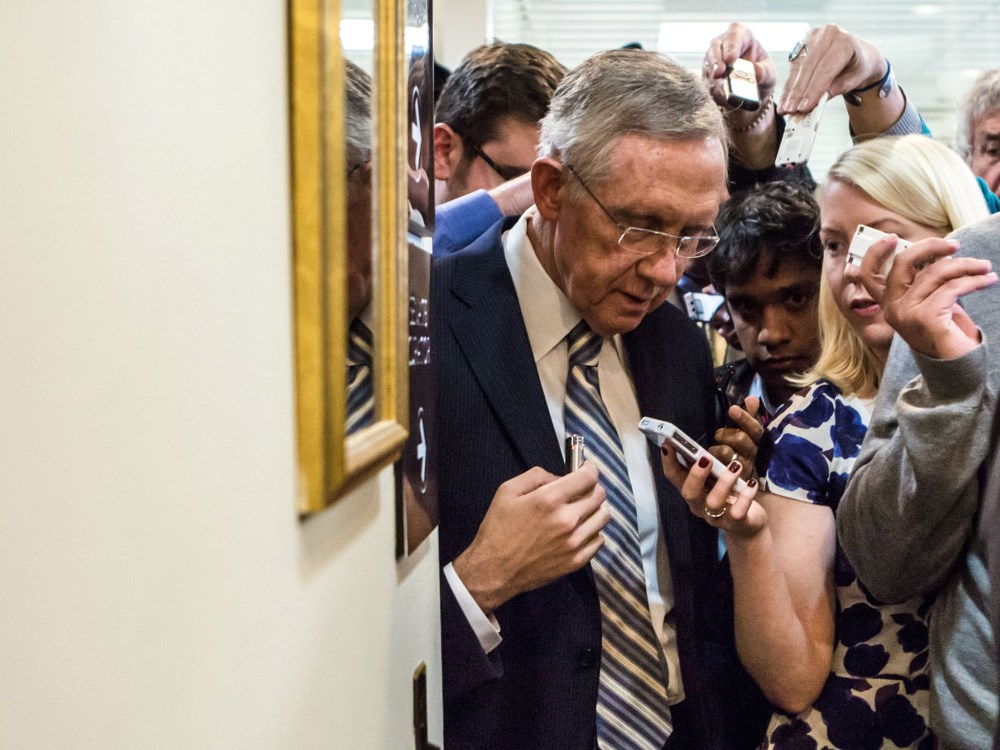
Democrats’ chance to fix the broken Senate—a big step in making it easier to pass key elements of President Obama’s second-term agenda—is fast approaching. But as the deadline gets closer, Harry Reid may be losing his nerve.
The Senate Majority Leader said on the floor Tuesday morning that he’ll take up filibuster reform as soon as work is done on a relief package for victims of Superstorm Sandy. “Once we complete that vital legislation, the Senate will take action to make this institution that we all love, the United States Senate, work more effectively,” Reid said. “We’ll consider changes in the Senate rules.” Reid added that the discussion is likely to come “later this month.”
In recent years, Republicans have used the filibuster to a historically unprecedented degree to tie the Senate in knots.
In a brief press conference a little later Tuesday, Reid said that within the next 24 to 36 hours, he’d determine whether he could forge a deal on rules reform with his GOP counterpart, Mitch McConnell. If not, Democrats will pass a rules change along party lines. Under Senate rules, a change can be accomplished with just 51 votes only on the first day of the legislative session. But Reid can use a parliamentary maneuver to extend that “day” indefinitely.
The issue was said to be a topic of discussion at a Senate Democratic caucus lunch a few hours later. But the exact nature of the reforms that Democrats will coalesce around remains up in the air. And the devil is likely to be in the details.
A group of younger, progressive senators led by Jeff Merkley of Oregon and Tom Udall of New Mexico has been pushing a package that, among other changes, would require the minority to conduct a “talking filibuster” (think Mr. Smith Goes to Washington), rather than being able to silently object. The overall effect would be to make it harder, both practically and politically, for the GOP to filibuster as a routine means of blocking Democratic legislation.
“There must be change,” said Udall on the Senate floor Tuesday, after Reid spoke. “The abuse of the filibuster and other procedural rules has prevented the U.S. Senate from doing its job. We are no longer ‘the world’s greatest deliberative body.’ In fact, we barely deliberate at all.” Reid appeared last fall to embrace the Merkley-Udall approach, which is also backed by Elizabeth Warren of Massachusetts and a coalition of powerful progressive groups including the Sierra Club, the NAACP, and SEIU. But recent reports suggest Reid is mulling a more modest package of changes which wouldn’t require the talking filibuster, though it would still scrap the filibuster on motions to proceed—that is, to begin debate on a bill—and make it harder in other situations. His possible change of heart comes after lobbying from a group of older senators, who fear the loss of prerogatives for individual senators. There’s little question that the Senate needs to be fixed. As Merkley frequently points out, during Lyndon Johnson’s six years as Senate Majority Leader, from 1955 to 1961, he had to use only one cloture motion to end debate. In Reid’s six years, he has used almost 400. Each filibuster can take a week of the Senate’s time, gumming up the works and preventing the chamber from doing its job. The result: as shown by this chart, compiled by the Brennan Center, the number of bills passed as a percentage of those introduced has declined steeply in recent years, and especially since Republicans entered the minority in 2007. Were it not for the filibuster, Democrats could likely have passed a climate-change bill and a healthcare law with a public option during Obama’s first term.
Zachary Roth Recommended



