









This week marks one year since the Senate passed a bill promising a sweeping overhaul of the nation’s immigration laws. It passed with bipartisan support, the culmination of months of negotiations uniting groups across the spectrum. Supporters memorably erupted into chants of “yes we can” just moments after the final vote was cast.
Now, one year later, hopes that Congress will finish what it started lay in shambles. Prospects that the House will take up any measure during a crucial midterm election year remain slim. Meanwhile, a massive influx of children making the journey to the U.S. on their own is diverting attention to security along the border.
%22This%20is%20not%20only%20a%20moral%20issue%2C%20this%20is%20an%20economic%20issue.%22′
The states on the front-lines are taking matters into their own hands. And just four years ago, harsh anti-immigration laws were the solution of choice. States like Alabama and Arizona laid out a plan: Make life for undocumented immigrants living there so inhospitable that it would drive immigrant communities out of the state. But it didn’t work for long — court challenges have since unraveled large swaths of the laws. Other states have since began sprinting in the opposite direction.
“A number of states are stepping into the vacuum saying lets do what we can to make life more bearable for the immigrants living in our communities,” said Frank Sharry, executive director of the pro-reform group America’s Voice.
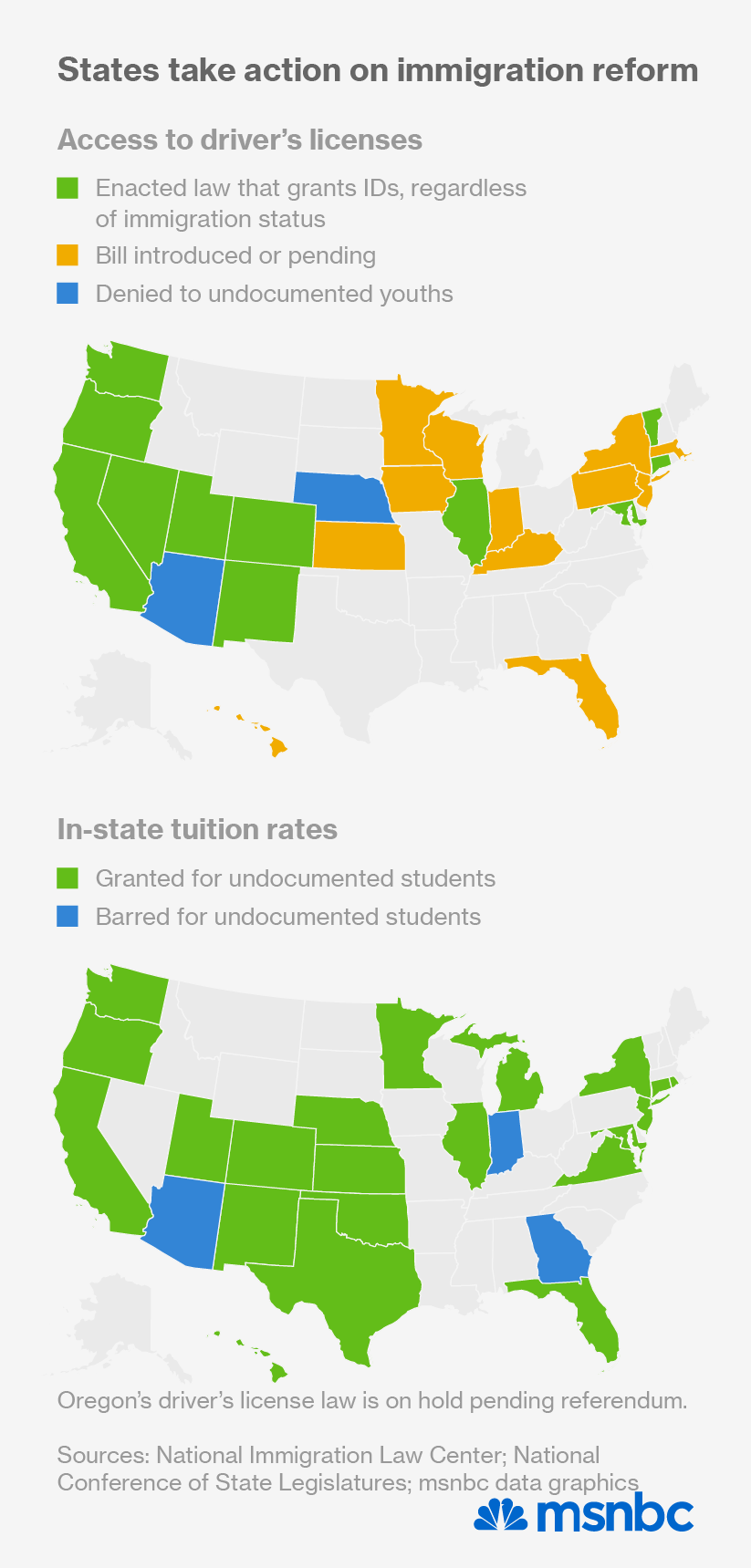
Currently, 11 states and the District of Columbia grant driver’s licenses to non-citizens. For immigrants living in those regions, a simple plastic ID card symbolizes an entire livelihood that was previously unattainable. Simple acts like driving your kids to school or grabbing milk at the grocery store are no longer perilous journeys. With a driver’s license, you can open a bank account, a far less risky option than stashing your entire life savings under the mattress.
“You’re making a high stakes gamble every single day, and to have a driver’s license makes a world of difference,” Sharry said.
By the end of 2013 alone, California, Colorado, Connecticut, Illinois, Maryland, Nevada, Oregon, Vermont and the District of Columbia enacted laws offering state-issued driver’s licenses to non citizens. More are on their way.
Jump starting the shift on immigration policy, President Obama initiated the Deferred Action for Childhood Arrivals (DACA) Program just months before his 2012 election win in the most dramatic step forward the administration has taken on offering reprieve to young immigrants who were brought into the U.S. illegally while they were just kids. The administration estimates that the program has offered 560,000 so-called “DREAMers” a chance to postpone action on their legal status for two years. Officials renewed the program earlier this month, and there are signs it is already working.
A June survey out by the American Immigration Council (AIC) found that 60% of DREAMers surveyed found a new job since their benefits kicked in. About 57% were able to obtain a driver’s license, allowing for just under half of those surveyed the ability to open their first bank account.
“This is not only a moral issue, this is an economic issue,” said Guillermo Cantor, senior policy analyst at AIC. “This obviously benefits everyone.”
Greater economic opportunity for young undocumented immigrants translates into more taxable income for the region, Cantor said. And rather than having a generation of kids trapped in the shadows, more are now able to contribute to their communities and become active members in a society they have called home for most of their lives.
“They are already American in every way but on paper,” he said.
The expanded rights for DREAMers began long before Obama’s executive order. In 2001, California and Texas, two states home to some of the largest proportions of undocumented immigrants in the U.S., became the first to enact legislation allowing in-state tuition rates for non-citizen students. Since then, some 19 other states have followed suit in expanding access to lower college rates to undocumented students.
With hopes of federal reforms pushed back for the foreseeable future, immigration rights advocates are pressuring Obama to repeat the action that he took for DREAMers, and extend rights to entire families who have lived in the U.S. for years. Others, a taking a different tack. In a growing number of cities across the country, advocates have focused efforts on disrupting how Immigration and Customs Enforcement (ICE) cooperates with local law enforcement. According the to Immigrant Legal Resource Center, almost 140 municipalities have succeeded in limiting policies to honor ICE requests to detain undocumented immigrants for later deportation. Advocates hope the decision from a federal court case in Oregon could lead to more policy shifts. A judge there found that a woman’s Fourth Amendment rights were violated when local police detained her for immigration authorities without having probable cause. “This decision recognizes the constitutional fault with ICE holds,” said Grisel Ruiz, and attorney for the Immigrant Legal Resource Center, which has been tracking ICE detainers across the country. “That really created this ripple of policy changes across the country.” Meanwhile a bill introduced in New York last week takes by far the most dramatic steps forward on immigrant rights. The bill, brought by Democratic state Sen. Gustavo Rivera, would effectively grant citizenship to the Empire State’s undocumented immigrants who could prove they have lived there and contributed to taxes for the last three years. And though the bill did not make it in time for the end of New York’s legislative session, Rivera said he hopes the proposal could serve as a model for other state legislators to mirror across the country. “We wanted to build the broadest bill possible,” Rivera told msnbc. He said states have the constitutional right to expand benefits to their undocumented immigrant community, and with Congress at an impasse, it was only a matter of time before state legislators stepped in. “If there is failure at the national level, what should states do?”
Amanda Sakuma Recommended


