








The House majority leader’s June 10 primary defeat has been attributed to many things: Republican extremism, Eric Cantor’s close ties to Wall Street, Cantor’s lousy constituent service, and even the fact that he’s Jewish. But Republicans were extremists in 2012, too, when Cantor beat his primary opponent by 58 points. In 2012 Cantor was just as cozy with Wall Street, no less indifferent to his constituents, and, of course, Jewish.
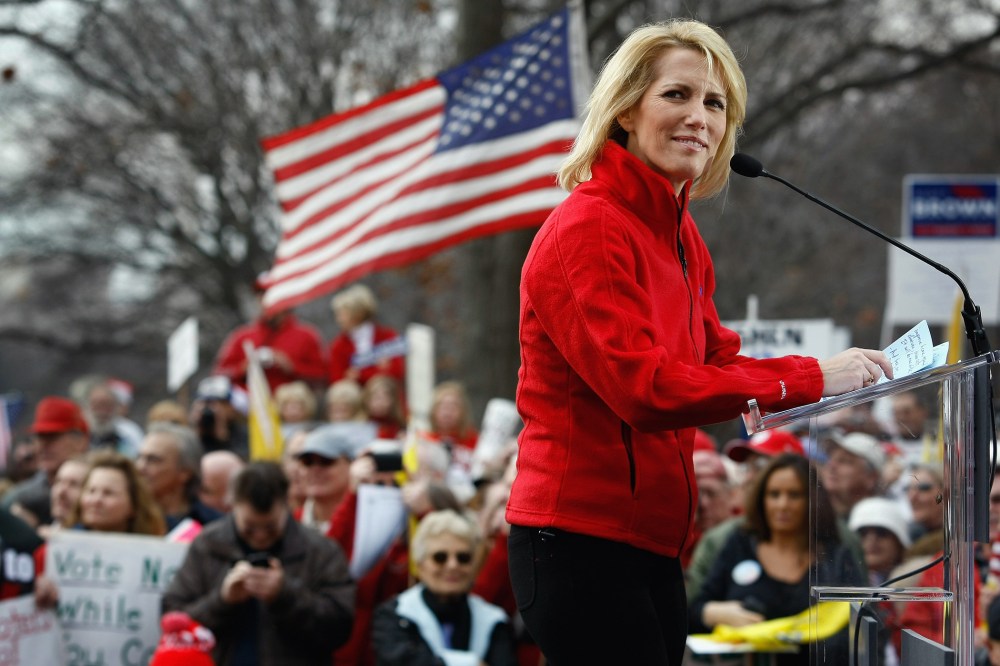
So what changed? Talk radio, primarily in the person of anti-immigration crusader Laura Ingraham.
Talk radio has, of course, commingled with Republican politics for decades. It was a springboard that Jesse Helms, the most conservative senator of his era, used to enter the Senate in 1972. In 1994, talk radio host Rush Limbaugh played a significant role in winning the GOP its first House of Representatives majority in 41 years.
%22Talk%20radio%20is%20running%20America.%20We%20have%20to%20deal%20with%20that%20problem.%22′
In those days, conservative radio was widely understood to be a megaphone to extend the GOP message. In 2002, former Vice President Al Gore called it “part and parcel of the Republican party.” When media scholars Kathleen Hall Jamieson and Joseph N. Cappella published a book six years ago about the phenomenon, they titled it, tellingly, “Echo Chamber.” (Liberal talk radio, though arguably no less partisan, has never enjoyed comparable popularity; Air America, for instance, lasted less than a decade.)
Somewhere along the way, though, the power relationship between the Republican party and its radio megaphone shifted. In 2006, the Bush White House found it necessary to summon conservative talk-radio hosts to Washington to shore up support. Then, as now, a major source of disaffection was the immigration bill. Charlie Sykes, a Milwaukee-based talk-radio host, took the occasion to tell White House counselor Dan Bartlett, “If the Republicans lose control of the House, they won’t have anybody but themselves to blame.” (The GOP did indeed lose the House that fall.)
In 2007, Senate Whip (and former Majority Leader) Trent Lott, R.-Miss., maintained that talk radio hosts killed the immigration bill, a claim that the Pew Research Journalism Project judged plausible given the size of the audience (26 million just for Limbaugh and Sean Hannity) and the fact that immigration had been talk radio’s most-discussed topic while the bill was in play. “Talk radio is running America,” Lott lamented before the bill’s demise. “We have to deal with that problem.”
Presidential election results in 2008 and 2012 clarified that talk radio was not, in fact, running the country. But Cantor’s defeat clarifies that the GOP did not deal with its talk-radio problem. At least in this isolated instance, talk radio is now running the GOP.
Talk radio’s Glenn Beck and Mark Levin lent support to Cantor challenger Dave Brat, but the crucial support, University of Virginia political scientist Larry Sabato told Politico, came from Laura Ingraham. Ingraham talked up Brat on her radio show; she also made personal appearances on Brat’s behalf. “She electrified the crowd when he had almost no money,” Sabato said. “He won the seat with peanuts, compared to Cantor’s millions. It was a clever substitution of free media for paid media.”
“I decided, ‘Look, if we’re ever going to get any good people to challenge the failed establishment, we’re going to at least need to give them a platform and a fair hearing,’” Ingraham told National Review. “So I helped give him a platform and a bigger microphone.”
The subhead to National Review’s piece about Ingraham’s central role states that Cantor’s loss was “a huge win for the grassroots.” But a radio show that reaches more than 2 million people (Ingraham’s Web site states, accurately, that she’s the “most listened-to woman in political talk radio in the United States”) and isn’t even based where the election took place, cannot sensibly be termed “grassroots.” “The Laura Ingraham Show” is a corporate enterprise, even if it happened in this instance to be pushing an anti-immigration agenda that most corporations oppose. Why the immigration issue should have acquired so much traction in Virginia remains a bit of a puzzle. According to this map from Slate Magazine (based on 2011 data from the Pew Hispanic Center), undocumented immigrants represent less than 4% of Virginia’s labor force—well below the rate in, say, Arizona, where undocumented immigrants account for 7.4%, or California, where they approach 10%. Immigrants represent about one-quarter of all Virginia farmworkers, most of them undocumented. But these are jobs that native-born Americans have demonstrated little interest in. Even so, Ingraham obviously struck a chord in Virginia’s seventh congressional district when she trashed Cantor as soft on amnesty. At one point she suggested that “instead of sending five Taliban MVPs over there” in exchange for prisoner-of-war Sgt. Bowe Bergdahl, “he could have traded just one Eric Cantor.” In an appearance on ABC’s “This Week” Cantor seemed to lose his composure after being shown this clip, saying “It cheapens the debate.” But all is not lost for Cantor. He might consider a return to power by becoming a talk-radio host himself. After all, where once conservative talk radio was a stepping stone to political office, political office is starting to look like a stepping stone to talk radio. In March, Mike Rogers, R.-Mich., a comparatively youthful 51 years-old and chairman of the House Intelligence committee, announced that he was retiring after only 14 years in Congress. He didn’t say he was leaving to spend more time with his family. He was leaving because he’d cut a deal with Cumulus Media to host a nationally-syndicated talk radio program. Maybe soon he’ll be making and breaking GOP leaders, too.
Timothy Noah Recommended


