










With the revelation that several senior Trump administration officials and Cabinet secretaries have testified or will soon testify before the House Jan. 6 committee, the political press is abuzz about what that could mean for the congressional fact-finding mission — and for the Justice Department’s criminal investigation. After all, as Politico reported Thursday, the DOJ and the Jan. 6 committee finally have reached a “general agreement” over evidence sharing that could grant federal investigators access to more than 1,000 transcripts of witness testimony.
That the DOJ soon will have a vehicle for obtaining evidence from the Jan. 6 committee has me thinking about a wholly different witness, however, and one whose name I don’t even know. Based on former Trump White House aide Cassidy Hutchinson’s prior testimony and committee members’ own statements at the hearings to date, an as-yet-unnamed White House employee or employees could be among the most significant witnesses to then-President Donald Trump’s words, actions and inaction on and around Jan. 6.
Specifically, at the so-called season finale of the committee’s hearings last week, Rep. Elaine Luria, D-Va., highlighted that “within 15 minutes of leaving the stage” at the Ellipse rally, Trump was informed about the attack on the Capitol by a person she described only as “a White House employee” who encountered Trump “as soon as he returned to the Oval [Office].” From there, Luria said, Trump went to the private dining room off the Oval Office at 1:25 p.m.
Later in the hearing, her colleague Rep. Adam Kinzinger, R-Ill., returned to that unnamed White House employee, noting that Trump left the dining room on Jan. 6 for the White House residence at 6:27 p.m. Kinzinger added:
As he was gathering his things in the dining room to leave, President Trump reflected on the day’s events with a White House employee. This was the same employee who had met President Trump in the Oval Office after he returned from the Ellipse. President Trump said nothing to the employee about the attack. He said only quote, “Mike Pence let me down.”
Put another way, the person who informed Trump about the eruption of violence on Jan. 6 also never heard him express any regret about what happened other than his regret that then-Vice President Mike Pence did not overturn the election. That he saw Trump on his way in and out of the Oval Office, roughly five hours apart, also suggests he witnessed a host of other conversations relevant to the intent and actions of Trump and others. And given Luria and Kinzinger’s descriptions of those conversations, it seems likely that the unnamed “White House employee” has spoken to the committee.
One possibility is that the unnamed “White House employee” was one of Trump’s White House valets.
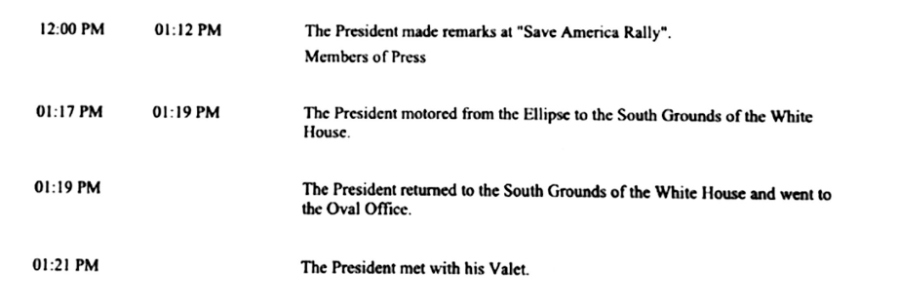
Trump’s “daily diary” for Jan. 6 — a document I and many others in the press dissected earlier this spring — clearly states that after arriving back at the White House from the Ellipse at 1:19 p.m. that afternoon, Trump “met with his Valet” two minutes later. Could that valet be the person who, according to Luria, informed Trump about the Capitol attack upon his return from the Ellipse and to whom, according to Kinzinger, he expressed his disgust with Pence later that night?
And if the unnamed White House employee is a White House valet, it wouldn’t be the first time someone in that job became an accidental guest star in Trump’s Jan. 6 drama.
When Hutchinson testified publicly on June 28, she disclosed a disturbing episode in the Oval Office dining room involving a White House “valet” that took place in December 2020, when the Associated Press reported then-Attorney General William Barr saw no evidence of widespread fraud in the election. Hutchinson testified that around the time the AP story broke, she heard a noise down the hall from Meadows’ office and was told moments later by a valet to “get the chief” to the dining room at Trump’s request. After Meadows returned, Hutchinson said, she went down to the dining room and found the valet inside “changing the tablecloth off of the dining room table.” She continued:
He motioned for me to come in and then pointed towards the front of the room near the fireplace mantel and the TV, where I first noticed there was ketchup dripping down the wall and there was a shattered porcelain plate on the floor. The valet had articulated that the President was extremely angry at the Attorney General’s AP interview and had thrown his lunch against the wall, which was causing him to have to clean up. So I grabbed a towel and started wiping the catsup off of the wall to help the valet out. And he said something to the effect of, he’s really ticked off about this.
There were almost certainly several White House valets — and even more than one valet just for the Oval Office. In May 2020, when one of the White House valets contracted Covid-19, Politico reported Trump had two Oval Office valets and three in his residence.
Still, keeping both the “White House employee” and the valet from the Dec. 2020, story anonymous is — at least at first blush — confounding. When the committee has withheld a witness’s name, it typically has done so expressly, as with the Twitter employee whose voice was “obscured to protect their identity” or the national security individual whose name was withheld due to “fear of retribution.” Why then at the last hearing did neither Luria nor Kinzinger name the “White House employee” whose job duties seemed to place him or her in and around the Oval Office? And why has the valet not been named either?
It’s possible all of the accounts revolve around a single White House valet stationed in the Oval Office. It’s also notable that after the hearing at which Hutchinson testified, Jan. 6 committee Vice Chair Rep. Liz Cheney, R-Wyo., announced that Trump himself had “tried to call a witness in our investigation — a witness you have not yet seen in these hearings. That person declined to answer or respond to President’s Trump’s call and instead alerted their lawyer to the call.” The lawyer, in turn, notified the committee, which then informed the Justice Department, Cheney disclosed. While the identity of the witness Trump tried to phone is still unknown, they have been revealed as a member of the White House “support staff.” A valet could easily qualify as support staff. According to Politico, the Oval Office valets “provide anything Trump requests, such as coffee, food or whatever else he might need during the day.” And if the unnamed “White House employee” was the recipient of Trump’s call, that would make some sense. Someone on the White House “support staff” who had not already been in communication with the committee or the DOJ likely would not have a lawyer. And if that person were the target of Trump’s attempted call — a call warranting further DOJ investigation and potentially constituting witness tampering — keeping their identity a secret would also make sense. Whether the unnamed “White House employee” and the valet at the center of Hutchinson’s ketchup story are one and the same remains to be seen. It also remains to be seen whether either of them is the person Trump attempted to call, leading the committee to share certain, non-public details about that call with the Justice Department for follow-up. But if the “general agreement” reached between the Jan. 6 committee and the DOJ holds, Attorney General Merrick Garland and his team can request more information about the “White House employee” and the valet soon — and get to the bottom of their identities. And just maybe, when the Jan. 6 committee’s hearings resume, we’ll find out as well.
Lisa Rubin is MS NOW's senior legal reporter and a former litigator.
Latest Post
Recommended


