








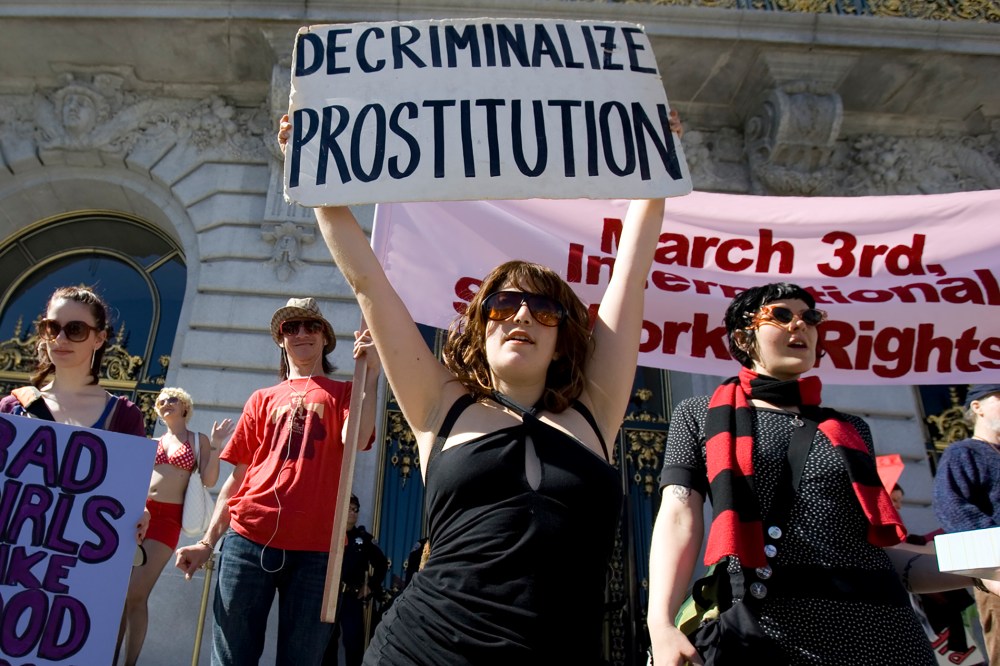
Amnesty International will vote this week on whether or not to adopt the decriminalization of sex work as a plank in its policy agenda. If the policy is approved, the human rights group will call on governments to repeal most laws that prohibit the sale and purchase of sex.
The vote has brought new fervor to a longstanding debate among feminists over whether or not governments should discourage sex work by imposing criminal penalties on buyers of sex.
RELATED: The sexual abuse to prison pipeline
While feminists broadly agree that people shouldn’t be imprisoned for selling sex, many advocate for the “Nordic model” of decriminalization, which suspends criminal penalties for sex workers themselves, but maintains them for their prospective clients.
That position gained visibility late last month, when five prominent Hollywood actresses — Meryl Streep, Kate Winslet, Emma Thompson, Anne Hathaway and Lena Dunham — signed onto a letter from the Coalition Against Trafficking in Women (CATW) that called for Amnesty to reject decriminalization of the sex trade.
But the celebrities and human rights advocates who signed that letter appear to be marching against the tide of opinion in progressive circles. In recent weeks, progressive outlets like Huffington Post, Think Progress, The Nation, and The New Statesman have published op-eds supporting Amnesty’s proposal.
The divide is in part ideological — the CATW letter labels prostitution as “a cause and consequence of gender inequality.” For the feminists of CATW, the sex trade is inherently exploitative and to decriminalize it is akin to enabling a system of “gender apartheid” in which the newly legitimated market will channel more and more women from the world’s most vulnerable populations into sex work, even as more privileged women continue to break glass ceilings in progressive democracies.
Some supporters of Amnesty’s proposal, like Nation contributor Melissa Gira Grant, view sex work as a legitimate job, exploitative only in the sense that all wage labor is. To Gira Grant, the refusal to recognize the legitimacy of sex work reflects a class bias among anti-prostitution feminists.
“The real message of anti–sex work feminists is, It’s the women working against sex work who are the real hard workers, shattering glass ceilings and elevating womanhood, while the tramps loll about down below,” she wrote in The Nation last year.
RELATED: Groundbreaking trans-themed film ‘Carl(a)’ gets a second life
This ideological divide drives much of the debate’s most heated rhetoric, as each side accuses the other of speaking from a place of privilege while ignoring the plight of the most vulnerable. But two of the questions at the heart of the controversy are fundamentally empirical ones: When the sex trade is decriminalized, does the increased demand for sex work lead to growth in sex trafficking? Do voluntary sex workers enjoy marked improvements in working conditions and health standards under full decriminalization?
On the second question, Amnesty suggests the answer is yes. In the summary findings of its initial research, the group writes, “Sex workers are criminalised and negatively affected by a range of sex work laws—not just those on the direct sale of sex.”
In Norway, selling sex isn’t a crime, but promoting the sale of sex is. This makes brothels criminal enterprises, which leads “to the systematic and rapid eviction of many sex workers from their places of work and homes,” Amnesty reports.
Amnesty also writes that police find it “easy in practice to circumvent the distinction between buyer and seller by treating sex workers as accomplices or material witnesses to a crime.” Sex workers commonly report that this antagonism with the police makes them less likely to report physical or sexual abuse suffered at the hands of their clients.
Five years after New Zealand passed full decriminalization in 2003, a government survey found that 70% of sex workers said they were more likely to report violence to the police since their trade had been decriminalized.
RELATED: How to solve our growing refugee crisis Decriminalization also aids efforts to staunch the spread of sexually transmitted disease. In many areas where prostitution is fully criminalized — including most U.S. cities — police can use the possession of condoms as evidence of prostitution. A 2008 report from The Independent Commission on AIDS in Asia found that “the criminalization of [sex work] clearly neutralizes otherwise supportive HIV policies, unless law enforcement agencies and the judiciary can be persuaded to cooperate with such policies.” Given the apparent drawbacks of criminalization, many active, voluntary sex workers broadly support decriminalization — the research consensus seems to suggest that they enjoy greater control over their trade when the police are not working to actively disrupt it. The literature on the relationship between decriminalization and rates of sex trafficking is decidedly more mixed. A 2012 study by researchers from the German Institute for Economic Research and the London School of Economics (LSE) found that “countries with legalized prostitution report a greater incidence of human trafficking inflow,” and the criminalization of prostitution in Sweden resulted in a decline in human trafficking inflows. Those findings are contested, with critics questioning the reliability of the data and how the researchers defined their terms — specifically whether they included sex workers who voluntarily migrated to areas of decriminalization as victims of “self-trafficking.” There is also the possibility that law enforcement polices the illegal sex trade more effectively when voluntary sex workers have the legal security to report suspected trafficking victims. This was the conclusion Dutch law enforcement reached into 2010, when confronted with an increase in trafficking prosecutions post-legalization. Still, the LSE study from 2012 wasn’t the only one to document a correlation between sex-trade legalization and trafficking inflows. In the larger sense, it’s possible that the heated ideological debate over sex work decriminalization masks a legitimate conflict of interest — between what would improve the lives of voluntary sex workers, and what would reduce the rate of human trafficking.
Eric Levitz Recommended


