








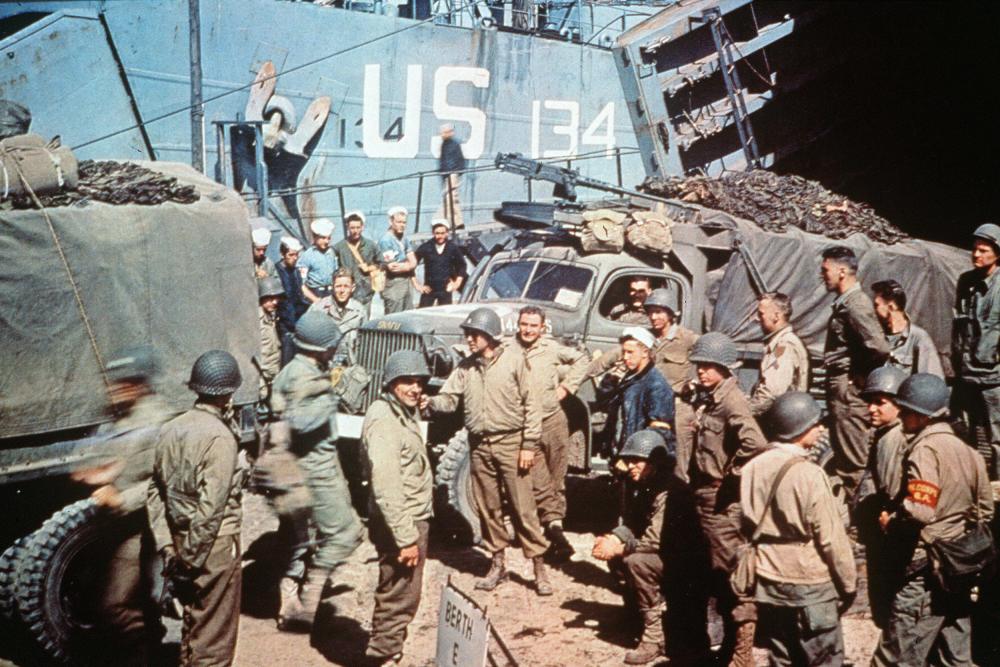
On the 75th anniversary of the D-Day invasion, we are running some of the columns Mike Barnicle wrote for the Boston Globe commemorating the 50th anniversary.
—
D-Day: The heroes remembered in Normandy, veterans retrace their crusade
The Boston Globe
June 5, 1994
By Mike Barnicle
STE. MERE-EGLISE, France — “Where is Robert Murphy?” the old trooper asked.
“He will be here soon,” the woman in the shop told him. “He comes all the time. He is like one of us. Wait, you’ll see.”
The man’s name was William Lundquist. He is 71 and he stood straight as a sentry in the raw drizzle yesterday at the end of a narrow alley between two homes directly across the village square from where American paratroopers of the 82d Airborne Division dropped from the sky just after midnight, June 6, 1944, to liberate first a town and, inevitably, a whole continent.
Lundquist, originally from Hartford, was with the airborne, but yesterday he stood beneath a street sign halfway up the cement wall that read: “Rue Robert Murphy.” The 100-yard length of pavement is named after Bob Murphy who, at 18 on that dark night half a century back, had come all the way from Boston to tumble out of the darkness and into the rescuing limbs of a huge, sprawling chestnut tree within the walled courtyard of Madame Angele Levrault’s backyard. She was the town teacher, and when Murphy hit the ground, Madame Levrault ran frightened from the outhouse that is still here, next to a basketball court where children clad in Nike sneakers and sweatshirts play.
Murphy is a 68-year-old Cape Cod lawyer. He is famous throughout this peaceful village. And Bill Lundquist, whose life after war took him all the way to California and decades of steady employment in the aircraft industry, had been waiting patiently to meet him. Both men and thousands of others — American, British, Canadian and French — were all over the Normandy coast yesterday, saying hello and saying goodbye. They had come to recall and reflect upon that great and awful moment when freedom was purchased at a huge cost on D-Day. All of them are old and somewhat gray now, some limp, some wrestle with the emotion of the moment as they stare at a remarkable scene through history’s wounded eyes. They are not here for any speeches or applause. They have, instead, come to stand on the stage one final time and take their generation’s last bow. For those who suffered, struggled and sacrificed here, the anniversary at Normandy is their curtain call.
“I was 19 years old,” Morley Piper remembered. “I was a platoon leader with Charlie Company, 3d Battalion, 29th Infantry Division. We landed on Omaha Beach and I still remember the noise and the light from the ship’s batteries behind us as we came in. It was something to see.”
Piper lives on the North Shore and is an executive with the New England Newspaper Association. He grew up in Canton, Ill., a place of 10,000 people where the bitter hand of the Depression still clung to the economy like a strangler’s claw when Piper enlisted in the United States Army.
“It was a different, a different country,” he pointed out. “As a matter of fact, when I signed up, so did my father. They were taking them as old as 40 and he joined right along with me. He served stateside. That’s the way it was.”
You would need the skills of archeology to find the lost land all those young boys left voluntarily to sail to their fate in battlefields like Normandy, Anzio, Iwo Jima and Okinawa, all in pursuit of an ideal called freedom. Then, they left a nation commonly known for opportunity. Today, we have been invaded with a false sense of entitlement — a shabby replacement for individual attainment — and litigation outweighs liberty.
But the generation that crawled on their stomachs through a shower of steel and shrapnel on these beaches, the boys who climbed a 10-story tall, straight-up cliff called Pointe du Hoc, all of it in the face of withering German gunfire, were not philosophers or politicians. They were simply Americans: Catholic, Jewish and Protestant; Greek, French, Irish, Italian and Polish. The sons of wealth as well as poverty, sons of doctors, engineers, poets, farmers and street sweepers, they came because they were called to a higher duty by their government.
“I left a life,” Leonard Weintraub was saying. “I was a lawyer in New York City. I had a life all worked out and all of a sudden I was a soldier.”
Weintraub, in his late 70s now, stood in the sun alongside Utah Beach where he came ashore at 9:30 in the morning on June 6, 1944, with the 9th Infantry. There was a souvenir shop 50 yards from where he stood, looking up and down the caramel-colored sand, whipped by a 30-mile-an-hour gale off the English Channel.
“There is nothing you could ever write that could describe what I saw and what took place here 50 years ago. The death, the destruction, the incredible desecration. It was enormous. Nothing would ever prepare you for a scene like that.
“I wasn’t supposed to be a soldier, yet here I was carrying a rifle, willing and ready to shoot people. I never wanted to kill anybody but I had to. That’s what we had to do and we did it.
“My parents were immigrants. They came to New York in 1903,” Weintraub said. “I remember the Depression with all its difficulties and I certainly remember the Army and fighting here on D-Day. Where we are standing right now,” he said, “they called it Liberty Road that morning because we came off the beach here. And if you asked if I think this generation could do what we did 50 years ago, the answer is no. No, I do not think they could — or would — because unfortunately the country has changed too much and so have we. . . . It is all kind of sad.”
Those who came — and those who stayed, in cemeteries and unmarked graves carved in the lush countryside — carried many of the same dreams young people lug today. However, the old soldiers were part of a remarkable, uncomplaining age of Americans, who bore the brunt of economic chaos and world disaster and responded heroically to both. There simply was no quit in them.
To them, this was a great crusade, a cause complete with symbols of good and evil. There were clearly stated objectives and a set of defined goals. And all of it was all so long ago that people unashamedly had respect and affection for their president, Franklin Roosevelt.
“My father was a doctor just like me,” Thomas Macdonnell, of Marshfield, Mo., was saying outside the stone cathedral in the square of Ste. Mere-Eglise where Bill Lundquist looked for Bob Murphy. “During the Depression, I chopped cotton for 75 cents a day. My dad charged $1 for house calls and 50 cents for office visits. He charged $15 for the delivery of a healthy baby.
“That was my world. It was small, simple and peaceful and it was filled with love despite the struggles. I joined the Army at 19 to help keep that world. My Army serial number is 17132441. A man never forgets something like that. “I landed on Omaha Beach with the 1st Division at 07:15. My sergeant’s name was Charlie Jutkiewicz. He was from Massachusetts. It was a horrible, horrible scene out there. “I can recall a boy next to me in the landing craft who was so convinced that he was going to die that he had all his hair cut off and he sent it home to his mother in an envelope along with a letter to Joliet, Ill., which was his home. We hit the beach and sure enough that boy got killed. I always felt badly that I did not know his name.” Tom Macdonnell is a scrappy, wiry little man who walks with a trace of injuries suffered on Omaha and at The Bulge in December 1944. Today, he has eight children and “a backyard a mile long.” “I would like to think my children, or their children, could and would do what we did here, but the answer is I don’t know. Nobody does. And God forbid we should ever be confronted with a situation where such action might be called for. “I don’t want anybody to celebrate what took place here because an awful lot of people were killed. That’s one reason why I became a doctor. I had been involved in taking enough lives. I went home to save a few. But I think the world should remember. I think that’s important.” Down the road from where old paratroopers gathered in Ste. Mere-Eglise, preparing to jump this afternoon in a recreation of their feat of 50 years ago, there is a dark graveyard at La Cambe where the remains of more than 5,000 German soldiers are buried beneath an umbrella of elms. Yesterday, a 72-year-old man from Berlin, Walter Scheel, stood, shoulders hunched, looking down at the grave of his brother Gunther, who died at 20 years of age on June 6, unsuccessfully defending Pointe du Hoc as Rangers scaled the cliffs. “I was with a Panzer division near Paris,” Walter Scheel said. “It was three months before I found that my brother had been killed. It is all so sad, even all these years later. “I feel awkward coming here, but I wanted to come. My brother and I were soldiers, not Nazis, and we were not much different from your soldiers. I can see that today. I have met many of them and they and I are not different. We are sad but happy to be alive.” Inside the Cathedral of Ste. Mere-Eglise, Pierre Feuf, 82, played the organ donated by paratroopers who fought here. The old man remembers the strangers who came to save his country. “They were a miracle from the sky,” he said. “We should never, ever forget.” Above him, there was a stained-glass window, a mixture of reds, blues and yellows, assembled in the form of a winged crusader wearing an airborne patch, the phrase, “Ils Sont Revenus” stenciled in the panes, the phrase meaning, “They have come back.” Outside the square was a blur of tourist buses, TV crews, concessionaires and gendarmes. And, always, there were the proud old men with their families and friends, returning to a spot where so many became forever young while the survivors defined an entire generation: They beat back a Depression, fought a world war on two global fronts, returned home, went to work, raised families, educated themselves through the GI Bill, purchased homes with VA mortgages, exploded into the suburbs, lived by the law, prayed and dreamed their children would be better off than they had been. It was the simple wish of a strong group. Now, as a squadron of C-130s suddenly darkened the sky, William Lundquist, who earned $28 a month as a paratrooper in 1944, came across the street, still looking for Robert Murphy. “I always wanted to meet the guy,” Bill Lundquist said. “I jumped with him. I’ve read about him. I’ve been here before and seen the street sign with his name on it. I just want to meet the guy.” Another veteran told Lundquist that Murphy would be here late today. He was supposed to jump with 37 other old men in a tribute to the past, outside this village. “Well, I guess it’ll have to wait,” Bill Lundquist was saying. “All I wanted to do was shake his hand and tell him — one old trooper to another — `Hey fella, you got the job done.’ “
Mike Barnicle
Mike Barnicle is an award-winning print and broadcast journalist. He's also a regular contributor for MSNBC's "Morning Joe." Recommended


