








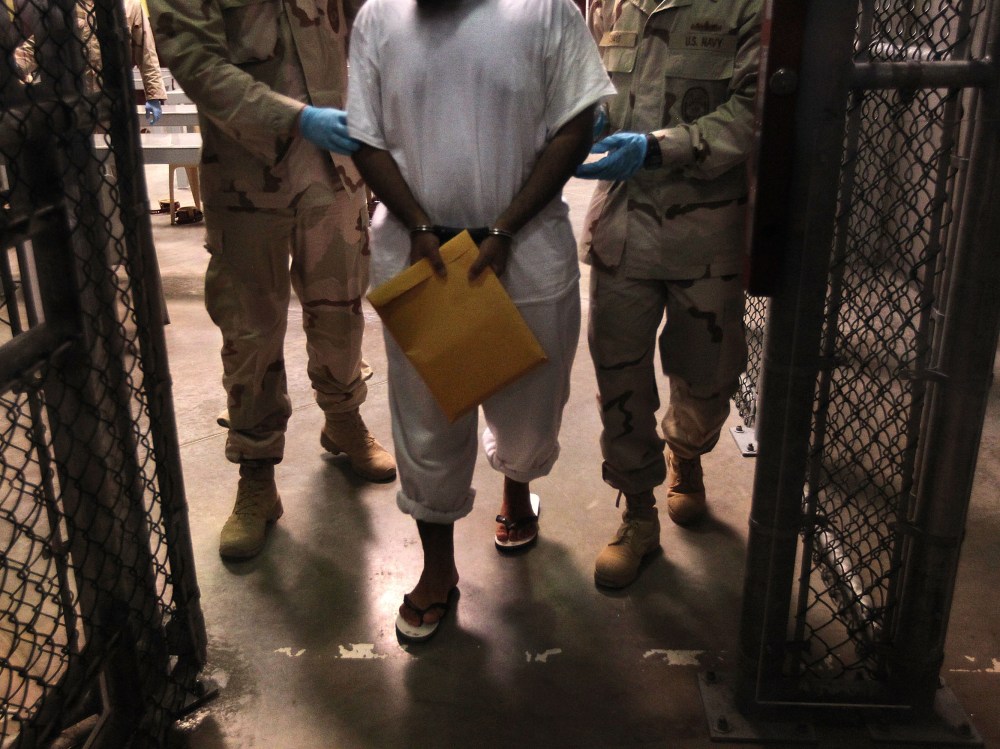
Pending an appeal, federal judges allowed groin searches to resume at Guantanamo Bay prison on Wednesday. The three-judge panel stayed the order U.S. District Judge Lamberth had issued July 11th demanding all Guantanamo guards halt the practice, saying the addition of the genital pat-down in prisoner searches “seems less like a valid choice on the part of the JDG commander and more like an attempt to deny counsel access through alternative means.”
In response to Judge Lamberth’s order, the Department of Justice filed an appeal Tuesday, stating that the U.S. District Court lacked the jurisdiction to rule on the issue of full-body frisks. The DOJ also contends that “the modified search procedure will endanger safety” because if prisoners know they will not be searched between their genitals and upper thigh, they will hide items in that area, and that Lamberth’s order does not allow for such searches even when a guard knows of or has reason to suspect hidden contraband.
The DOJ relies on the written statement of General John F. Kelly, who is responsible for JTF-GTMO operations. Kelly filed a 10-page declaration alongside the DOJ’s on Tuesday requesting an administrative stay. Kelly cites Guantanamo prisoner Adnan Latif’s November 2012 suicide as the motivating factor behind the new search policy. An investigation into the suicide of Latif found that he died by an overdose of Invega–a prescription drug used to treat schizophrenia. Kelly cites that report saying it:
“…found that Latif hoarded medications and ingested them shortly before he was found unresponsive. Several factors, to include the prohibition against searching a detainee’s groin area contributed to the ability of Latif to hoard the medications. The report found that the prohibition against searching a detainee’s groin area created “extraordinary opportunities for detainees to conceal contraband should they choose.”
The DOJ cites Kelly’s statement and the report on Latif’s suicide in its urging for the reinstatement of the search policy, saying it was “a possible contributing factor” to Latif’s death.
Attorney David Remes, who represented Latif and still counts 17 prisoners as clients, responded to Kelly’s assertion and the ruling in an email to msnbc: “The government says it needs to search all the detainees this way because it believes a single detainee–my late client Adnan Latif–may have smuggled medications in his underwear. He didn’t smuggle medications, and in any case the government’s reaction is way out of proportion.”
Kelly’s declaration also includes two photos of contraband items discovered in late June, which the DOJ references when it states the “detention facility is currently threatened by the presence of contraband weapons.” Nails, a wrench, and a pen are included in the confiscated objects. The DOJ’s appeal also states that “the current full-body frisk procedure is necessary and appropriate for moves outside a detainee’s camp of residence and for all contacts with non-JTF-GTMO personnel” since items like those discovered in late June can be found on the ground and picked up. Remes asked of the new policy, “Can it really be so vital that the military be allowed to grope the men without interruption?”
Katherine Guthrie Recommended


