








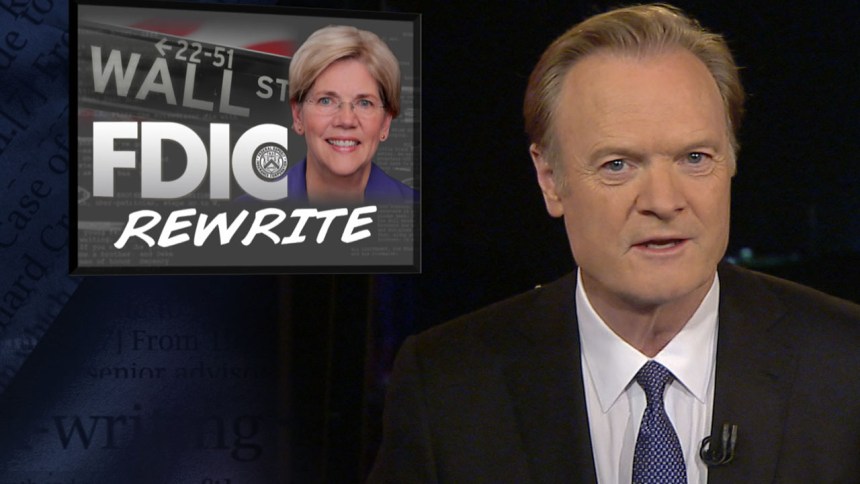
Sens. John McCain and Elizabeth Warren are fighting to bring back legislation introduced in the post-Depression 1930s, which separated commercial banks from investment banks and ensured that large investment firms couldn’t make risky bets with the deposits of average Americans.
The original legislation, called The Banking Act of 1933 but commonly referred to as Glass-Steagall, was partly repealed by 90 senators in 1999 and signed out of law by President Bill Clinton. Fourteen years later, McCain and Warren, along with Democrat Maria Cantwell and Independent Angus King, have introduced “The 21st Century Glass-Steagall Act.”
The new Glass-Steagall would reintroduce two repealed provisions from the original law. As Wonkblog helpfully explains, when people refer to Glass-Steagall they usually mean four particular sections in the The Banking Act of 1933: Sections, 16, 20, 21, and 32. Each of these regulations deals with the relationship between investment banks and commercial banks.
Section 16 says, basically, that commercial banks like Bank of America or Wells Fargo can’t deal directly in securities-trading. Section 21 says that investment firms can’t collect deposits. These provisions are still law today, and weren’t touched by the 1999 repeal.
What 1999’s Gramm-Leach-Bliley Act rolled back were the other two provisions–21 and 32–which forbid investment companies from being affiliated with commercial banks, and kept Fed member banks from sharing board members with investment companies.
“The classic example of the kind of deal this enabled was the merger of Citicorp, a commercial bank, with the Travelers Group, a financial conglomerate which owned the investment banks Smith Barney and Salomon Brothers,” writes Wonkblog’s Dylan Matthews. “Bank of America’s purchase of Merrill Lynch in 2008 also likely wouldn’t have been possible before Gramm-Leach-Bliley.”
There’s still a debate among economists about how much the Glass-Steagall repeal contributed to the 2008 financial crisis, if at all. Nobel prize-winning economist Joseph Stiglitz was among the first to cite a strong connection: “When repeal of Glass-Steagall brought investment and commercial banks together, the investment-bank culture came out on top,” he wrote in a January 2009 issue of Vanity Fair. “There was a demand for the kind of high returns that could be obtained only through high leverage and big risk-taking.” Others have called the connection minimal and maintain that Warren and McCain’s new version is little more than a band-aid to conceal larger issues. “Some cynics even suggest that the banks are surreptitiously encouraging Warren in her misguided adventure in order to keep her away from issues where she can actually endanger their business model,” writes Matthew C. Klein over at Bloomberg View. Whether the repeal of Glass-Steagall hurt the economy, or whether the new version could help it become simpler and more efficient, may be a moot point if Warren and Co. can’t get their legislation through Congress. The odds seem small, but Warren doesn’t appear to be intimidated by them. “Let me put it this way,” she told CNBC Tuesday, “If you don’t fight for it, the chances are zero.”
Evan Puschak Recommended


