








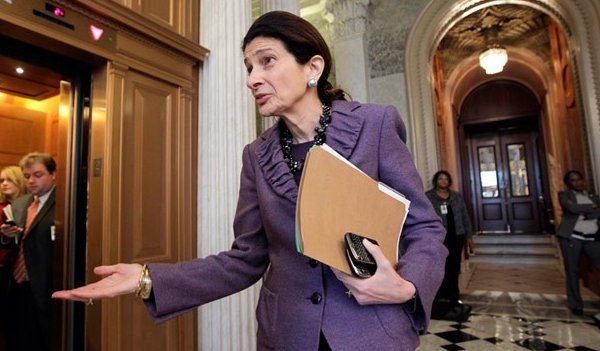
Sen. Olympia Snowe (R-Maine) stunned much of the political world this week when she announced her retirement, and spent a fair amount of time explaining her decision ever since. In a Washington Post op-ed today, the Republican moderate complains that the Senate has become deeply dysfunctional, with leaders no longer willing to compromise and find consensus.
I’m not unsympathetic to the message, but I’m less sure about the messenger.
Moderate senators willing to break with their party tend to be pretty powerful, especially in recent years, and few have had the kind of influence Snowe has enjoyed. But the Maine Republican, despite three terms in the chamber, struggled to use that influence constructively. Snowe would routinely stress the importance of “working together” to find “common ground,” but it was the transition from platitudes to policy that led to breakdowns — Snowe wanted her colleagues to work cooperatively, but consistently seemed reluctant to take the lead, despite her power.
Jamison Foser has written about this many times, summarizing Snowe’s vision in a five-word maxim: “Somebody (else) should do something!”
Jon Chait made the case today that Snowe has been “given the opportunity to wield” enormous power, but “has used it, on the whole, quite badly.”
When George W. Bush proposed a huge, regressive tax cut in 2001, Snowe, sitting at the heart of a decisive block of centrists, used her leverage to support the passage of a modestly smaller and less regressive version. When Barack Obama proposed a large fiscal stimulus in 2009, Snowe (citing fears of deficits that she had helped create) decided to shave a nice round $100 billion off his figure and call it a day. If a Gingrich administration proposed spending a trillion dollars to erect a 100 foot tall solid gold Winston Churchill statue on Mars, Snowe would no doubt decide, after careful deliberation, that the wise course was to trim the height down to 90 feet and perhaps use a cheaper bronze alloy in the base.
In our system of government, there is value in compromise. In any system, compromise for the sake of compromise is a mistake.
Fleshing out Chait’s point in more detail, Matt Yglesias delved deeper into the two most notable, and arguably most important, incidents of Snowe’s career. One is 2001 when the new President George W Bush wanted to implement large regressive debt-financed tax cuts. Snowe held a decisive position in the bargaining over this, and she chose to use her influence to secure instead the passage of a slightly smaller regressive debt-financed tax cut package. Then in 2009 when the new President Barack Obama wanted to implement large tax-and-spending side stimulus, Snowe again held a decisive position. She chose to use her influence to trim down the spending side of the package, with a particular focus on reducing federal financial assistance to state and local governments. Were these good ideas? It seems to me that they were not good ideas. That there was, in fact, no logic behind them. The policy logic behind the Obama stimulus clearly dictated a bigger rather than a smaller package of aid to state and local government, but if Snowe rejected the policy logic behind the Obama stimulus she could have simpy rejected the whole idea. Similarly, the policy logic behind the Bush tax cuts (“Reagan proved deficits don’t matter”) argued for the Bush proposal while the policy logic of rejecting debt-financed semi-permanent tax cuts argued for rejecting Bush’s whole approach. These were the key moments in recent American budget history. Polarization and partisanship aside she had plenty of power at these moments. She just failed to use the power to any meaningful effect. Absolutely nobody is walking around saying “the Bush tax cuts were great, but I’m sure glad they were slightly smaller than the president original proposed.” Either taking advantage of the low interest rate environment of the aughts to pass regressive tax cuts was a good idea or it wasn’t. Opinions on the American Recovery and Reinvestment Act are sharply divided, but approximately zero people believe the Snowe/Collins/Specter/Nelson compromise version of ARRA was the right thing to do. That’s not because of “polarization” it’s because their position didn’t make any sense on the merits and just reflected a mindless less is better than more mentality. The problem with Snowe’s approach to governance is not her moderation or willingness to work those of differing views. Rather, the concern is with Snowe’s reluctance to use her influence to work towards meaningful and worthwhile goals.
The place for in-depth analysis, commentary and informed perspectives. Recommended


