








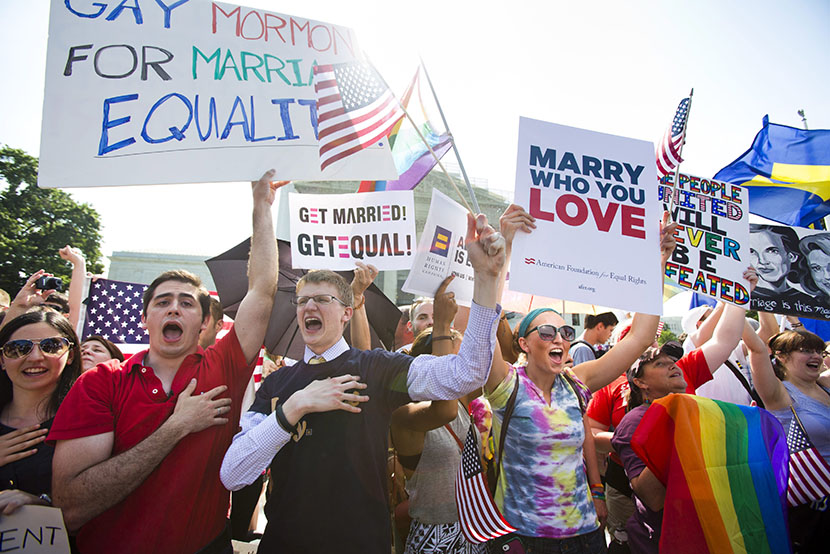
On June 26, Frances Herbert and her wife were camping on Cape Cod. Just after 10:00 a.m., their lives changed completely.
That was the morning the U.S. Supreme Court handed down its historic decision in United States v. Windsor, declaring a key provision of the federal Defense of Marriage Act unconstitutional. DOMA, which prohibited the federal government from recognizing married gay couples, had also prevented Frances from sponsoring her wife Takako Ueda, who is originally from Japan, for a green card. Last week, that legalized discrimination came to an end.
Like many of the more than 1,500 couples that my organization, Immigration Equality, heard from in the week following the ruling, Frances and Takako initially worried the news was too good to be true.
“We won?” Takako asked on the phone, making sure she hadn’t misheard over the spotty cell reception.
“And no one can take it away?” Frances wanted to know.
After we assured them the news was real, and that Takako’s green card would be arriving soon, the jubilation set in.
This Independence Day is especially meaningful for many families who, for the first time, are making long-term plans to live here in the United States.
In San Francisco, Anthony Makk expects that his green card will soon arrive. Anthony and his husband, Bradford Wells, have been together for more than two decades, building small businesses and a loving home. Because of DOMA, Anthony was faced an uncertain future, despite their marriage.
Everywhere I’ve gone over the past ten days–from the steps of the Supreme Court to New York’s especially jubilant Gay Pride march–couples have hugged me, cried with me and asked me if it was true. I am finally able to deliver the news I have waited years to say: “Yes, you can get a green card.”
In preparation for the Court’s ruling, Immigration Equality worked with the Obama administration to ensure every couple who has waited so long is treated equally under the law, and that green card applications are approved fairly and without delay.
That work is paying off. Two days following the decision in Windsor, a couple in Fort Lauderdale, Florida, learned their application had been approved. Homeland Security Secretary Janet Napolitano, whose agency oversees immigration, also assured couples that change would happen quickly. In a statement, Napolitano announced that, “effective immediately, I have directed U.S. Citizenship and Immigration Services to review immigration visa petitions filed on behalf of a same-sex spouse in the same manner as those filed on behalf of an opposite-sex spouse.” New petitions are now being filed, and the administration announced it has kept a list of denied applications, and will re-open those and process them with no further paperwork–or fees–required. On Monday, my organization filed an application on behalf of Edwin Blesch, a U.S. citizen, and his South African husband, Tim Smulian. They are anxiously awaiting good news. As I told the White House the afternoon following the ruling, “Other than Edie Windsor, no one has awaited this decision more anxiously than LGBT immigrant families.” For some couples, the Court’s decision seemed almost divinely timed. Immigration Equality clients Kelly Ryan and Lucy Truman were days away from leaving the country. Lucy, who is British, was looking up flights online and beginning to pack. Her visa was set to expire on June 30–just 5 days after the ruling. In Potomac, Maryland, Kelly Costello and her Peruvian wife, Fabiola Morales, had double the reasons to celebrate. Three days before the Court ruled, Kelly gave birth to twins. Thanks to the ruling, the threat of separation that hung over her family is gone, and they can begin planning their lives as a family of four Americans. Even with these moving stories, it is difficult to convey just how positively different this Independence Day feels to so many. The countless couples forced into exile abroad can now come home. Those who have been separated–in some cases, for a decade or more–can now be together. And for many Americans, this July 4th feels a bit more patriotic; and they feel a bit more equal. As Brandon Perlberg, a New Yorker forced abroad to be with his partner, told The Guardian, “While I have this feeling of being an exile, of being forced from my country, I have never had more vested in its future. I have never been more proud of calling myself an American.”
Rachel Tiven Recommended


